North Korean cult of personality in the context of "Mao Zedong's cult of personality"

Play Trivia Questions online!

or

Skip to study material about North Korean cult of personality in the context of "Mao Zedong's cult of personality"


⭐ Core Definition: North Korean cult of personality

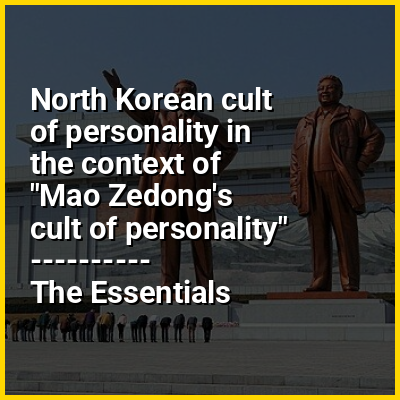
The cult of personality surrounding the Kim family has existed in North Korea for decades and can be found in many examples of North Korean culture. Although not acknowledged by the North Korean government, many defectors and Western visitors state there are often stiff penalties for those who criticize or do not show "proper" respect for the former leaders of the country, Kim Il Sung and Kim Jong Il, officially referred to as "eternal leaders of Korea". The personality cult began soon after Kim Il Sung took power in 1948, and was greatly expanded after his death in 1994.

While other countries have had cults of personality to various degrees, the pervasiveness and extreme nature of North Korea's personality cult surpasses that of both its original influences, Joseph Stalin and Mao Zedong. The cult is also marked by the intensity of the people's feelings for and devotion to their leaders, and the key role played by a Confucianized ideology of familism both in maintaining the cult and thereby in sustaining the regime itself. The North Korean cult of personality is a large part of Juche, the official ideology of the country.
↓ Menu

In this Dossier

North Korean cult of personality in the context of Censorship in North Korea

North Korea ranks among some of the most extreme censorship in the world, with the government able to take strict control over communications. North Korea sits at one of the lowest places of Reporters Without Borders' 2025 Press Freedom Index, ranking 179 out of the 180 countries investigated.

In North Korea, all media outlets are owned and controlled by the government, and all news content are produced and censored by the Korean Central News Agency. The media dedicate a large portion of their resources toward political propaganda and promoting the personality cult of the Kim family (Kim Il Sung, Kim Jong Il, and Kim Jong Un). The government of Kim Jong Un still has authority over and control of the press and information and has been repeatedly ranked one of the top 5 countries in the world with the least amount of media freedom.

↑ Return to Menu

North Korean cult of personality in the context of Workers' Party of Korea

The Workers' Party of Korea (WPK) is the sole ruling party of North Korea. Founded in 1949 from a merger between the Workers' Party of North Korea and the Workers' Party of South Korea, the WPK is the oldest active party in Korea. It also controls the Korean People's Army, North Korea's armed forces. The WPK is the largest party represented in the Supreme People's Assembly and coexists with two other legal parties that are completely subservient to the WPK and must accept the WPK's "leading role" as a condition of their existence. The WPK is banned in South Korea under the National Security Act and is sanctioned by the United Nations, the European Union, Australia, and the United States.

The North Korean Branch Bureau of the Communist Party of Korea (CPK) was founded in 1945. In 1946, it was briefly renamed to the Communist Party of North Korea, becoming independent of the CPK, and merged with the New People's Party of Korea in the same year to eventually form the Workers' Party of North Korea. In 1948, the WPNK founded North Korea. In 1949, WPNK merged with the Workers' Party of South Korea to form the Workers' Party of Korea. In 1950, WPK leader Kim Il Sung launched the Korean War, aiming to militarily unite Korea, but was deterred by American intervention. Kim Il Sung attempted to stay neutral during the Sino–Soviet split, while decreasing both Chinese and Soviet influence in the WPK. Kim Il Sung purged rival factions in the WPK in the 1950s and 1960s, while promoting his own cult of personality.

↑ Return to Menu

North Korean cult of personality in the context of North Korea–Russia relations

North Korea and Russia share close military and security relations. Both nations share interest in an geopolitical alignment in challenging the West. The two states share a border along the lower Tumen River, which is 17 kilometers (11 mi) long.

The Soviet Union occupied the northern part of the Korean Peninsula after the surrender of Japan in 1945. The Soviet Union was responsible for the creation of North Korea, and installed Kim Il Sung as the new nation's leader. After the proclamation of the Democratic People's Republic of Korea in 1948, the Soviet Union became the first country to recognize it as the sole legitimate authority in Korea. The Soviet Union supported North Korea during the Korean War. North Korea received major Soviet military and political support during the Cold War. The personality cult around North Korea's Kim family was heavily influenced by Stalinism. China and the Soviet Union competed for influence in North Korea after the Sino-Soviet split in the 1960s, leading North Korea to seek autonomy from both nations. In 1961, the North Korea and the Soviet Union signed a Treaty of Friendship, Cooperation and Mutual Assistance.

↑ Return to Menu

North Korean cult of personality in the context of Propaganda in North Korea

Propaganda is widely used and produced by the government of the Democratic People's Republic of Korea (North Korea). Most propaganda is based on the Juche ideology, veneration of the ruling Kim family, the promotion of the Workers' Party of Korea, and hostilities against both the Republic of Korea and the United States.

The first syllable of Juche, "ju", means the man; the second syllable, "che", means body of oneself. Article 3 of the Socialist Constitution proclaims, "The DPRK is guided in its activities by the Juche idea, a world outlook centered on people, a revolutionary ideology for achieving the independence of the masses of people."

↑ Return to Menu

North Korean cult of personality in the context of Kim family (North Korea)

The Kim family, officially the Mount Paektu Bloodline (Korean백두혈통), named for Paektu Mountain, in the ideological discourse of the Workers' Party of Korea (WPK), and often referred to as the Kim dynasty after the end of the Cold War, is the three-generation lineage of North Korean leadership, descending from the country's founder and first leader, Kim Il Sung. Kim Il Sung came to rule the north in 1948, after the end of Japanese rule split the region in 1945. Following his death in 1994, Kim Il Sung's role as supreme leader was passed to his son, Kim Jong Il, and then in 2011 to his grandson, Kim Jong Un. The three have each served as leaders of the Workers' Party of Korea (titled as Chairman from 1948 to 1966, General Secretary from 1966 to 2012, First Secretary from 2012 to 2016, Chairman again from 2016 to 2021, and General Secretary again since 2021) and as North Korea's supreme leaders since the state's establishment in 1948.

The North Korean government denies that there is a personality cult surrounding the Kim family, describing the people's devotion to the family as a personal manifestation of support for their nation's leadership. The Kim family has been described as a de facto absolute monarchy or hereditary dictatorship.

↑ Return to Menu

North Korean cult of personality in the context of Mansu Hill Grand Monument

The Mansu Hill Grand Monument (Korean만수대대기념비) is a complex of monuments in Pyongyang, North Korea. There are 229 figures in all, commemorating the history of the revolutionary struggle of the Korean people, and especially their leaders. The central part of the monument consists of two 22-meter-tall (72 ft) bronze statues of Kim Il Sung and Kim Jong Il.

↑ Return to Menu