North-Eastern State in the context of "Taraba State"

Play Trivia Questions online!

or

Skip to study material about North-Eastern State in the context of "Taraba State"

Ad spacer

⭐ Core Definition: North-Eastern State

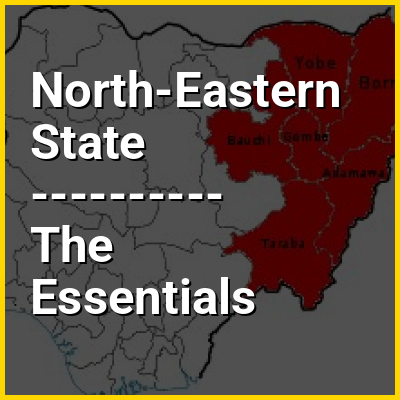
North-Eastern State is a former administrative division of Nigeria. It was created on 27 May 1967 from parts of the Northern Region. Its capital was the city of Maiduguri.

On 3 February 1976, two states were carved out of North-Eastern state, namely Bauchi state and Gongola state, and the remaining portion of the North-Eastern state was renamed to Borno state. The North-Eastern state was divided into Bauchi, Borno and Gongola states. Gombe State was later split out of Bauchi, Yobe State from Borno and Gongola was split into Taraba State and Adamawa State.

↓ Menu

>>>PUT SHARE BUTTONS HERE<<<
In this Dossier

North-Eastern State in the context of Northern Nigeria

Northern Nigeria (or Arewancin Nijeriya) was an autonomous division within Nigeria, distinctly different from the southern part of the country, with independent customs, foreign relations and security structures. In 1962, it acquired the territory of the British Northern Cameroons, which voted to become a province within Northern Nigeria.

In 1967, Northern Nigeria was divided into the North-Eastern State, North-Western State, Kano State, Kaduna State, Kwara State, and the Benue-Plateau State, each with its own Governor.

↑ Return to Menu

North-Eastern State in the context of Bauchi State

Bauchi (Hausa: Jihar Bauchi /Fula: Leydi Bauchi 𞤤𞤫𞤴𞤣𞤭 𞤦𞤢𞤵𞤷𞥅𞤭) is a state in the North-East geopolitical zone of Nigeria, It is bordered by Jigawa to the north, Yobe to the north-east, Gombe to the east, Taraba and Plateau to the south, Kaduna to the west and Kano to the northwest respectfully. It takes its name from the historic city of Bauchi, which also serves as its capital. The state was formed in the year 1976, when the former North-Eastern State was broken up. It originally included the area that is now Gombe State, which became a distinct state in 1996.

Of the 36 states, Bauchi is the fifth largest in area and also the fifth most populous, with an estimated population of over 8,308,800 as of 2022. Geographically, the state is divided between the West Sudanian savanna in the south and the drier, semi-desert Sahelian savanna in the north with a small part of the montane Jos Plateau in the southwest. A key defining characteristic of the state’s landscape is Yankari National Park, a large wildlife park in southern Bauchi State that contains large populations of waterbuck, African buffalo, patas monkey, hippopotamus, roan antelope, and western hartebeest along with some of Nigeria's last remaining West African lion, African leopard and African bush elephant populations.
↑ Return to Menu

North-Eastern State in the context of Governor of Kano State

This is a list of administrators and governors of Kano State.Kano State was formed on 27 May 1967 when the Northern region was split into Benue-Plateau, Kano, Kwara, North-Central, North-Eastern and North-Western states.

↑ Return to Menu

North-Eastern State in the context of Borno State

BornoListen is a state in the North-East geopolitical zone of Nigeria. It is bordered by Yobe to the west, Gombe to the southwest, and Adamawa to the south while its eastern border forms part of the national border with Cameroon. Its northern border forms part of the national border with Niger and its northeastern border forms all of the national border with Chad. It is the only Nigerian state to border up to three countries. It takes its name from the historic emirate of Borno, with the emirate's old capital of Maiduguri serving as the capital city of Borno State. The state was formed in 1976 when the former North-Eastern State was broken up. It originally included the area that is now Yobe State, which became a distinct state in 1991.

Borno is the second largest in area of the 36 states, only behind Niger State. Despite its size, the state is the eleventh most populous with an estimated population of about 5.86 million as of 2016. Geographically, the state is divided between the semi-desert Sahelian savanna in the north and the West Sudanian savanna in the centre and south with a part of the montane Mandara Plateau in the southeast. In the far northeast of the state is the Nigerian portion of Lake Chad and the Lake Chad flooded savanna ecoregion; the lake is fed by the Yobe River which forms the state's border with Niger until it reaches the lakebed. In the centre of the state is part of the Chad Basin National Park, a large national park that contains populations of black crowned crane, spotted hyena, patas monkey, and roan antelope along with transient herds of some of Nigeria's last remaining African bush elephants. However, a section of the park, the Sambisa Forest, was taken over during the Boko Haram insurgency in the early 2010s forcing many fauna to flee; large animals were not seen until 2019 and 2020 when a massive herd of migratory elephants returned to Borno.

↑ Return to Menu