Norse–Gaels in the context of King of Man and the Isles


Norse–Gaels in the context of King of Man and the Isles

⭐ Core Definition: Norse–Gaels

The Norse–Gaels (Old Irish: Gall-Goídil; Irish: Gall-Ghaeil; Scottish Gaelic: Gall-Gàidheal; Manx: Goal-Gael, 'foreigner-Gaels') were a people of mixed Gaelic and Norse ancestry and culture. They emerged in the Viking Age, when Vikings who settled in Ireland and in Scotland became Gaelicised and intermarried with Gaels. The Norse–Gaels dominated much of the Irish Sea and Scottish Sea regions from the 9th to 12th centuries. They founded the Kingdom of the Isles (which included the Hebrides and the Isle of Man), the Kingdom of Dublin, the Lordship of Galloway (which is named after them), and briefly ruled the Kingdom of York (939–944 AD). The most powerful Norse–Gaelic dynasty were the Uí Ímair or Ivar dynasty.

Over time, the Norse–Gaels became ever more Gaelicised and disappeared as a distinct group. However, they left a lasting influence, especially in the Isle of Man and Outer Hebrides, where most placenames are of Norse–Gaelic origin. Several Scottish clans have Norse–Gaelic roots, such as Clan MacDonald, Clan MacDougall and Clan MacLeod. The elite mercenary warriors known as the gallowglass (gallóglaigh) emerged from these Norse–Gaelic clans and became an important part of Irish warfare. The Viking longship also influenced the Gaelic birlinn and longa fada, which were used extensively until the 17th century. Norse–Gaelic surnames survive today and include MacIvor, MacAskill, and [Mac]Cotter.
↓ Menu
HINT:

In this Dossier

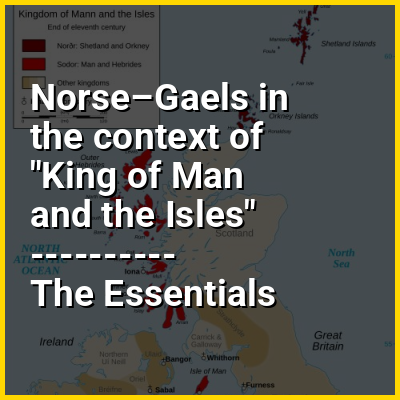
Norse–Gaels in the context of Kingdom of Mann and the Isles

The Kingdom of the Isles, also known as Sodor, was a Norse–Gaelic kingdom comprising the Isle of Man, the Hebrides and the islands of the Clyde from the 9th to the 13th centuries. The islands were known in Old Norse as the Suðreyjar, or "Southern Isles" as distinct from the Norðreyjar or Northern Isles of Orkney and Shetland. In Scottish Gaelic, the kingdom is known as Rìoghachd nan Eilean. The territory is sometimes called the Kingdom of Mann and the Isles, although only some of the later rulers claimed that title. The historical record is incomplete, and the kingdom was not a continuous entity throughout the entire period. At times the rulers were independent of external control, although for much of the period they had overlords in Norway, Ireland, England, Scotland or Orkney. At times there also appear to have been competing claims for all or parts of the territory. The islands have a total land area of over 8,300 square kilometres (3,205 sq mi) and extend for more than 500 kilometres (310 mi) from north to south.

Viking influence in the area began in the late 8th century, and whilst there is no doubt that the Uí Ímair dynasty played a prominent role in this early period, the records for the dates and details of the rulers are speculative until the mid-10th century. Hostility between the Kings of the Isles and the rulers of Ireland, and intervention by the crown of Norway (either directly or through their vassal the Earl of Orkney) were recurring themes.

View the full Wikipedia page for Kingdom of Mann and the Isles
↑ Return to Menu

Norse–Gaels in the context of North Germanic peoples

North Germanic peoples, Nordic peoples and in a medieval context Norsemen, were a Germanic linguistic group originating from the Scandinavian Peninsula. They are identified by their cultural similarities, common ancestry and common use of the Proto-Norse language from around 200 AD, a language that around 800 AD became the Old Norse language, which in turn later became the North Germanic languages of today.

The North Germanic peoples are thought to have emerged as a distinct people in what is now southern Sweden in the early centuries AD. Several North Germanic tribes are mentioned by classical writers in antiquity, in particular the Swedes, Danes, Geats, Gutes and Rugii. During the subsequent Viking Age, seafaring North Germanic adventurers, commonly referred to as Vikings, raided and settled territories throughout Europe and beyond, founding several important political entities and exploring the North Atlantic as far as North America. Groups that arose from this expansion include the Normans, the Norse–Gaels and the Rus' people. The North Germanic peoples of the Viking Age went by various names among the cultures they encountered, but are generally referred to as Norsemen.

View the full Wikipedia page for North Germanic peoples
↑ Return to Menu

Norse–Gaels in the context of Somerled

Somerled (died 1164), known in Middle Irish as Somairle, Somhairle, and Somhairlidh, and in Old Norse as Sumarliði [ˈsumɑrˌliðe], was a mid-12th-century Norse-Gaelic lord who, through marital alliance and military conquest, rose in prominence to create the Kingdom of Argyll and the Isles. Little is certain of Somerled's origins, although he may have been born in the north of Ireland and appears to have belonged to a Norse–Gaelic family of some prominence. His father, GilleBride, of royal Irish ancestry, appears to have conducted a marriage alliance with Máel Coluim mac Alaxandair, son of Alexander I of Scotland, and claimant to the Scottish throne. During a period of alliance with David I of Scotland, Somerled married Ragnhild, daughter of Óláfr Guðrøðarson, King of Man and the Isles in 1140. In 1153, Olaf of Man died and was succeeded by his son, Godred. But Godred Olafsson was a very unpopular ruler. Somerled was asked by Thorfinn Ottarson, a Manx chief, to allow Somerled's son, Dugall, to be appointed king of Man and the Isles. Somerled agreed and with 80 ships confronted Godred off the coast of Islay on January 5–6, 1156. After the sea battle, Somerled and Godred divided the Kingdom of Man and the Isles between them but Godred did not accept Dugall as King of Man. Accordingly, two years later, Somerled defeated and drove Godred from power. Dugall continued as King of Man and Somerled thus ruled the entire kingdom of Argyll, Man and the Isles until his death.

Somerled was slain in 1164 at the Battle of Renfrew, amidst an invasion of mainland Scotland, commanding forces drawn from all over his kingdom. The reasons for his attack are unknown. He may have wished to nullify Scottish encroachment, but the scale of his venture suggests that he nursed greater ambitions. On his death, Somerled's vast kingdom disintegrated, although his sons retained much of the southern Hebridean portion. Compared to his immediate descendants, who associated themselves with reformed religious orders, Somerled may have been something of a religious traditionalist. In the last year of his life, he attempted to persuade the head of the Columban monastic community, Flaithbertach Ua Brolcháin, Abbot of Derry, to relocate from Ireland to Iona, a sacred island within Somerled's sphere of influence. Unfortunately for Somerled, his demise denied him the ecclesiastical reunification he sought, and decades later his descendants oversaw the obliteration of the island's Columban monastery. Iona's oldest surviving building, St Oran's Chapel, dates to the mid-12th century, and may have been built by Somerled or his family.

View the full Wikipedia page for Somerled
↑ Return to Menu