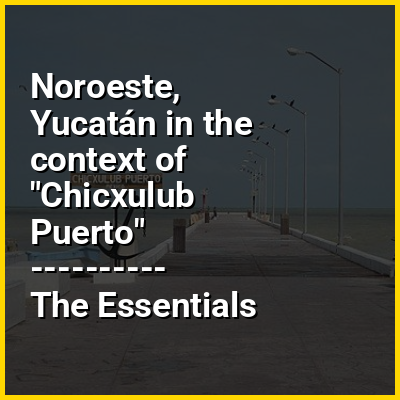
Noroeste, Yucatán in the context of Chicxulub Puerto


Noroeste, Yucatán in the context of Chicxulub Puerto
HINT:

👉 Noroeste, Yucatán in the context of Chicxulub Puerto

Chicxulub Puerto (Spanish: [tʃikʃuˈlub ˈpweɾto] ) is a small coastal town in Progreso Municipality in the Mexican state of Yucatán. It is located on the Gulf of Mexico, in the northwestern region of the state about 8 km (5 mi) east of the city port of Progreso, the municipality seat, and 42 km (26 mi) north of the city of Mérida, the state capital. According to the INEGI census conducted in 2020, the port town had a population of 7,591 inhabitants.

Chicxulub Puerto is most famous for being near the geographic center of the Chicxulub crater, an impact crater discovered by geologists on the Yucatán Peninsula and extending into the ocean. It was created by the impact some 66 million years ago of the Chicxulub impactor, an asteroid or comet which caused the Cretaceous–Paleogene extinction event, which led to the extinction of all non-avian dinosaurs. Chicxulub Puerto lies almost exactly on the geographic center of the crater, and has used its notoriety for tourism, having opened tourist attractions such as a museum dedicated to the meteor impact.

↓ Explore More Topics
In this Dossier

Noroeste, Yucatán in the context of Kanasín

Kanasín (In the Yucatec Maya language: “tense or strongly tightened”) is a city in the Mexican state of Yucatán and the municipal seat of the municipality of the same name. It is located in the northwestern region of the state, forming part of the Mérida metropolitan area. According to the 2020 census carried out by the National Institute of Statistics and Geography (INEGI), it had a population of 139,753, making it the second largest Yucatecan city after Mérida, the 8th most populous in southeastern Mexico and the 101st most populous in the country.

In pre-Columbian times, the space that the city currently occupies was located in the ancient Mayan chiefdom of Chakan. Kanasín was established around the mid-16th century under the encomienda tributary system following the Spanish conquest of Yucatán. The name of the city derives precisely from a Mayan language term used to name a plant with reddish flowers that grows in the area. In 2007, it officially received city status. At the end of 2021, it hosted the First Ibero-American Meeting of Poetry. Today, it is a significant development pole as an industrial corridor for the state, together with the nearby city of Umán, which is also a suburb of Mérida.

View the full Wikipedia page for Kanasín
↑ Return to Menu