Newton's second law of motion in the context of "Impulse (physics)"

Play Trivia Questions online!

or

Skip to study material about Newton's second law of motion in the context of "Impulse (physics)"


👉 Newton's second law of motion in the context of Impulse (physics)

In classical mechanics, impulse (symbolized by J or Imp) is the change in momentum of an object. If the initial momentum of an object is p1, and a subsequent momentum is p2, the object has received an impulse J:
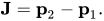
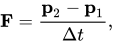
Momentum is a vector quantity, so impulse is also a vector quantity:Newton's second law of motion states that the rate of change of momentum of an object is equal to the resultant force F acting on the object:so the impulse J delivered by a steady force F acting for time Δt is:

↓ Explore More Topics
In this Dossier

Newton's second law of motion in the context of Pressure-gradient force

In fluid mechanics, the pressure-gradient force is the force that results when there is a difference in pressure across a surface. In general, a pressure is a force per unit area across a surface. A difference in pressure across a surface then implies a difference in force, which can result in an acceleration according to Newton's second law of motion, if there is no additional force to balance it. The resulting force is always directed from the region of higher-pressure to the region of lower-pressure. When a fluid is in an equilibrium state (i.e. there are no net forces, and no acceleration), the system is referred to as being in hydrostatic equilibrium. In the case of atmospheres, the pressure-gradient force is balanced by the gravitational force, maintaining hydrostatic equilibrium. In Earth's atmosphere, for example, air pressure decreases at altitudes above Earth's surface, thus providing a pressure-gradient force which counteracts the force of gravity on the atmosphere.

↑ Return to Menu