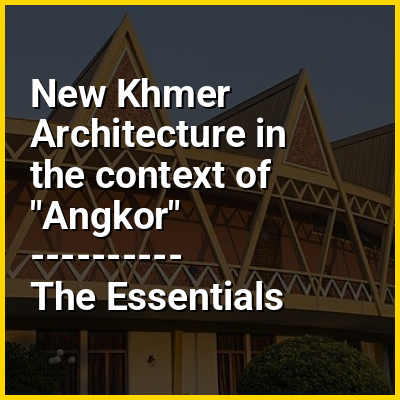
New Khmer Architecture in the context of "Angkor"

Play Trivia Questions online!

or

Skip to study material about New Khmer Architecture in the context of "Angkor"


⭐ Core Definition: New Khmer Architecture

New Khmer Architecture (Khmer: ស្ថាបត្យកម្មខ្មែរថ្មី) was an architectural movement in Cambodia during the 1950s and 1960s. The style blended elements of the Modern movement with two distinctly Cambodian traditions: the great Khmer tradition of Angkor and the vernacular architecture tradition of domestic buildings. The term was coined by authors Helen Grant Ross and Darryl Leon Collins.

The Kingdom of Cambodia gained independence from France in 1953. Winning the elections in 1955, Prince Norodom Sihanouk founded the Sangkum Reastr Niyum, a political experiment in economic development that specifically developed this art and architectural style. It reached its apotheosis in the 1960s and ended abruptly in 1970 with the overthrow of Norodom Sihanouk by General Lon Nol.
↓ Menu

In this Dossier

New Khmer Architecture in the context of Phnom Penh

Phnom Penh is the capital and most populous city of Cambodia. It has been the national capital since 1865 and has grown to become the nation's primate city and its political, economic, industrial, and cultural centre. The city's name derives from Wat Phnom, a Buddhist temple, and Lady Penh, the city's founder. It sits at the confluence of the Tonlé Sap and Mekong rivers, and is the start of the Bassac River. It is also the seat of Cambodia's monarchy, based at the Royal Palace.

Founded in 1372, Phnom Penh succeeded Angkor Thom as the national capital in 1434 following the fall of Angkor, and remained so until 1497. It regained its capital status during the French colonial era. It underwent a period of investment and modernization during Cambodia's independence period, earning the nickname the "Pearl of Asia" for its colonial French, New Khmer and Art Deco architecture. The city's population swelled in the 1960s and 1970s as refugees fled from civil war and American bombing during the Vietnam War. Phnom Penh's entire population was forcibly evacuated in 1975 by the Khmer Rouge, and faced persecution, forced labour and genocide. Phnom Penh remained largely uninhabited during the Democratic Kampuchea era until Vietnam-backed forces took the city in 1979. The city was reconstructed and infrastructure improved in the modern era with the support of international investment and aid. By 2019, it was home to more than 2 million people, approximately 14% of the Cambodian population.

↑ Return to Menu