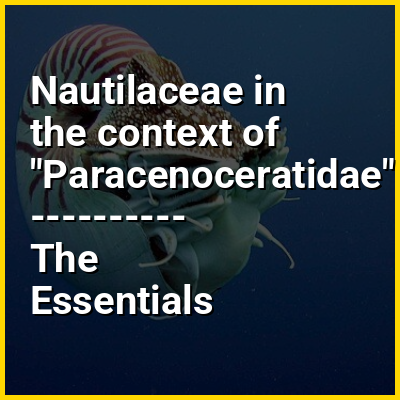
The Nautilaceae form one of five superfamilies that make up the Nautilida according to Bernard Kummel (1964), and the only one that survived past the Triassic. The Nautilaceae comprise six families: Nautilidae, Paracenoceratidae, Pseudonautilidae, Cymatoceratidae, Hercoglossidae, and Aturiidae. Shimanskiy (1957) separated the Paracenoceratidae and Pseudonautilidae from his near equivalent Nautilina and added them to the Lyroceratina, expanding the equivalent Clydonautiloidea and bringing it into the Jurassic. The Nautilaceae are represented by Nautilus and Allonautilus genera of the Nautilidae, the only extant family in this group.
Species in the Nautilaceae are generally smooth and involute with straight to strongly sinuous sutures and a small siphuncle. Some groups have sinuous plications or ribs.