Narmer Palette in the context of "Fourth millennium BC"

Play Trivia Questions online!

or

Skip to study material about Narmer Palette in the context of "Fourth millennium BC"

Ad spacer

⭐ Core Definition: Narmer Palette

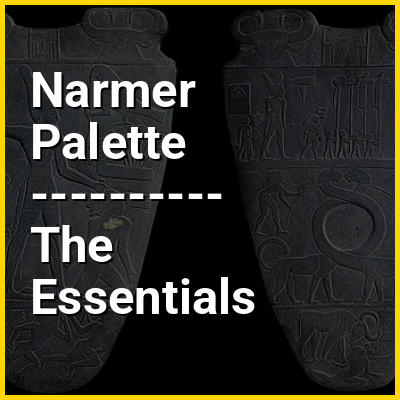
The Narmer Palette, also known as the Great Hierakonpolis Palette or the Palette of Narmer, is a significant Egyptian archaeological find, dating from about the 31st century BC, belonging, at least nominally, to the category of cosmetic palettes. It contains some of the earliest hieroglyphic inscriptions ever found. The tablet is thought by some to depict the unification of Upper and Lower Egypt under the king Narmer. Along with the Scorpion Macehead and the Narmer Maceheads, also found together in the main deposit at Nekhen, the Narmer Palette provides one of the earliest known depictions of an Egyptian king. On one side, the king is depicted with the bulbed White Crown of Upper (southern) Egypt, and the other side depicts the king wearing the level Red Crown of Lower (northern) Egypt, which also makes it the earliest known example of a king wearing both types of headdress. The Palette shows many of the classic conventions of Ancient Egyptian art, which must already have been formalized by the time of the Palette's creation. Egyptologists Bob Brier and A. Hoyt Hobbs have referred to the Narmer Palette as "The oldest Egyptian historical record".

The Palette, which has survived five millennia in almost perfect condition, was discovered by British archeologists James Quibell and Frederick W. Green, in what they called the Main Deposit in the Temple of Horus at Nekhen, during the dig season of 1897–98. Also found at this dig were the Narmer Macehead and the Scorpion Macehead. The exact place and circumstances of these finds were not recorded very clearly by Quibell and Green. In fact, Green's report placed the Palette in a different layer one or two metres (yards) away from the deposit, which is considered to be more accurate on the basis of the original excavation notes. It has been suggested that these objects were royal donations made to the temple. Nekhen, or Hierakonpolis, was one of four power centers in Upper Egypt that preceded the consolidation of Upper Egypt at the end of the Naqada III period. Hierakonpolis's religious importance continued long after its political role had declined. Palettes were typically used for grinding cosmetics, but this palette is too large and heavy (and elaborate) to have been created for personal use and was probably a ritual or votive object, specifically made for donation to, or use in, a temple. One theory is that it was used to grind cosmetics to adorn the statues of the deities.
↓ Menu

>>>PUT SHARE BUTTONS HERE<<<
In this Dossier

Narmer Palette in the context of 4th millennium BCE

The 4th millennium BC spanned the years 4000 BC to 3001 BC. Some of the major changes in human culture during this time included the beginning of the Bronze Age and the invention of writing, which played a major role in starting recorded history.

The city states of Sumer and the (Predynastic) Kingdom of Egypt were established and grew to prominence. Agriculture spread widely across Eurasia.

↑ Return to Menu

Narmer Palette in the context of Warka Vase

The Warka Vase or Uruk vase is a slim carved alabaster vessel found in a temple complex in the ruins of the ancient city of Uruk, located in the modern Al Muthanna Governorate, in southern Iraq. Like the Uruk Trough, Mask of Warka, and the Narmer Palette from Egypt, it is one of the earliest surviving works of narrative relief sculpture, found, no in situ, in a layer dated to c. 3100–2900 BC. Simple relief sculpture is also known from much earlier periods, from the site of Göbekli Tepe, dating to circa 9000 BC.

The bottom register displays naturalistic components of life, including water and plants, such as date palm, barley, and wheat. On the upper portion of the lowest register, alternating rams and ewes march in a single file. The middle register conveys naked men carrying baskets of foodstuffs symbolizing offerings. Lastly, the top register depicts the goddess a female deity accepting a votive offer. A female deity stands at the front portion of the gate surrounded by her richly filled shrine and storehouse (identifiable by two reed door poles with dangling banners). This scene may illustrate a reproduction of the ritual marriage between the goddess and her consort that ensures Uruk's continued vitality.

↑ Return to Menu

Narmer Palette in the context of State-building

State-building as a specific term in social sciences and humanities, refers to political and historical processes of creation, institutional consolidation, stabilization and sustainable development of states, from the earliest emergence of statehood up to the modern times. Within historical and political sciences, there are several theoretical approaches to complex questions related to the role of various contributing factors (geopolitical, economic, social, cultural, ethnic, religious, internal, external) in state-building processes.

Since the end of the 20th century, state-building has developed into becoming an integral part and even a specific approach to peacebuilding by the international community. Observers across the political and academic spectra have come to see the state-building approach as the preferred strategy to peacebuilding in a number of high-profile conflicts, including the Israeli–Palestinian conflict, and war-related conflicts in Bosnia and Herzegovina, Iraq, and Afghanistan.

↑ Return to Menu

Narmer Palette in the context of Register (art)

In art and archaeology, sculpture and painting, a register is a horizontal level in a work that consists of several levels arranged one above the other, especially where the levels are clearly separated by lines. Modern comic books typically use similar conventions. It is thus comparable to a row, or a line in modern texts. In the study of ancient writing, such as cuneiform and Egyptian hieroglyphs, "register" may be used of vertical compartments like columns containing writing that are arranged side by side and separated by lines, especially in cylinder seals, which often mix text and images. Normally, when dealing with images it only refers to row compartments stacked vertically.

The use of registers is common in Ancient Egyptian art, from the Narmer Palette onwards, and in medieval art in large frescos and illuminated manuscripts. Narrative art, especially covering the lives of sacred figures, is often presented as a sequence of small scenes arranged in registers.

↑ Return to Menu