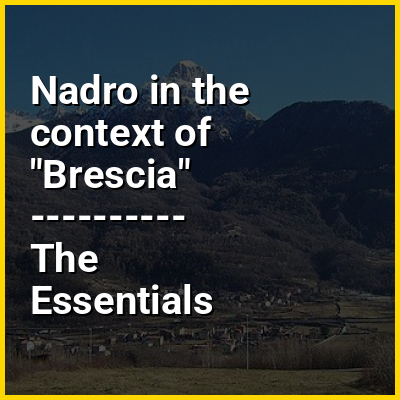
Nadro (Nàder in camunian dialect) is an Italian hamlet (frazione) of the comune of Ceto (BS), Lombardy. It has 655 inhabitants.
It lies 75 km from Brescia, along the strada Statale 42 del Tonale e della Mendola and is situated in Val Camonica.

Nadro (Nàder in camunian dialect) is an Italian hamlet (frazione) of the comune of Ceto (BS), Lombardy. It has 655 inhabitants.
It lies 75 km from Brescia, along the strada Statale 42 del Tonale e della Mendola and is situated in Val Camonica.
The rock drawings in Valcamonica (Camonica Valley) are located in the Province of Brescia, Italy, and constitute the largest collections of prehistoric petroglyphs in the world. The collection was recognized by UNESCO in 1979 and was Italy's first recognized World Heritage Site. UNESCO has formally recognized more than 140,000 figures and symbols, but new discoveries have increased the number of catalogued incisions to between 200,000 and 300,000. The petroglyphs are spread on all surfaces of the valley, but concentrated in the areas of Darfo Boario Terme, Capo di Ponte, Nadro, Cimbergo and Paspardo.
The Camunian rose (Italian: rosa camuna; Lombard: roeusa camuna/rösa camüna) is the name given to a particular symbol represented among the rock carvings of Camonica Valley (Brescia, Italy). It consists of a meandering closed line that winds around nine cup marks. It can be symmetrical, asymmetrical or form a swastika.
Val Camonica or Valcamonica (Eastern Lombard: Al Camònega), also Valle Camonica and anglicized as Camonica Valley, is one of the largest valleys of the central Alps, in eastern Lombardy, Italy. It extends about 90 kilometres (56 mi) from the Tonale Pass to Corna Trentapassi, in the commune of Pisogne near Lake Iseo. It has an area of about 1,335 km (515 sq mi) and 118,323 inhabitants. The River Oglio runs through it, rising at Ponte di Legno and flowing into Lake Iseo between Pisogne and Costa Volpino.
Almost all of the valley is included in the administrative territory of the province of Brescia, except for Lovere, Rogno, Costa Volpino and the Val di Scalve, which belong to the province of Bergamo. Since 1979, the rock drawings along the valley have been a UNESCO World Heritage Site, while the entire valley became a UNESCO World Biosphere Reserve in 2018.