Mygdonia in the context of "Therma"

Play Trivia Questions online!

or

Skip to study material about Mygdonia in the context of "Therma"


⭐ Core Definition: Mygdonia

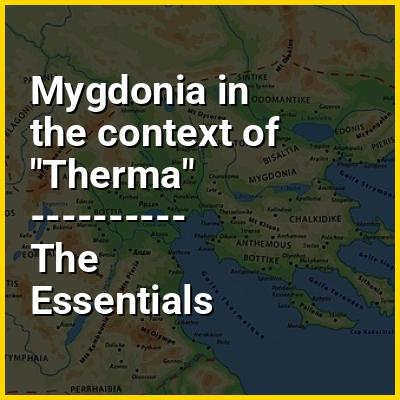
Mygdonia (/mɪɡˈdniə/; Greek: Μυγδονία, romanizedMygdonia) was an ancient territory, part of ancient Thrace, later conquered by Macedon, which comprised the plains around Therma (Thessalonica) together with the valleys of Klisali and Besikia, including the area of the Axios river mouth and extending as far east as Lake Bolbe. To the north it was joined by Crestonia. The Echeidorus, which flowed into the Thermaic Gulf near the marshes of the Axios, had its sources in Crestonia. The pass of Aulon or Arethusa was probably the boundary of Mygdonia towards Bisaltia. The maritime part of Mygdonia formed a district called Amphaxitis, a distinction which first occurs in Polybius, who divides all the great plain at the head of the Thermaic gulf into Amphaxitis and Bottiaea, and which is found three centuries later in Ptolemy. The latter introduces Amphaxitis twice under the subdivisions of Macedonia (in one instance placing the mouths of the Echidorus and Axios in Amphaxitis, and mentioning Thessalonica as the only town in the district, which agrees with Polybius and with Strabo). In another place Ptolemy includes Stageira and Arethusa in Amphaxitis, which, if correct, would indicate that a portion of Amphaxitis, very distant from the Axios, was separated from the remainder by a part of Mygdonia; but since this is improbable, the word is perhaps an error of the text.

↓ Menu

In this Dossier

Mygdonia in the context of Bryges

Bryges or Briges (Greek: Βρύγοι or Βρίγες) is the historical name given to a people of the ancient Balkans. They are generally considered to have been related to the Phrygians, who during classical antiquity lived in western Anatolia. Both names, Bryges and Phryges, are assumed to be variants of the same root. Based on archaeological evidence, some scholars such as Nicholas Hammond and Eugene N. Borza argue that the Bryges/Phrygians were members of the Lusatian culture that migrated into the southern Balkans during the Late Bronze Age.

↑ Return to Menu

Mygdonia in the context of Amphaxitis

Amphaxitis (Ancient Greek: Ἀμφαξῖτις) refers to the western maritime part of the Mygdonia district of ancient Macedonia, on Axius river.

↑ Return to Menu

Mygdonia in the context of Periphetes

Periphetes (/ˌpɛrɪˈftz/; Ancient Greek: Περιφήτης) is the name of several characters from Greek mythology.

  • Periphetes, an Arcadian king as the son of Nyctimus, son of King Lycaon. He was the father of Parthaon, ancestor of Psophis, one of the possible eponyms for the city of Psophis.
  • Periphetes, also known as Corynetes (Κορυνήτης) meaning Club-Bearer from the club (κορύνη) which he carried, was a son of Hephaestus and Anticleia or of Poseidon. Periphetes was lame (possibly in his feet, πόδας) like his father and used a bronze club as a crutch. He roamed the road from Athens to Troezen where he robbed travelers and killed them with his club. Theseus encountered and killed him near Epidauros (See Plutarch, Life of Theseus, et al.).
  • Periphetes, son of Copreus; he was killed during the Trojan War by Hector.
  • Periphetes, king of Mygdonia. He fought with Sithon for the hand of the latter's daughter Pallene and was killed.
  • Periphetes, a Trojan who was killed by Teucer.
↑ Return to Menu