Mycenae in the context of "Cyclopes"

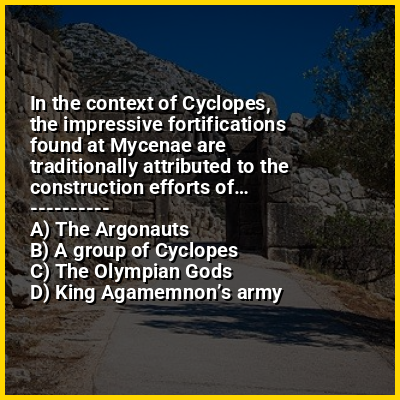
⭐ In the context of Cyclopes, the impressive fortifications found at Mycenae are traditionally attributed to the construction efforts of…

Ad spacer

⭐ Core Definition: Mycenae

Mycenae (/mˈsn/ my-SEE-nee; Ancient Greek: Μυκῆναι or Μυκήνη, Mykē̂nai or Mykḗnē) is an archaeological site near Mykines in Argolis, north-eastern Peloponnese, Greece. It is located about 120 kilometres (75 miles) south-west of Athens; 11 kilometres (7 miles) north of Argos; and 48 kilometres (30 miles) south of Corinth. The site is 19 kilometres (12 miles) inland from the Saronic Gulf and built upon a hill rising 274 metres (899 feet) above sea level.

In the second millennium BC, Mycenae was one of the major centres of Greek civilization—a military stronghold which dominated much of southern Greece, Crete, the Cyclades and parts of southwest Anatolia. The period of Greek history from about 1600 BC to about 1100 BC is called Mycenaean in reference to Mycenae. At its peak in 1350 BC, the citadel and lower town had a population of 30,000 and an area of 32 hectares (79 acres).
↓ Menu

>>>PUT SHARE BUTTONS HERE<<<
In this Dossier

Mycenae in the context of Mycenaean Greece

Mycenaean Greece (or the Mycenaean civilization) was the last phase of the Bronze Age in ancient Greece, spanning the period from approximately 1750 to 1050 BC. It represents the first advanced and distinctively Greek civilization in mainland Greece with its palatial states, urban organization, works of art, and writing system. The Mycenaeans were mainland Greek peoples who were likely stimulated by their contact with insular Minoan Crete and other Mediterranean cultures to develop a more sophisticated sociopolitical culture of their own. The most prominent site was Mycenae, after which the culture of this era is named. Other centers of power that emerged included Pylos, Tiryns, and Midea in the Peloponnese, Orchomenos, Thebes, and Athens in Central Greece, and Iolcos in Thessaly. Mycenaean settlements also appeared in Epirus, Macedonia, on islands in the Aegean Sea, on the south-west coast of Asia Minor, and on Cyprus, while Mycenaean-influenced settlements appeared in the Levant and Italy.

The Mycenaean Greeks introduced several innovations in the fields of engineering, architecture and military infrastructure, while trade over vast areas of the Mediterranean was essential for the Mycenaean economy. Their syllabic script, Linear B, offers the first written records of the Greek language, and their religion already included several deities also to be found in the Olympic pantheon. Mycenaean Greece was dominated by a warrior elite society and consisted of a network of palace-centered states that developed rigid hierarchical, political, social, and economic systems. At the head of this society was the king, known as a wanax.

↑ Return to Menu

Mycenae in the context of Linear B

Linear B is a syllabic script that was used for writing in Mycenaean Greek, the earliest attested form of the Greek language. The script predates the Greek alphabet by several centuries, the earliest known examples dating to around 1450 BC. It is adapted from the earlier Linear A, an undeciphered script perhaps used for writing the Minoan language, as is the later Cypriot syllabary, which also recorded Greek. Linear B, found mainly in the palace archives at Knossos, Kydonia, Pylos, Thebes and Mycenae, disappeared with the fall of the Mycenaean civilization during the Late Bronze Age collapse. The succeeding period, known as the Greek Dark Ages, provides no evidence of the use of writing.

Linear B was deciphered in 1952 by English architect and self-taught linguist Michael Ventris based on the research of the American classicist Alice Kober. It is the only Bronze Age Aegean script to have been deciphered, with Linear A, Cypro-Minoan, and Cretan hieroglyphic remaining unreadable.

↑ Return to Menu

Mycenae in the context of Mycenaean Greek

Mycenaean Greek is the earliest attested form of the Greek language. It was spoken on the Greek mainland and Crete in Mycenaean Greece (16th to 12th centuries BC). The language is preserved in inscriptions in Linear B, a script first attested on Crete before the 14th century BC. Most inscriptions are on clay tablets found in Knossos, in central Crete, as well as in Pylos, in the southwest of the Peloponnese. Other tablets have been found at Mycenae itself, Tiryns and Thebes and at Chania, in Western Crete. The language is named after Mycenae, one of the major centres of Mycenaean Greece.

The tablets long remained undeciphered, and many languages were suggested for them, until Michael Ventris, building on the extensive work of Alice Kober, deciphered the script in 1952.

↑ Return to Menu

Mycenae in the context of Ares

Ares (/ˈɛərz/; Ancient Greek: Ἄρης, Árēs [árɛːs]) is the Greek god of war and courage. He is one of the Twelve Olympians, and the son of Zeus and Hera. Many Greeks were ambivalent towards him. He embodies the physical valor necessary for success in war but can also personify sheer brutality and bloodlust, in contrast to his sister Athena, whose martial functions include military strategy and generalship. An association with Ares endows places, objects, and other deities with a savage, dangerous, or militarized quality.

Although Ares's name shows his origins as Mycenaean, his reputation for savagery was thought by some to reflect his likely origins as a Thracian deity. Some cities in Greece and several in Asia Minor held annual festivals to bind and detain him as their protector. In parts of Asia Minor, he was an oracular deity. Still further away from Greece, the Scythians were said to ritually kill one in a hundred prisoners of war as an offering to their equivalent of Ares. The later belief that ancient Spartans had offered human sacrifice to Ares may owe more to mythical prehistory, misunderstandings, and reputation than to reality.

↑ Return to Menu

Mycenae in the context of Tiryns

Tiryns (/ˈtɪrɪnz/ or /ˈtrɪnz/; Ancient Greek: Τίρυνς; Modern Greek: Τίρυνθα) is a Mycenaean archaeological site in Argolis in the Peloponnese, and the location from which the mythical hero Heracles was said to have performed his Twelve Labours. It lies 20 km (12 mi) south of Mycenae.

Tiryns was a hill fort with occupation ranging back seven thousand years, from before the beginning of the Bronze Age. It reached its height of importance between 1400 and 1200 BC, when it became one of the most important centers of the Mycenaean world, and in particular in Argolis. Its most notable features were its palace, its Cyclopean tunnels and especially its walls, which gave the city its Homeric epithet of "mighty walled Tiryns". Tiryns became associated with the myths surrounding Heracles, as the city was the residence of the hero during his labors, and some sources cite it as his birthplace.

↑ Return to Menu

Mycenae in the context of Military of Mycenaean Greece

The military nature of Mycenaean Greece (c. 1800–1050 BC) in the Late Bronze Age is evident by the numerous weapons unearthed, warrior and combat representations in contemporary art, as well as by the preserved Greek Linear B records. The Mycenaeans invested in the development of military infrastructure with military production and logistics being supervised directly from the palatial centres.

Late Bronze Age Greece was divided into a series of warrior kingdoms, the most important being centered in Mycenae, to which the culture of this era owes its name, Tiryns, Pylos and Thebes. From the 15th century BC, Mycenaean power started expanding towards the Aegean, the Anatolian coast and Cyprus. Mycenaean armies shared several common features with other contemporary Late Bronze Age powers: they were initially based on heavy infantry, with spears, large shields and in some occasions armor. In the 13th century BC, Mycenaean units underwent a transformation in tactics and weaponry and became more uniform and flexible and their weapons became smaller and lighter. Some representative types of Mycenaean armor/weapons were the boar's tusk helmet and the "Figure-of-eight" shield. Moreover, most features of the later hoplite panoply of Classical Greece were already known at this time.

↑ Return to Menu

Mycenae in the context of Menelaus

In Greek mythology, Menelaus (/ˌmɛnəˈl.əs/; Ancient Greek: Μενέλαος, Menélaos) was a Greek king of Mycenaean (pre-Dorian) Sparta. According to the Iliad, the Trojan War began as a result of Menelaus's wife, Helen, fleeing to Troy with the Trojan prince Paris. Menelaus was a central figure in the Trojan War, leading the Spartan contingent of the Greek army, under his elder brother Agamemnon, king of Mycenae. Prominent in both the Iliad and Odyssey, Menelaus was also popular in Greek vase painting and Greek tragedy, the latter more as a hero of the Trojan War than as a member of the doomed House of Atreus.

↑ Return to Menu

Mycenae in the context of Heinrich Schliemann

Johann Ludwig Heinrich Julius Schliemann (German: [ˈʃliːman]; 6 January 1822 – 26 December 1890) was a German businessman and an influential archaeologist. He was an advocate of the historicity of places mentioned in the works of Homer and an archaeological excavator of Hisarlık, now presumed to be the site of Troy, along with the Mycenaean sites Mycenae and Tiryns. His work lent weight to the idea that Homer's Iliad reflects historical events. Schliemann's excavation of nine layers of archaeological remains has been criticized as destructive of significant historical artefacts, including the layer that is believed to be the Homeric Troy.

↑ Return to Menu