Museum of Comparative Zoology in the context of Harvard Museum of Natural History


Museum of Comparative Zoology in the context of Harvard Museum of Natural History

⭐ Core Definition: Museum of Comparative Zoology

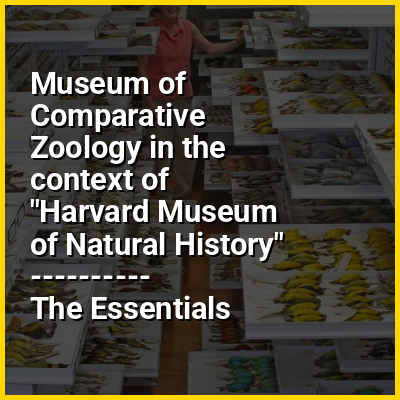
The Museum of Comparative Zoology (formally the Agassiz Museum of Comparative Zoology and often abbreviated to MCZ) is a zoology museum located on the grounds of Harvard University in Cambridge, Massachusetts. It is one of three natural-history research museums at Harvard, whose public face is the Harvard Museum of Natural History.

Harvard MCZ's collections consist of some 21 million specimens, of which several thousand are on rotating public display. While the research collections of the MCZ are not open to the public, the museum maintains MCZbase, a public database of its zoological collections.
↓ Menu
HINT:

In this Dossier

Museum of Comparative Zoology in the context of George Gaylord Simpson

George Gaylord Simpson (June 16, 1902 – October 6, 1984) was an American paleontologist. Simpson was perhaps the most influential paleontologist of the twentieth century, and a major participant in the modern synthesis, contributing Tempo and Mode in Evolution (1944), The Meaning of Evolution (1949) and The Major Features of Evolution (1953). He was an expert on extinct mammals and their intercontinental migrations. Simpson was extraordinarily knowledgeable about Mesozoic fossil mammals and fossil mammals of North and South America. He anticipated such concepts as punctuated equilibrium (in Tempo and Mode) and dispelled the myth that the evolution of the horse was a linear process culminating in the modern Equus caballus. He coined the word hypodigm in 1940, and published extensively on the taxonomy of fossil and extant mammals. Simpson was influentially, and incorrectly, opposed to Alfred Wegener's theory of continental drift, but accepted the theory of plate tectonics (and continental drift) when the evidence became conclusive.

He was Professor of Zoology at Columbia University, and Curator of the Department of Geology and Paleontology at the American Museum of Natural History from 1945 to 1959. He was Curator of the Museum of Comparative Zoology at Harvard University from 1959 to 1970, and a Professor of Geosciences at the University of Arizona from 1968 until his retirement in 1982.

View the full Wikipedia page for George Gaylord Simpson
↑ Return to Menu

Museum of Comparative Zoology in the context of Holotype

A holotype is a single physical example (or illustration) of an organism that is the one that was used when the species (or lower-ranked taxon) was formally described. It may be the only such physical example (or illustration), or it may have been explicitly designated as the holotype from among several examples. Under the International Code of Zoological Nomenclature (ICZN), there are several kinds of name-bearing types, and a holotype is one of them. Between the International Code of Nomenclature for algae, fungi, and plants (ICN) and the ICZN, the definitions of types are similar in intent but not identical in terminology or underlying concept.

For example, the holotype for the butterfly Plebejus idas longinus is a preserved specimen of that subspecies, held by the Museum of Comparative Zoology at Harvard University. In botany and mycology, an isotype is a duplicate of the holotype, generally pieces from the same individual plant or samples from the same genetic individual.

View the full Wikipedia page for Holotype
↑ Return to Menu

Museum of Comparative Zoology in the context of Louis Agassiz

Jean Louis Rodolphe Agassiz FRS (For) FRSE (/ˈæɡəsi/ AG-ə-see; French: [aɡasi]; May 28, 1807 – December 14, 1873) was a Swiss-born American biologist and geologist who is recognized as a scholar of Earth's natural history.

Spending his early life in Switzerland, he received a PhD at Erlangen and a medical degree in Munich. After studying with Georges Cuvier and Alexander von Humboldt in Paris, Agassiz was appointed professor of natural history at the University of Neuchâtel. He emigrated to the United States in 1847 after visiting Harvard University. He went on to become professor of zoology and geology at Harvard, to head its Lawrence Scientific School, and to found its Museum of Comparative Zoology.

View the full Wikipedia page for Louis Agassiz
↑ Return to Menu

Museum of Comparative Zoology in the context of Harry B. Whittington

Harry Blackmore Whittington FRS (24 March 1916 – 20 June 2010) was a British palaeontologist who made a major contribution to the study of fossils of the Burgess Shale and other Cambrian fauna. His works are largely responsible for the concept of Cambrian explosion, whereby modern animal body plans are explained to originate during a short span of geological period. With initial work on trilobites, his discoveries revealed that these arthropods were the most diversified of all invertebrates during the Cambrian Period. He was responsible for setting the standard for naming and describing the delicate fossils preserved in Konservat-Lagerstätten.

After completing his PhD from the University of Birmingham, Whittington spent much of his career out of Britain. He started his professional career at the University of Rangoon, Burma. Then he moved to China to teach at Ginling Women's College. After the end of World War II, he moved to Harvard University to become Professor of Palaeontology, and simultaneously Curator of Invertebrate Palaeontology at the Museum of Comparative Zoology. It was during this period that he began his major works in palaeontological research. Towards the last part of his career, he returned to England as Woodwardian Chair in Geology at the Department of Earth Sciences, University of Cambridge and was affiliated to Sidney Sussex College.

View the full Wikipedia page for Harry B. Whittington
↑ Return to Menu