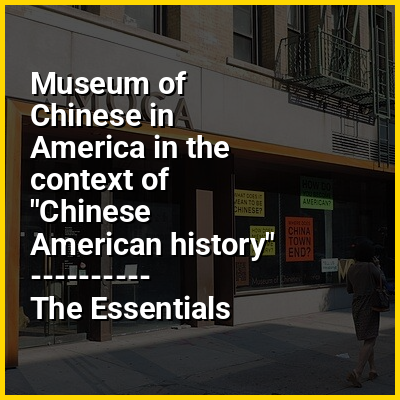
The Museum of Chinese in America (traditional Chinese: 美國華人博物館; simplified Chinese: 美国华人博物馆; pinyin: Měiguó Huárén Bówùguǎn; Jyutping: Mei5gwok3 Waa4jan4 Bok3mat6gun2; abbreviated MOCA) is a museum in Chinatown, Manhattan, New York City, which exhibits Chinese American history. It is a nonprofit 501(c)(3) education and cultural institution that presents the living history, heritage, culture, and diverse experiences of Chinese Americans through exhibitions, educational services and public programs. Much of its collection was damaged or destroyed in a fire in January 2020. The museum reopened to the public on July 15, 2021. It has been criticized by some Chinatown residents due to concerns related to gentrification.
HINT:
In this Dossier
- ⭐ Core Definition: Museum of Chinese in America
- Museum of Chinese in America in the context of Chinatown, Manhattan
- Museum of Chinese in America in the context of Chinese Americans in New York City
Museum of Chinese in America in the context of Chinatown, Manhattan
Manhattan's Chinatown is a neighborhood in Lower Manhattan, New York City, bordering the Lower East Side to its east, Little Italy to its north, Civic Center to its south, and Tribeca to its west. With an estimated population of 90,000 to 100,000 people, Chinatown is home to the highest concentration of Chinese people in the Western Hemisphere. Manhattan's Chinatown is also one of the oldest Chinese ethnic enclaves. The Manhattan Chinatown is one of nine Chinatown neighborhoods in New York City, as well as one of twelve in the New York metropolitan area, which contains the largest ethnic Chinese population outside of Asia, comprising an estimated 924,619 uniracial individuals in 2024.
Chinatown is also a densely populated neighborhood, with over 141,000 residents living in its vicinity encompassing 1.7 square miles, "of which 28.1% identified as Asian" in 2023. Historically, Chinatown was primarily populated by Cantonese speakers. However, in the 1980s and 1990s, large numbers of Fuzhounese-speaking immigrants also arrived and formed a sub-neighborhood annexed to the eastern portion of Chinatown east of The Bowery, which has become known as Little Fuzhou subdivided away from the primarily Cantonese populated original longtime established Chinatown of Manhattan from the proximity of The Bowery going west, known as Little Hong Kong/Guangdong. As many Fuzhounese and Cantonese speakers now speak Mandarin—the official language in Mainland China and Taiwan—in addition to their native languages, this has made it more important for Chinatown residents to learn and speak Mandarin. Although now overtaken in size by the rapidly growing Flushing Chinatown (located in the New York City borough of Queens) and Brooklyn Chinatown, the Manhattan Chinatown remains a dominant cultural force for the Chinese diaspora, as home to the Museum of Chinese in America and as the headquarters of numerous publications based both in the U.S. and China that are geared to overseas Chinese.
View the full Wikipedia page for Chinatown, ManhattanMuseum of Chinese in America in the context of Chinese Americans in New York City
The New York metropolitan area is home to the largest and most prominent ethnic Chinese population outside of Asia, with populations representing all 34 provincial-level administrative units of China. Estimated at 924,619 in 2024, it is the largest and most prominent metropolitan Asian national diaspora outside Asia. New York City proper contained an estimated 628,763 Chinese Americans in 2017, by far the highest ethnic Chinese population of any city outside Asia.
New York City and its surrounding metropolitan area, including Long Island and parts of New Jersey, is home to 12 Chinatowns: districts where Chinese immigrants were made to live for economic survival and physical safety that are now known as important sites of tourism and urban economic activity. The city proper includes six Chinatowns (or nine, including the emerging Chinatowns in Elmhurst and Whitestone, Queens, and East Harlem, Manhattan). There are also Chinese communities in more suburban areas such as Jersey City, New Jersey, Nassau County, Long Island; Edison, New Jersey; West Windsor, New Jersey; and Parsippany-Troy Hills, New Jersey.
View the full Wikipedia page for Chinese Americans in New York City