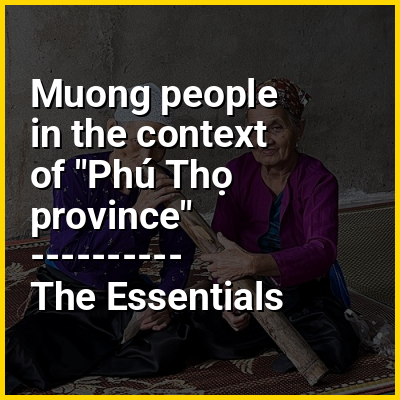
The Mường (Mường Bi dialect: mõl Mường; Vietnamese: người Mường) are an ethnic group native to northern Vietnam. The Mường is the country's third largest of 53 minority groups, with an estimated population of 1.45 million (according to the 2019 census). The Mường people inhabit a mountainous region of northern Vietnam centered in Hòa Bình Province and some districts of Phú Thọ province and Thanh Hóa Province. They speak the Mường language which is related to the Vietnamese language and the Thổ language and share ancient ethnic roots with the Vietnamese (Kinh) people.
HINT:
In this Dossier
- ⭐ Core Definition: Muong people
- Muong people in the context of Vietnamese people
- Muong people in the context of List of ethnic groups in Vietnam
- Muong people in the context of Thổ people
- Muong people in the context of Sênh tiền
- Muong people in the context of Muong language
Muong people in the context of Vietnamese people
The Vietnamese people (Vietnamese: người Việt, lit. 'Việt people') or the Kinh people (Vietnamese: người Kinh, lit. 'Metropolitan people'), also known as the Viet people or the Viets, are a Southeast Asian ethnic group native to modern-day northern Vietnam and southern China who speak Vietnamese, the most widely spoken Austroasiatic language.
Vietnamese Kinh people account for 85.32% of the population of Vietnam in the 2019 census, and are officially designated and recognized as the Kinh people (người Kinh) to distinguish them from the other minority groups residing in the country such as the Hmong, Cham, or Mường. The Vietnamese are one of the four main groups of Vietic speakers in Vietnam, the others being the Mường, Thổ, and Chứt people. Diasporic descendants of the Vietnamese in China, known as the Gin people, are one of 56 ethnic groups officially recognized by the People's Republic of China, residing in the Guangxi Zhuang Autonomous Region.
View the full Wikipedia page for Vietnamese peopleMuong people in the context of List of ethnic groups in Vietnam
Fifty-four ethnic groups in Vietnam have been officially recognized by the Vietnamese government since 2 March 1979. Each ethnicity has its own unique language, traditions, and culture. The largest ethnic groups are: Kinh 85.32%, Tày 1.92%, Thái 1.89%, Mường 1.51%, Hmong 1.45%, Khmer 1.32%, Nùng 1.13%, Dao 0.93%, Hoa 0.78%, with all others accounting for the remaining 3.7% (2019 census). The Vietnamese terms for ethnic groups are dân tộc (nation) and sắc tộc (ethnicity).
View the full Wikipedia page for List of ethnic groups in VietnamMuong people in the context of Thổ people
The Thổ ethnic group (also Keo, Mon, Cuoi, Ho, Tay Poong) inhabits the mountainous regions of northern Vietnam, mainly Nghệ An Province southwest of Hanoi. Many Thổ speak the Tho language, which is closely related to Vietnamese.The Thổ population numbered 91,430 in 2019.
The Thổ are one of the 4 main groups of Vietic speakers in Vietnam, the others being the Việt, Mường, and Chứt. The name Thổ, which means "autochthonous" was originally applied to the Tày ethnic group, however this usage is obsolete.
View the full Wikipedia page for Thổ peopleMuong people in the context of Sênh tiền
The sênh tiền or sinh tiền (formerly called phách sâu tiền or phách quán tiền) is a clapper used in Vietnamese traditional instrumental and vocal music. It is a combination of clapper, rasp, and jingle made from three pieces of hardwood and old Chinese coins. It is also played among the Muong people.
View the full Wikipedia page for Sênh tiềnMuong people in the context of Muong language
Mường (thiếng Mươ̒ng; Vietnamese: tiếng Mường) is a group of dialects spoken by the Mường people of Vietnam. They are in the Austroasiatic language family and closely related to Vietnamese. According to Phan (2012), the Mường dialects are not a single language, or even most closely related to each other, but rather are an ethnically defined and paraphyletic taxon.
Mường dialects are primarily spoken in mountainous regions of the northern Vietnamese provinces of Hòa Bình, Thanh Hóa, Vĩnh Phúc, Yên Bái, Sơn La, and Ninh Bình.
View the full Wikipedia page for Muong language