Multiplication in the context of Univariate polynomial


Multiplication in the context of Univariate polynomial

Multiplication Study page number 1 of 5

Play TriviaQuestions Online!

or

Skip to study material about Multiplication in the context of "Univariate polynomial"


⭐ Core Definition: Multiplication

Multiplication is one of the four elementary mathematical operations of arithmetic, with the other ones being addition, subtraction, and division. The result of a multiplication operation is called a product. Multiplication is often denoted by the cross symbol, ×, by the mid-line dot operator, , by juxtaposition, or, in programming languages, by an asterisk, *.

The multiplication of whole numbers may be thought of as repeated addition; that is, the multiplication of two numbers is equivalent to adding as many copies of one of them, the multiplicand, as the quantity of the other one, the multiplier; both numbers can be referred to as factors. This is to be distinguished from terms, which are added.

↓ Menu
HINT:

In this Dossier

Multiplication in the context of Algebra

Algebra is a branch of mathematics that deals with abstract systems, known as algebraic structures, and the manipulation of expressions within those systems. It is a generalization of arithmetic that introduces variables and algebraic operations other than the standard arithmetic operations, such as addition and multiplication.

Elementary algebra is the main form of algebra taught in schools. It examines mathematical statements using variables for unspecified values and seeks to determine for which values the statements are true. To do so, it uses different methods of transforming equations to isolate variables. Linear algebra is a closely related field that investigates linear equations and combinations of them called systems of linear equations. It provides methods to find the values that solve all equations in the system at the same time, and to study the set of these solutions.

View the full Wikipedia page for Algebra
↑ Return to Menu

Multiplication in the context of Number

A number is a mathematical object used to count, measure, and label. The most basic examples are the natural numbers: 1, 2, 3, 4, 5, and so forth. Individual numbers can be represented in language with number words or by dedicated symbols called numerals; for example, "five" is a number word and "5" is the corresponding numeral. As only a limited list of symbols can be memorized, a numeral system is used to represent any number in an organized way. The most common representation is the Hindu–Arabic numeral system, which can display any non-negative integer using a combination of ten symbols, called numerical digits. Numerals can be used for counting (as with cardinal number of a collection or set), labels (as with telephone numbers), for ordering (as with serial numbers), and for codes (as with ISBNs). In common usage, a numeral is not clearly distinguished from the number that it represents.

In mathematics, the notion of number has been extended over the centuries to include zero (0), negative numbers, rational numbers such as one half , real numbers such as the square root of 2 , and π, and complex numbers which extend the real numbers with a square root of −1, and its combinations with real numbers by adding or subtracting its multiples. Calculations with numbers are done with arithmetical operations, the most familiar being addition, subtraction, multiplication, division, and exponentiation. Their study or usage is called arithmetic, a term which may also refer to number theory, the study of the properties of numbers.

View the full Wikipedia page for Number
↑ Return to Menu

Multiplication in the context of Exponentiation

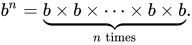
In mathematics, exponentiation, denoted b, is an operation involving two numbers: the base, b, and the exponent or power, n. When n is a positive integer, exponentiation corresponds to repeated multiplication of the base: that is, b is the product of multiplying n bases:In particular, .

The exponent is usually shown as a superscript to the right of the base as b or in computer code as b^n. This binary operation is often read as "b to the power n"; it may also be referred to as "b raised to the nth power", "the nth power of b", or, most briefly, "b to the n".

View the full Wikipedia page for Exponentiation
↑ Return to Menu

Multiplication in the context of Rational number

In mathematics, a rational number is a number that can be expressed as the quotient or fraction of two integers, a numerator p and a non-zero denominator q. For example, is a rational number, as is every integer (for example, ). The set of all rational numbers is often referred to as "the rationals", and is closed under addition, subtraction, multiplication, and division by a nonzero rational number. It is a field under these operations and therefore also calledthe field of rationals or the field of rational numbers. It is usually denoted by boldface Q, or blackboard bold

A rational number is a real number. The real numbers that are rational are those whose decimal expansion either terminates after a finite number of digits (example: 3/4 = 0.75), or eventually begins to repeat the same finite sequence of digits over and over (example: 9/44 = 0.20454545...). This statement is true not only in base 10, but also in every other integer base, such as the binary and hexadecimal ones (see Repeating decimal § Extension to other bases).

View the full Wikipedia page for Rational number
↑ Return to Menu

Multiplication in the context of Complex plane

In mathematics, the complex plane is the plane formed by the complex numbers, with a Cartesian coordinate system such that the horizontal x-axis, called the real axis, is formed by the real numbers, and the vertical y-axis, called the imaginary axis, is formed by the imaginary numbers.

The complex plane allows for a geometric interpretation of complex numbers. Under addition, they add like vectors. The multiplication of two complex numbers can be expressed more easily in polar coordinates: the magnitude or modulus of the product is the product of the two absolute values, or moduli, and the angle or argument of the product is the sum of the two angles, or arguments. In particular, multiplication by a complex number of modulus 1 acts as a rotation.

View the full Wikipedia page for Complex plane
↑ Return to Menu

Multiplication in the context of Arithmetic

Arithmetic is an elementary branch of mathematics that deals with numerical operations like addition, subtraction, multiplication, and division. In a wider sense, it also includes exponentiation, extraction of roots, and taking logarithms.

Arithmetic systems can be distinguished based on the type of numbers they operate on. Integer arithmetic is about calculations with positive and negative integers. Rational number arithmetic involves operations on fractions of integers. Real number arithmetic is about calculations with real numbers, which include both rational and irrational numbers.

View the full Wikipedia page for Arithmetic
↑ Return to Menu

Multiplication in the context of Algebraic operation

In mathematics, a basic algebraic operation is a mathematical operation similar to any one of the common operations of elementary algebra, which include addition, subtraction, multiplication, division, raising to a whole number power, and taking roots (fractional power). The operations of elementary algebra may be performed on numbers, in which case they are often called arithmetic operations. They may also be performed, in a similar way, on variables, algebraic expressions, and more generally, on elements of algebraic structures, such as groups and fields.

An algebraic operation on a set may be defined more formally as a function that maps to the tuples of a given length of elements of . The length of the tuples is called the arity of the operation, and each member of the tuple is called an operand. The most common case is the case of arity two, where the operation is called a binary operation and the operands form an ordered pair. A unary operation is an operation of arity one that has only one operand; for example, the square root. An example of a ternary operation (arity three) is the triple product.

View the full Wikipedia page for Algebraic operation
↑ Return to Menu

Multiplication in the context of Addition

Addition, usually denoted with the plus sign +, is one of the four basic operations of arithmetic, the other three being subtraction, multiplication, and division. The addition of two whole numbers results in the total or sum of those values combined. For example, the adjacent image shows two columns of apples, one with three apples and the other with two apples, totaling to five apples. This observation is expressed as "3 + 2 = 5", which is read as "three plus two equals five".

Besides counting items, addition can also be defined and executed without referring to concrete objects, using abstractions called numbers instead, such as integers, real numbers, and complex numbers. Addition belongs to arithmetic, a branch of mathematics. In algebra, another area of mathematics, addition can also be performed on abstract objects such as vectors, matrices, and elements of additive groups.

View the full Wikipedia page for Addition
↑ Return to Menu

Multiplication in the context of Elementary arithmetic

Elementary arithmetic is a branch of mathematics involving addition, subtraction, multiplication, and division. Due to its low level of abstraction, broad range of application, and position as the foundation of all mathematics, elementary arithmetic is generally the first branch of mathematics taught in schools.

View the full Wikipedia page for Elementary arithmetic
↑ Return to Menu

Multiplication in the context of Binary operation

In mathematics, a binary operation or dyadic operation is a rule for combining two elements (called operands) to produce another element. More formally, a binary operation is an operation of arity two.

More specifically, a binary operation on a set is a binary function that maps every pair of elements of the set to an element of the set. Examples include the familiar arithmetic operations like addition, subtraction, multiplication, set operations like union, complement, intersection. Other examples are readily found in different areas of mathematics, such as vector addition, matrix multiplication, and conjugation in groups.

View the full Wikipedia page for Binary operation
↑ Return to Menu

Multiplication in the context of Sector (instrument)

The sector, also known as a sector rule, proportional compass, or military compass, is a major calculating instrument that was in use from the end of the sixteenth century until the nineteenth century. It is an instrument consisting of two rulers of equal length joined by a hinge. A number of scales are inscribed upon the instrument which facilitate various mathematical calculations. It is used for solving problems in proportion, multiplication and division, geometry, and trigonometry, and for computing various mathematical functions, such as square roots and cube roots. Its several scales permitted easy and direct solutions of problems in gunnery, surveying and navigation. The sector derives its name from the fourth proposition of the sixth book of Euclid, where it is demonstrated that similar triangles have their like sides proportional. Some sectors also incorporated a quadrant, and sometimes a clamp at the end of one leg which allowed the device to be used as a gunner's quadrant.

View the full Wikipedia page for Sector (instrument)
↑ Return to Menu

Multiplication in the context of Imaginary unit

The imaginary unit, usually denoted by i, is a mathematical constant that is a solution to the quadratic equation x = −1, which is not solved by any real number. Any real-number multiple of the imaginary unit is called an imaginary number.

Combining the real numbers with the imaginary unit using addition and multiplication generates a new number system called the complex numbers, which consists of all numbers of the form a + bi with real numbers a and b.

View the full Wikipedia page for Imaginary unit
↑ Return to Menu

Multiplication in the context of Subtraction

Subtraction (which is signified by the minus sign, –) is one of the four arithmetic operations along with addition, multiplication and division. Subtraction is an operation that represents removal of objects from a collection. For example, in the adjacent picture, there are 5 − 2 peaches—meaning 5 peaches with 2 taken away, resulting in a total of 3 peaches. Therefore, the difference of 5 and 2 is 3; that is, 5 − 2 = 3. While primarily associated with natural numbers in arithmetic, subtraction can also represent removing or decreasing physical and abstract quantities using different kinds of objects including negative numbers, fractions, irrational numbers, vectors, decimals, functions, and matrices.

In a sense, subtraction is the inverse of addition. That is, c = ab if and only if c + b = a. In words: the difference of two numbers is the number that gives the first one when added to the second one.

View the full Wikipedia page for Subtraction
↑ Return to Menu

Multiplication in the context of Division (mathematics)

Division is one of the four basic operations of arithmetic. The other operations are addition, subtraction, and multiplication. What is being divided is called the dividend, which is divided by the divisor, and the result is called the quotient.

At an elementary level the division of two natural numbers is, among other possible interpretations, the process of calculating the number of times one number is contained within another. For example, if 20 apples are divided evenly between 4 people, everyone receives 5 apples (see picture). However, this number of times or the number contained (divisor) need not be integers.

View the full Wikipedia page for Division (mathematics)
↑ Return to Menu

Multiplication in the context of Euclidean vector

In mathematics, physics, and engineering, a Euclidean vector or simply a vector (sometimes called a geometric vector or spatial vector) is a geometric object that has magnitude (or length) and direction. Euclidean vectors can be added and scaled to form a vector space. A vector quantity is a vector-valued physical quantity, including units of measurement and possibly a support, formulated as a directed line segment. A vector is frequently depicted graphically as an arrow connecting an initial point A with a terminal point B, and denoted by

A vector is what is needed to "carry" the point A to the point B; the Latin word vector means 'carrier'. It was first used by 18th century astronomers investigating planetary revolution around the Sun. The magnitude of the vector is the distance between the two points, and the direction refers to the direction of displacement from A to B. Many algebraic operations on real numbers such as addition, subtraction, multiplication, and negation have close analogues for vectors, operations which obey the familiar algebraic laws of commutativity, associativity, and distributivity. These operations and associated laws qualify Euclidean vectors as an example of the more generalized concept of vectors defined simply as elements of a vector space.

View the full Wikipedia page for Euclidean vector
↑ Return to Menu

Multiplication in the context of Polynomial

In mathematics, a polynomial is a mathematical expression consisting of indeterminates (also called variables) and coefficients, that involves only the operations of addition, subtraction, multiplication and exponentiation to nonnegative integer powers, and has a finite number of terms. An example of a polynomial of a single indeterminate is . An example with three indeterminates is .

Polynomials appear in many areas of mathematics and science. For example, they are used to form polynomial equations, which encode a wide range of problems, from elementary word problems to complicated scientific problems; they are used to define polynomial functions, which appear in settings ranging from basic chemistry and physics to economics and social science; and they are used in calculus and numerical analysis to approximate other functions. In advanced mathematics, polynomials are used to construct polynomial rings and algebraic varieties, which are central concepts in algebra and algebraic geometry.

View the full Wikipedia page for Polynomial
↑ Return to Menu

Multiplication in the context of Operation (mathematics)

In mathematics, an operation is a function from a set to itself. For example, an operation on real numbers will take in real numbers and return a real number. An operation can take zero or more input values (also called "operands" or "arguments") to a well-defined output value. The number of operands is the arity of the operation.

The most commonly studied operations are binary operations (i.e., operations of arity 2), such as addition and multiplication, and unary operations (i.e., operations of arity 1), such as additive inverse and multiplicative inverse. An operation of arity zero, or nullary operation, is a constant. The mixed product is an example of an operation of arity 3, also called ternary operation.

View the full Wikipedia page for Operation (mathematics)
↑ Return to Menu