Multiple rocket launcher in the context of "Precision-guided munition"

Play Trivia Questions online!

or

Skip to study material about Multiple rocket launcher in the context of "Precision-guided munition"


⭐ Core Definition: Multiple rocket launcher

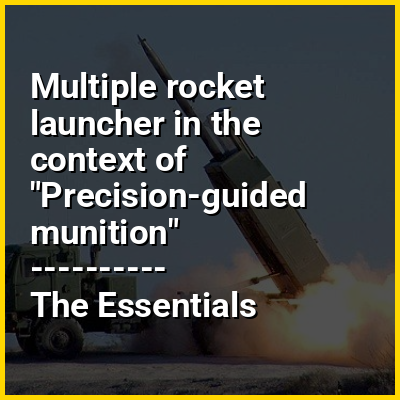
A multiple rocket launcher (MRL) or multiple launch rocket system (MLRS) is a type of rocket artillery system that contains multiple launchers which are fixed to a single platform, and shoots its rocket ordnance in a fashion similar to a volley gun. Rockets are self-propelled in flight and have different capabilities than conventional artillery shells, such as longer effective range, lower recoil, typically considerably higher payload than a similarly sized gun artillery platform, or even carrying multiple warheads.

Unguided rocket artillery is notoriously inaccurate and slow to reload compared to gun artillery. A multiple rocket launcher helps compensate for this with its ability to launch multiple rockets in rapid succession, which, coupled with the large kill zone of each warhead, can easily deliver saturation fire over a target area. However, modern rockets can use GPS or inertial guidance to combine the advantages of rockets with the higher accuracy of precision-guided munitions.
↓ Menu

In this Dossier

Multiple rocket launcher in the context of BM-21 Grad

The BM-21 "Grad" (Russian: БМ-21 "Град", lit.'hailstorm') is a self-propelled 122 mm multiple rocket launcher designed in the Soviet Union. The system and the M-21OF rocket were first developed in the early 1960s, and saw their first combat use in March 1969 during the Sino-Soviet border conflict. BM stands for boyevaya mashina (Russian: боевая машинаcombat vehicle), and the nickname grad means "hail". The complete system with the BM-21 launch vehicle and the M-21OF rocket is designated as the M-21 field-rocket system and is more commonly known as a Grad multiple rocket launcher system.

In NATO countries the system, either the complete system or the launch vehicle only, was initially known as the M1964. Several other countries have copied the Grad or developed similar systems. In Russian service its intended replacement is the 9A52-4 Tornado. Many similar 122 mm MLRS systems are made by different countries based on the BM-21 Grad.

↑ Return to Menu

Multiple rocket launcher in the context of Large-calibre artillery

The formal definition of large-calibre artillery used by the United Nations Register of Conventional Arms (UNROCA) is "guns, howitzers, artillery pieces, combining the characteristics of a gun, howitzer, mortar, or rocket, capable of engaging surface targets by delivering primarily indirect fire, with a calibre of 76.2 mm (3.00 in) and above". This definition, shared by the Arms Trade Treaty and the Treaty on Conventional Armed Forces in Europe, is updated from an earlier definition in United Nations General Assembly Resolution 46/36L, which set a threshold of 100 mm (3.9 in). Several grammatical changes were made to that latter in 1992 and the threshold was lowered in 2003 to yield the current definition, as endorsed by UN General Assembly Resolution 58/54.

Historically, large-calibre weapons have included bombards and siege guns.

↑ Return to Menu

Multiple rocket launcher in the context of Artillery battery

In military organizations, an artillery battery is a unit or multiple systems of artillery, mortar systems, rocket artillery, multiple rocket launchers, surface-to-surface missiles, ballistic missiles, cruise missiles, grouped to facilitate better battlefield communication and command and control, as well as to provide dispersion for its constituent gunnery crews and their systems. The term is also used in a naval context to describe groups of guns on warships.

↑ Return to Menu

Multiple rocket launcher in the context of Technical (vehicle)

A technical, known as a non-standard tactical vehicle (NSTV) in United States military parlance, is a light improvised fighting vehicle which has been modified to mount small arms and light weapons (SALW) and heavy weaponry.

The vehicles most commonly used to make technicals are open-backed civilian pickup trucks and vehicles with four-wheel drive capabilities. Armaments used include machine guns, automatic grenade launchers, anti-aircraft autocannons, rotary cannons, anti-tank weapons, anti-tank guns, anti-tank guided missiles, mortars, multiple rocket launchers, recoilless rifles, and other support weaponry. Technicals perform a similar function to gun trucks and self-propelled guns, but are helpless against more advanced weaponry and superior air power.

↑ Return to Menu

Multiple rocket launcher in the context of Siege cannon

Siege artillery (also siege guns or siege cannons) are heavy guns designed to bombard fortifications, cities, and other fixed targets. They are distinct from field artillery and are a class of siege weapon capable of firing heavy cannonballs or shells that required enormous transport and logistical support to operate. They lacked mobility and thus were rarely useful in more mobile warfare situations, generally having been superseded by heavy howitzers (towed and self-propelled artillery), strategic bomber aircraft, surface-to-surface missiles, ballistic missiles, cruise missiles and multiple rocket launchers in modern warfare.

↑ Return to Menu

Multiple rocket launcher in the context of M270 Multiple Launch Rocket System

The M270 Multiple Launch Rocket System (M270 MLRS) is an American armored self-propelled multiple launch rocket system.

The U.S. Army variant of the M270 is based on the chassis of the Bradley Fighting Vehicle. The first M270s were delivered in 1983, and were adopted by several NATO and non-NATO militaries. The platform first saw combat with the United States in the 1991 Gulf War. It has received multiple improvements since its inception, including the ability to fire guided missiles. M270s have been used by Ukraine in the Russian invasion of Ukraine.

↑ Return to Menu

Multiple rocket launcher in the context of Katyusha rocket launcher

The Katyusha (Russian: Катю́ша, IPA: [kɐˈtʲuʂə] ) is a type of rocket artillery first built and fielded by the Soviet Union in World War II. Multiple rocket launchers such as these deliver explosives to a target area more intensively than conventional artillery, but with lower accuracy and requiring a longer time to reload. They are fragile compared to artillery guns, but are cheap, easy to produce, and usable on almost any chassis. The Katyushas of World War II, the first self-propelled artillery mass-produced by the Soviet Union, were usually mounted on ordinary trucks. This mobility gave the Katyusha, and other self-propelled artillery, another advantage: being able to deliver a large blow all at once, and then move before being located and attacked with counter-battery fire.

Katyusha weapons of World War II included the BM-13 launcher, light BM-8, and heavy BM-31. Today, the nickname Katyusha is also applied to newer truck-mounted post-Soviet – in addition to non-Soviet – multiple-rocket launchers, notably the common BM-21 Grad and its derivatives.

↑ Return to Menu

Multiple rocket launcher in the context of 9A52-4 Tornado

The Tornado is a family of multiple rocket launchers of 122 to 300mm calibre developed by NPO Splav for the Russian Ground Forces with the aim to replace previous multiple rocket launchers. Variants of the system, which include the Tornado-G and Tornado-S models, have different capabilities and roles in the battlefield. The Tornado is designed primarily to fire cluster munitions but also can be used to fire thermobaric warheads.

↑ Return to Menu