Multi-user dungeon in the context of "Synchronous conferencing"

Play Trivia Questions online!

or

Skip to study material about Multi-user dungeon in the context of "Synchronous conferencing"


⭐ Core Definition: Multi-user dungeon

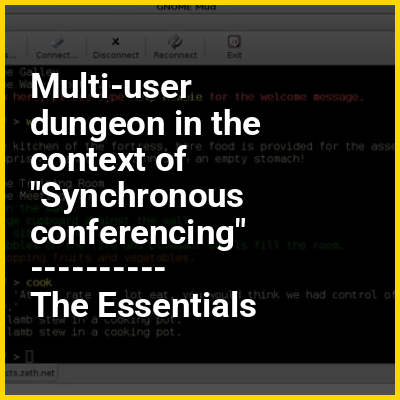
A multi-user dungeon (MUD, /mʌd/), also known as a multi-user dimension or multi-user domain, is a multiplayer real-time virtual world, usually text-based or storyboarded. MUDs combine elements of role-playing games, hack and slash, player versus player, interactive fiction, and online chat. Players can read or view descriptions of rooms, objects, other players, and non-player characters, and perform actions in the virtual world that are typically also described. Players typically interact with each other and the world by typing commands that resemble a natural language, as well as using a character typically called an avatar.

Traditional MUDs implement a role-playing video game set in a fantasy world populated by fictional races and monsters, with players choosing classes in order to gain specific skills or powers. The objective of this sort of game is to slay monsters, explore a fantasy world, complete quests, go on adventures, create a story by roleplaying, and advance the created character. Many MUDs were fashioned around the dice-rolling rules of the Dungeons & Dragons series of games.
↓ Menu

In this Dossier

Multi-user dungeon in the context of Virtual community

A virtual community is a social network of individuals who connect through specific social media, potentially crossing geographical and political boundaries in order to pursue mutual interests or goals. Some of the most pervasive virtual communities are online communities operating under social networking services.

Howard Rheingold discussed virtual communities in his book, The Virtual Community, published in 1993. The book's discussion ranges from Rheingold's adventures on The WELL, computer-mediated communication, social groups and information science. Technologies cited include Usenet, MUDs (Multi-User Dungeon) and their derivatives MUSHes and MOOs, Internet Relay Chat (IRC), chat rooms and electronic mailing lists. Rheingold also points out the potential benefits for personal psychological well-being, as well as for society at large, of belonging to a virtual community. At the same time, it showed that job engagement positively influences virtual communities of practice engagement.

↑ Return to Menu

Multi-user dungeon in the context of Synchronous computer-mediated communication

Online chat is any direct text-, audio- or video-based (webcams), one-on-one or one-to-many (group) chat (formally also known as synchronous conferencing), using tools such as instant messengers, Internet Relay Chat (IRC), talkers and possibly MUDs or other online games. Online chat includes web-based applications that allow communication – often directly addressed, but anonymous between users in a multi-user environment. Web conferencing is a more specific online service, that is often sold as a service, hosted on a web server controlled by the vendor. Online chat may address point-to-point communications as well as multicast communications from one sender to multiple receivers and voice and video chat, or may be a feature of a web conferencing service.

Online chat in a narrower sense is any kind of communication over the Internet that offers a real-time transmission of text messages from sender to receiver. Chat messages are generally short in order to enable other participants to respond quickly. Thereby, a feeling similar to a spoken conversation is created, which distinguishes chatting from other text-based online communication forms such as Internet forums and email. The expression online chat comes from the word chat which means "informal conversation".

↑ Return to Menu

Multi-user dungeon in the context of The Virtual Community (book)


The Virtual Community is a 1993 book about virtual communities by Howard Rheingold, a member of the early network system The WELL. A second edition, with a new concluding chapter, was published in 2000 by MIT Press.

The book's discussion ranges from Rheingold's adventures on The WELL, computer-mediated communication and social groups and information science. Technologies cited include Usenet, MUDs (multi-user dungeons) and their derivatives MUSHes and MOOs, Internet Relay Chat (IRC), chat rooms, and electronic mailing lists. Rheingold also points out the potential benefits for personal psychological well-being, as well as for society at large, of belonging to a virtual community.

↑ Return to Menu

Multi-user dungeon in the context of MUSH

In multiplayer online games, a MUSH (a backronymed variation on MUD most often expanded as Multi-User Shared Hallucination, though Multi-User Shared Hack, Habitat, and Holodeck are also observed) is a text-based online social medium to which multiple users are connected at the same time. MUSHes are often used for online social interaction and role-playing games, although the first forms of MUSH do not appear to be coded specifically to implement gaming activity. MUSH software was originally derived from MUDs; today's two major MUSH variants are descended from TinyMUD, which was fundamentally a social game.MUSH has forked over the years and there are now different varieties with different features, although most have strong similarities and one who is fluent in coding one variety can switch to coding for the other with only a little effort. The source code for most widely used MUSH servers is open source and available from its current maintainers.

A primary feature of MUSH codebases that tends to distinguish it from other multi-user environments is the ability, by default, of any player to extend the world by creating new rooms or objects and specifying their behavior in the MUSH's internal scripting language.

↑ Return to Menu

Multi-user dungeon in the context of MOO

A MOO ("multi-user dungeon (MUD), object-oriented") is a text-based online virtual reality system to which multiple users (players) are connected at the same time.

The term MOO is used in two distinct, but related, senses. One is to refer to those programs descended from the original MOO server, and the other is to refer to any MUD that uses object-oriented techniques to organize its database of objects, particularly if it does so in a similar fashion to the original MOO or its derivatives. Most of this article refers to the original MOO and its direct descendants, but see non-descendant MOOs for a list of MOO-like systems.

↑ Return to Menu

Multi-user dungeon in the context of Avatar (computing)

In computing, an avatar is a graphical representation of a user, the user's character, or persona. Avatars can be two-dimensional icons in Internet forums and other online communities, where they are also known as profile pictures (pfp), userpics, or formerly picons (personal icons, or possibly "picture icons"). Alternatively, an avatar can take the form of a three-dimensional model, as used in online worlds and video games, or an imaginary character with no graphical appearance, as in text-based games or worlds such as MUDs.

The term avatāra (/ˈævətɑːr, ˌævəˈtɑːr/) originates from Sanskrit, and was adopted by early computer games and science fiction novelists. Richard Garriott extended the term to an on-screen user representation in 1985, and the term gained wider adoption in Internet forums and MUDs. Nowadays, avatars are used in a variety of online settings including social media, virtual assistants, instant messaging platforms, and digital worlds such as World of Warcraft and Second Life. They can take the form of an image of one's real-life self, as often seen on platforms like Facebook and LinkedIn, or a virtual character that diverges from the real world. Often, these are customised to show support for different causes, or to create a unique online representation.

↑ Return to Menu

Multi-user dungeon in the context of Talker

A talker is a chat system that people use to talk to each other over the Internet. Dating back to the 1980s, they were a predecessor of instant messaging.A talker is a communication system precursor to MMORPGs and other virtual worlds such as Second Life. Talkers are a form of online virtual worlds in which multiple users are connected at the same time to chat in real-time. People log in to the talkers remotely (usually via Telnet), and have a basic text interface with which to communicate with each other.

The early talkers were similar to MUDs with most of the complex game machinery stripped away, leaving just the communication level commands – hence the name "talker". ew-too was, in fact, a MUD server with the game elements removed.

↑ Return to Menu