Mount Mazama in the context of "Cascade Volcanoes"

Play Trivia Questions online!

or

Skip to study material about Mount Mazama in the context of "Cascade Volcanoes"

Ad spacer

⭐ Core Definition: Mount Mazama

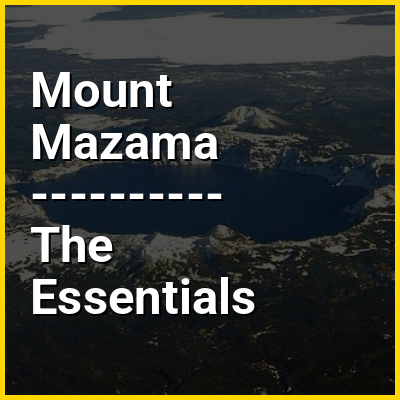
Mount Mazama (Klamath: Tum-sum-ne) is a complex volcano in the western U.S. state of Oregon, in a segment of the Cascade Volcanic Arc and Cascade Range. The volcano is in Klamath County, in the southern Cascades, 60 miles (97 km) north of the Oregon–California border. Its collapse, due to the eruption of magma emptying the underlying magma chamber, formed a caldera that holds Crater Lake (Giiwas in the Native American language Klamath). Mount Mazama originally had an elevation of approximately 12,000 feet (3,700 m), but following its climactic eruption this was reduced to 8,157 feet (2,486 m). Crater Lake is 1,943 feet (592 m) deep, the deepest freshwater body in the U.S. and the second deepest in North America after Great Slave Lake in Canada.

Mount Mazama formed as a group of overlapping volcanic edifices such as shield volcanoes and small composite cones, becoming active intermittently until its climactic eruption 7,700 years ago. This eruption, the largest known within the Cascade Volcanic Arc in a million years, destroyed Mazama's summit, reducing its approximate 12,000-foot (3,700 m) height by about 1 mile (1,600 m). Much of the edifice fell into the volcano's partially emptied neck and magma chamber, creating a caldera. The region's volcanic activity results from the subduction of the offshore oceanic plate, and is influenced by local extensional faulting. Mazama is dormant, but the U.S. Geological Survey says eruptions on a smaller scale are likely, which would pose a threat to its surroundings.
↓ Menu

>>>PUT SHARE BUTTONS HERE<<<
In this Dossier

Mount Mazama in the context of Caldera

A caldera (/kɔːlˈdɛrə, kæl-/ kawl-DERR-ə, kal-) is a large cauldron-like hollow that forms shortly after the emptying of a magma chamber in a volcanic eruption. The ejection of large volumes of magma in a short time can upset the integrity of a magma chamber's structure by in effect removing much of the chamber's filling material. The walls and ceiling of a chamber may now not be able to support its own weight and any substrate or rock resting above. The ground surface then collapses into the emptied or partially emptied magma chamber, leaving a large depression at the surface that may have a diameter of dozens of kilometers. Although sometimes described as a crater, the feature is actually a type of sinkhole, as it is formed through subsidence and collapse rather than an explosion or impact. Compared to the thousands of volcanic eruptions that occur over the course of a century, the formation of a caldera is a rare event, occurring only a few times within a given window of 100 years. Only nine caldera-forming collapses are known to have occurred between 1911 and 2022, with the caldera collapses at Kīlauea, Hawaii, in 2018 and Hunga Tonga–Hunga Haʻapai in 2022 being the most recent. Volcanoes that have formed a caldera are sometimes described as "caldera volcanoes".

↑ Return to Menu

Mount Mazama in the context of Crater Lake

Crater Lake (Klamath: Giiwas) is a volcanic crater lake in south-central Oregon in the Western United States. It is the main feature of Crater Lake National Park and is a tourist attraction for its deep blue color and water clarity. The lake partly fills a 2,148-foot-deep (655 m) caldera that was formed around 7,700 (± 150) years agoby the collapse of the volcano Mount Mazama. No rivers flow into or out of the lake; the evaporation is compensated for by rain and snowfall at a rate such that the total amount of water is replaced every 150 years. With a depth of 1,949 feet (594 m), the lake is the deepest in the United States. In the world, it ranks eleventh for maximum depth, as well as fifth for mean depth.

Crater Lake features two small islands. Wizard Island, located near the western shore of the lake, is a cinder cone about 316 acres (128 hectares) in size. Phantom Ship, a natural rock pillar, is located near the southern shore.

↑ Return to Menu