Moons of Haumea in the context of "W. M. Keck Observatory"

Play Trivia Questions online!

or

Skip to study material about Moons of Haumea in the context of "W. M. Keck Observatory"

Ad spacer

⭐ Core Definition: Moons of Haumea

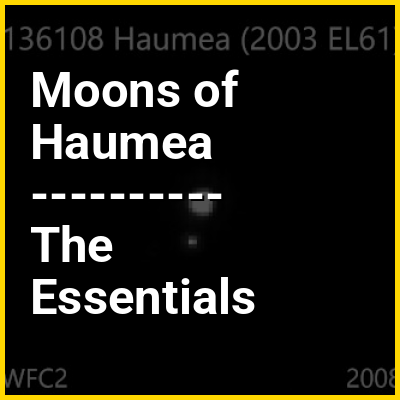
The dwarf planet Haumea has two known moons, Hiʻiaka and Namaka, named after Hawaiian goddesses. These small moons were discovered in 2005, from observations of Haumea made at the large telescopes of the W. M. Keck Observatory in Hawaii.

Haumea's moons are unusual in a number of ways. They are thought to be part of its extended collisional family, which formed billions of years ago from icy debris after a large impact disrupted Haumea's ice mantle. Hiʻiaka, the larger, outermost moon, has large amounts of pure water ice on its surface, which is rare among Kuiper belt objects. Namaka, about one tenth the mass, has an orbit with surprising dynamics: it is unusually eccentric and appears to be greatly influenced by both the elongated shape of Haumea and by the larger satellite.
↓ Menu

>>>PUT SHARE BUTTONS HERE<<<
In this Dossier

Moons of Haumea in the context of Natural satellite

A natural satellite is, in the most common usage, an astronomical body that orbits a planet, dwarf planet, or small Solar System body (or sometimes another natural satellite). Natural satellites are colloquially referred to as moons, a derivation from the Moon of Earth.

In the Solar System, there are six planetary satellite systems, altogether comprising 419 natural satellites with confirmed orbits. Seven objects commonly considered dwarf planets by astronomers are also known to have natural satellites: Orcus, Pluto, Haumea, Quaoar, Makemake, Gonggong, and Eris. As of January 2022, there are 447 other minor planets known to have natural satellites.

↑ Return to Menu