Mongolian writing systems in the context of Soyombo alphabet


Mongolian writing systems in the context of Soyombo alphabet

⭐ Core Definition: Mongolian writing systems

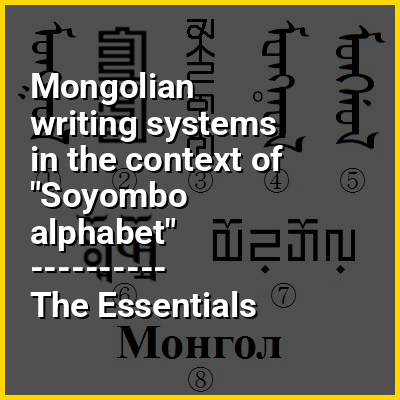
Various Mongolian writing systems have been devised for the Mongolian language over the centuries, and from a variety of scripts. The oldest and native script, called simply the Mongolian script, has been the predominant script during most of Mongolian history, and is still in active use today in the Inner Mongolia region of China and has de facto use in Mongolia.

It has in turn spawned several alphabets, either as attempts to fix its perceived shortcomings, or to allow the notation of other languages, such as Chinese, Sanskrit and Tibetan. In the 20th century, Mongolia briefly switched to the Latin script, but then almost immediately replaced it with the modified Cyrillic alphabet because of its smaller discrepancy between written and spoken form, contributing to the success of the literacy campaign, which increased the literacy rate from 17.3% to 73.5% between 1941 and 1950. Nevertheless, Mongols living in Inner Mongolia as well as other parts of China continued to use alphabets based on the traditional Mongolian script.
↓ Menu
HINT:

In this Dossier

Mongolian writing systems in the context of Khalkha Mongolian

The Khalkha dialect is a dialect of central Mongolian widely spoken in Mongolia. According to some classifications, the Khalkha dialect includes Inner Mongolian varieties such as Shiliin gol, Ulaanchab and Sönid. As it was the basis for the Cyrillic orthography of Mongolian, it is de facto the national language of Mongolia. The name of the dialect is related to the name of the Khalkha Mongols and the Khalkha River.

There are certain differences between normative (standardised form of Khalkha) and spoken Khalkha. For example, the normative language uses proximal demonstratives based on the word stem ʉː/n- (except for the nominative in [i̠n] and the accusative which takes the stem ʉːn-) and thus exhibits the same developmental tendency as exhibited by Oirat. On the other hand, the spoken language also makes use of paradigms that are based on the stems inʉːn- and inĕn-. This seems to agree with the use in Chakhar Mongolian. The same holds for the distal demonstrative /tir/.

View the full Wikipedia page for Khalkha Mongolian
↑ Return to Menu