Molecular cloning in the context of "Recombinant DNA"

Play Trivia Questions online!

or

Skip to study material about Molecular cloning in the context of "Recombinant DNA"

Ad spacer

⭐ Core Definition: Molecular cloning

Molecular cloning is a set of experimental methods in molecular biology that are used to assemble recombinant DNA molecules and to direct their replication within host organisms. The use of the word cloning refers to the fact that the method involves the replication of one molecule to produce a population of cells with identical DNA molecules. Molecular cloning generally uses DNA sequences from two different organisms: the species that is the source of the DNA to be cloned, and the species that will serve as the living host for replication of the recombinant DNA. Molecular cloning methods are central to many contemporary areas of modern biology and medicine.

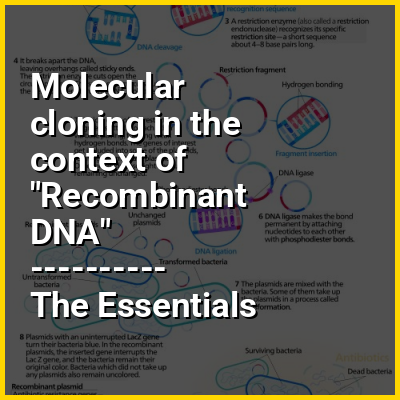
In a conventional molecular cloning experiment, the DNA to be cloned is obtained from an organism of interest, then treated with enzymes in the test tube to generate smaller DNA fragments. Subsequently, these fragments are then combined with vector DNA to generate recombinant DNA molecules. The recombinant DNA is then introduced into a host organism (typically an easy-to-grow, benign, laboratory strain of E. coli bacteria). This will generate a population of organisms in which recombinant DNA molecules are replicated along with the host DNA. Because they contain foreign DNA fragments, these are transgenic or genetically modified microorganisms (GMOs). This process takes advantage of the fact that a single bacterial cell can be induced to take up and replicate a single recombinant DNA molecule. This single cell can then be expanded exponentially to generate a large number of bacteria, each of which contains copies of the original recombinant molecule. Thus, both the resulting bacterial population, and the recombinant DNA molecule, are commonly referred to as "clones". Strictly speaking, recombinant DNA refers to DNA molecules, while molecular cloning refers to the experimental methods used to assemble them. The idea arose that different DNA sequences could be inserted into a plasmid and that these foreign sequences would be carried into bacteria and replicated as part of the plasmid. That is, these plasmids could serve as cloning vectors to carry genes.
↓ Menu

>>>PUT SHARE BUTTONS HERE<<<
In this Dossier

Molecular cloning in the context of Recombinant proteins

Recombinant DNA (rDNA) molecules are DNA molecules formed by laboratory methods of genetic recombination (such as molecular cloning) that bring together genetic material from multiple sources, creating sequences that would not otherwise be found in the genome.

Recombinant DNA is the general name for a piece of DNA that has been created by combining two or more fragments from different sources. Recombinant DNA is possible because DNA molecules from all organisms share the same chemical structure, differing only in the nucleotide sequence. Recombinant DNA molecules are sometimes called chimeric DNA because they can be made of material from two different species like the mythical chimera. rDNA technology uses palindromic sequences and leads to the production of sticky and blunt ends.

↑ Return to Menu

Molecular cloning in the context of Cloning

Cloning is the process of producing individual organisms with identical genomes, either by natural or artificial means. In nature, some organisms produce clones through asexual reproduction; this reproduction of an organism by itself without a mate is known as parthenogenesis. In the field of biotechnology, cloning is the process of creating cloned organisms of cells and of DNA fragments.

The artificial cloning of organisms, sometimes known as reproductive cloning, is often accomplished via somatic-cell nuclear transfer (SCNT), a cloning method in which a viable embryo is created from a somatic cell and an egg cell. In 1996, Dolly the sheep achieved notoriety for being the first mammal cloned from a somatic cell. Another example of artificial cloning is molecular cloning, a technique in molecular biology in which a single living cell is used to clone a large population of cells that contain identical DNA molecules.

↑ Return to Menu

Molecular cloning in the context of Vector (molecular biology)

In molecular cloning, a vector is any particle (e.g., plasmids, cosmids, Lambda phages) used as a vehicle to artificially carry a foreign nucleic sequence – usually DNA – into another cell, where it can be replicated and/or expressed. A vector containing foreign DNA is termed recombinant DNA. The four major types of vectors are plasmids, viral vectors, cosmids, and artificial chromosomes. Of these, the most commonly used vectors are plasmids. Common to all engineered vectors are the origin of replication, a multicloning site, and a selectable marker.

The vector itself generally carries a DNA sequence that consists of an insert (in this case the transgene) and a larger sequence that serves as the "backbone" of the vector. The purpose of a vector which transfers genetic information to another cell is typically to isolate, multiply, or express the insert in the target cell. All vectors may be used for cloning and are therefore cloning vectors, but there are also vectors designed specially for cloning, while others may be designed specifically for other purposes, such as transcription and protein expression. Vectors designed specifically for the expression of the transgene in the target cell are called expression vectors, and generally have a promoter sequence that drives the expression of the transgene. Simpler vectors called transcription vectors are only capable of being transcribed but not translated: they can be replicated in a target cell but not expressed, unlike expression vectors. Transcription vectors are used to amplify their insert.

↑ Return to Menu

Molecular cloning in the context of Plasmids

A plasmid is a small, extrachromosomal DNA molecule within a cell that is physically separated from chromosomal DNA and can replicate independently. They are most commonly found as small circular, double-stranded DNA molecules in bacteria and archaea; however plasmids are sometimes present in eukaryotic organisms as well. Plasmids often carry useful genes, such as those involved in antibiotic resistance, virulence, secondary metabolism and bioremediation. While chromosomes are large and contain all the essential genetic information for living under normal conditions, plasmids are usually very small and contain additional genes for special circumstances.

Artificial plasmids are widely used as vectors in molecular cloning, serving to drive the replication of recombinant DNA sequences within host organisms. In the laboratory, plasmids may be introduced into a cell via transformation. Synthetic plasmids are available for procurement over the internet by various vendors using submitted sequences typically designed with software, if a design does not work the vendor may make additional edits from the submission.

↑ Return to Menu

Molecular cloning in the context of Metagenome

Metagenomics is the study of all genetic material from all organisms in a particular environment, providing insights into their composition, diversity, and functional potential. Metagenomics has allowed researchers to profile the microbial composition of environmental and clinical samples without the need for time-consuming culture of individual species.

Metagenomics has transformed microbial ecology and evolutionary biology by uncovering previously hidden biodiversity and metabolic capabilities. As the cost of DNA sequencing continues to decline, metagenomic studies now routinely profile hundreds to thousands of samples, enabling large-scale exploration of microbial communities and their roles in health and global ecosystems.

↑ Return to Menu

Molecular cloning in the context of Zetaproteobacteria

The class Zetaproteobacteria is the sixth and most recently described class of the Pseudomonadota. Zetaproteobacteria can also refer to the group of organisms assigned to this class. The Zetaproteobacteria were originally represented by a single described species, Mariprofundus ferrooxydans, which is an iron-oxidizing neutrophilic chemolithoautotroph originally isolated from Kamaʻehuakanaloa Seamount (formerly Loihi) in 1996 (post-eruption). Molecular cloning techniques focusing on the small subunit ribosomal RNA gene have also been used to identify a more diverse majority of the Zetaproteobacteria that have as yet been unculturable.

Regardless of culturing status, the Zetaproteobacteria show up worldwide in estuarine and marine habitats associated with opposing steep redox gradients of reduced (ferrous) iron and oxygen, either as a minor detectable component or as the dominant member of the microbial community. Zetaproteobacteria have been most commonly found at deep-sea hydrothermal vents, though recent discovery of members of this class in near-shore environments has led to the reevaluation of Zetaproteobacteria distribution and significance.

↑ Return to Menu

Molecular cloning in the context of Fragmentation (cell biology)

Fragmentation describes the process of splitting into several pieces or fragments. In cell biology, fragmentation is useful for a cell during both DNA cloning and apoptosis. DNA cloning is important in asexual reproduction or creation of identical DNA molecules, and can be performed spontaneously by the cell or intentionally by laboratory researchers. Apoptosis is the programmed destruction of cells, and the DNA molecules within them, and is a highly regulated process. These two ways in which fragmentation is used in cellular processes describe normal cellular functions and common laboratory procedures performed with cells. However, problems within a cell can sometimes cause fragmentation that results in irregularities such as red blood cell fragmentation and sperm cell DNA fragmentation.

↑ Return to Menu