Mobutu Sese Seko in the context of "DRC"

Play Trivia Questions online!

or

Skip to study material about Mobutu Sese Seko in the context of "DRC"

Ad spacer

⭐ Core Definition: Mobutu Sese Seko

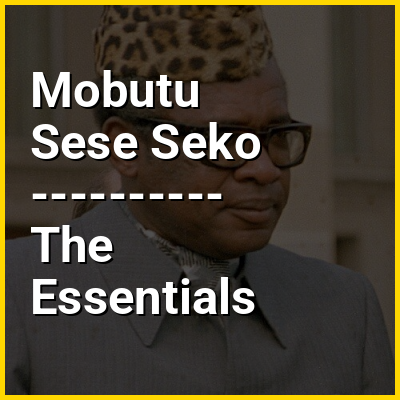
Mobutu Sese Seko Nkuku Ngbendu wa za Banga (/məˈbt ˈsɛs ˈsɛk/ mə-BOO-too SESS-ay SEK-oh; born Joseph-Désiré Mobutu; 14 October 1930 – 7 September 1997), often shortened to Mobutu Sese Seko or Mobutu and also known by his initials MSS, was a Congolese politician and military officer who was the first and only president of Zaire from 1971 to 1997. Previously, Mobutu served as the second president of the Democratic Republic of the Congo, from 1965 to 1971. He also served as the fifth chairperson of the Organisation of African Unity from 1967 to 1968. During the Congo Crisis in 1960, Mobutu, then serving as Chief of Staff of the Congolese Army, deposed the nation's democratically elected government of Patrice Lumumba with the support of the U.S. and Belgium. Mobutu installed a government that arranged for Lumumba's execution in 1961, and continued to lead the country's armed forces until he took power directly in a second coup in 1965.

To consolidate his power, he established the Popular Movement of the Revolution as the sole legal political party in 1967, changed the Congo's name to Zaire in 1971, and his own name to Mobutu Sese Seko in 1972. Mobutu protected his rule through an intensely autocratic regime and came to preside over a period of widespread human rights violations. He attempted to purge the country of all colonial cultural influence through his program of "national authenticity". Mobutu was the object of a pervasive cult of personality.
↓ Menu

>>>PUT SHARE BUTTONS HERE<<<
In this Dossier

Mobutu Sese Seko in the context of Congo Crisis

The Congo Crisis (French: Crise congolaise) was a period of political upheaval and conflict between 1960 and 1965 in the Republic of the Congo (today the Democratic Republic of the Congo). The crisis began almost immediately after the Congo became independent from Belgium and ended, unofficially, with the entire country under the rule of Joseph-Désiré Mobutu. Constituting a series of civil wars, the Congo Crisis was also a proxy conflict in the Cold War, in which the Soviet Union and the United States supported opposing factions. Around 100,000 people are believed to have been killed during the crisis.

A nationalist movement in the Belgian Congo demanded the end of colonial rule: this led to the country's independence on 30 June 1960. Minimal preparations had been made and many issues, such as federalism, tribalism, and ethnic nationalism, remained unresolved. In the first week of July, 1960, a mutiny broke out in the army and violence erupted between black and white civilians. Belgium sent troops to protect fleeing white citizens. Katanga and South Kasai seceded with Belgian support. Amid continuing unrest and violence, the United Nations deployed peacekeepers, but UN secretary-general Dag Hammarskjöld refused to use these troops to help the central government in Léopoldville (Kinshasa) fight the secessionists. Prime Minister Patrice Lumumba, the charismatic leader of the largest nationalist faction, reacted by calling for assistance from the Soviet Union, which promptly sent military advisers and other support.

↑ Return to Menu

Mobutu Sese Seko in the context of Democratic Republic of the Congo

The Democratic Republic of the Congo (DRC), also known as the DR Congo, Congo-Kinshasa, or simply the Congo, or more infrequently Zaire (its official name from 1971 to 1997), is a country in Central Africa. By land area, it is the second-largest country in Africa and the 11th-largest in the world. With a population of around 112 million, the DR Congo is the fourth-most populous in Africa and the most populous nominally Francophone country in the world. French is the official and most widely spoken language, though there are over 200 indigenous languages. The national capital and largest city is Kinshasa, which is also the economic center. The country is bordered by the Republic of the Congo, the Cabinda exclave of Angola, and the South Atlantic Ocean to the west; the Central African Republic and South Sudan to the north; Uganda, Rwanda, Burundi, and Tanzania (across Lake Tanganyika) to the east; and Zambia and Angola to the south. Centered on the Congo Basin, most of the country's terrain is covered by dense rainforests and is crossed by many rivers, while the east and southeast are mountainous.

The territory of the Congo was first inhabited by Central African foragers around 90,000 years ago and was settled in the Bantu expansion about 2,000 to 3,000 years ago. In the west, the Kingdom of Kongo ruled around the mouth of the Congo River from the 14th to the 19th century. In the center and east, the empires of Mwene Muji, Luba, and Lunda ruled between the 15th and 19th centuries. These kingdoms were broken up by Europeans during the colonization of the Congo Basin. King Leopold II of Belgium acquired rights to the Congo territory in 1885 and called it the Congo Free State. In 1908, Leopold ceded the territory after international pressure in response to widespread atrocities, and it became a Belgian colony. Congo achieved independence from Belgium in 1960 and was immediately confronted by a series of secessionist movements, the assassination of Prime Minister Patrice Lumumba, and the seizure of power by Mobutu Sese Seko in 1965. Mobutu renamed the country Zaire in 1971 and imposed a personalist dictatorship.

↑ Return to Menu

Mobutu Sese Seko in the context of Kinshasa

Kinshasa (/kɪnˈʃɑːsə/; French: [kinʃasa]; Lingala: Kinsásá), formerly named Léopoldville from 1881–1966 (Dutch: Leopoldstad), is the capital and largest city of the Democratic Republic of the Congo. Kinshasa is one of the world's fastest-growing megacities, with an estimated population of 17.8 million in 2024. It is the most densely populated city in the DRC, the third-most populous city and third-largest metropolitan area in Africa, and the world's twenty-second most populous city and fourth-most populous capital city. It is the leading economic, political, and cultural center of the DRC, housing several industries including manufacturing, telecommunications, banking, and entertainment. The city also hosts some of the DRC's significant institutional buildings, such as the People's Palace, Palace of the Nation, Court of Cassation, Constitutional Court, African Union City, Marble Palace, Martyrs Stadium, Government House, Kinshasa Financial Center, and other national departments and agencies.

The Kinshasa site has been inhabited by Teke and Humbu people for centuries and was known as Nshasa before transforming into a commercial hub during the 19th and 20th centuries. The city was named Léopoldville by Henry Morton Stanley in honor of Leopold II of Belgium. The name was changed to Kinshasa in 1966 during Mobutu Sese Seko's Zairianisation campaign as a tribute to Nshasa village. Covering 9,965 square kilometers, Kinshasa stretches along the southern shores of the Pool Malebo on the Congo River. It forms an expansive crescent across flat, low-lying terrain at an average altitude of about 300 meters. Kinshasa borders the Mai-Ndombe Province, Kwilu Province, and Kwango Province to the east; the Congo River delineates its western and northern perimeters, constituting a natural border with the Republic of the Congo; to the south lies the Kongo Central Province. Across the river sits Brazzaville, the smaller capital of the neighboring Republic of the Congo, forming the world's closest pair of capital cities despite being separated by a four-kilometer-wide unbridged span of the Congo River.

↑ Return to Menu

Mobutu Sese Seko in the context of North Kivu

North Kivu (Swahili: Jimbo la Kivu Kaskazini) is a province bordering Lake Kivu in the eastern Democratic Republic of the Congo. The capital city is Goma. Spanning approximately 59,483 square kilometers with a population estimate of 8,985,711 as of 2020, it is bordered by Ituri Province to the north, Tshopo Province to the northwest, Maniema Province to the southwest, and South Kivu Province to the south, as well as Uganda and Rwanda to the east.

North Kivu's administrative history traces back to the colonial era when it was initially part of the Stanley Falls District within the Congo Free State. Following a series of territorial reorganizations, North Kivu became incorporated into Orientale Province, with Stanleyville (modern-day Kisangani) as the provincial capital. The area gained provincial status in 1962 but was demoted to a district under Mobutu Sese Seko's regime in 1965. It was formally reinstated in 1988 under Ordinance-Law No. 88/1976 and Ordinance-Law No. 88-031, which redefined the previous Kivu Province into tripartite separate provinces: North Kivu, South Kivu, and Maniema. Presently, North Kivu comprises three cities—Goma, Butembo, and Beni—and six territories: Beni, Lubero, Masisi, Rutshuru, Nyiragongo, and Walikale. A 2013 decree also proposed city status for Kasindi, Oicha, and Luholu. The province's eastern border is home to the Rwenzori Mountains, part of the Albertine Rift, which serves as a key freshwater source and supports a diverse ecosystem. North Kivu also hosts Virunga National Park, a UNESCO World Heritage Site home to endangered mountain gorillas.

↑ Return to Menu

Mobutu Sese Seko in the context of Zaire

Zaire, officially the Republic of Zaire, was a state in central Africa from 1971 to 1997. It was, by area, the third-largest country in Africa after Sudan and Algeria, and the 11th-largest country in the world from 1965 to 1991. With a population of over 23 million, Zaire was the most populous Francophone country in Africa. Zaire was strategically important to the West during the Cold War, particularly the U.S., as a counterbalance to Soviet influence in Africa. The U.S. and its allies supported the Mobutu Regime (1965–1997) with military and economic aid to prevent the spread of communism.

The country was a one-party totalitarian military dictatorship, run by Mobutu Sese Seko and his Popular Movement of the Revolution. Zaire was established following Mobutu's seizure of power in a military coup in 1965, after five years of political upheaval following independence from Belgium known as the Congo Crisis. Zaire had a strongly centralist constitution, and foreign assets were nationalized. The period is sometimes referred to as the Second Congolese Republic.

↑ Return to Menu

Mobutu Sese Seko in the context of 1965 Democratic Republic of the Congo coup d'état

The second Mobutu coup d'état, launched on November 25, 1965, was a successful coup attempt in the Republic of the Congo (Léopoldville) by General Joseph Mobutu which overthrew President Joseph Kasa-Vubu and Prime Minister Evariste Kimba. The coup was caused by the political impasse between President Kasa-Vubu and Moïse Tshombe, which threatened to develop into a violent confrontation and destabilize the country even further. The coup was initially met with cautious approval domestically and abroad. It marked the end of the years-long Congo Crisis.

During his first coup in 1960 however, Mobutu temporarily removed Kasa-Vubu from power to "restore order" before stepping down and reinstating him. This time, Mobutu seized full power and became president himself. He then declared a state of emergency and assumed near-dictatorial powers. Though he promised to restore democracy in five years, he instead consolidated power and established an authoritarian regime that would dominate the Congo (later Zaire) for over three decades.

↑ Return to Menu

Mobutu Sese Seko in the context of Ngbandi language

The Ngbandi language is a dialect continuum of the Ubangian family spoken by a half-million or so people in the Democratic Republic of Congo (Ngbandi proper) and in the Central African Republic (Yakoma and others). It is primarily spoken by the Ngbandi people, which included the dictator of what was then known as Zaire, Mobutu Sese Seko.

↑ Return to Menu