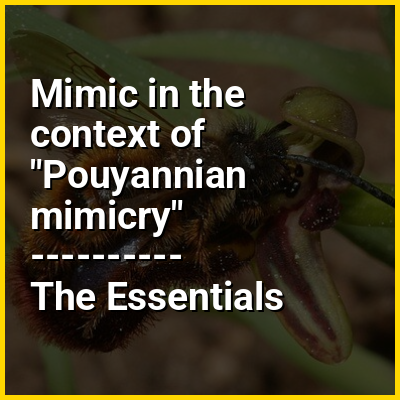
In evolutionary biology, mimicry is the evolved resemblance of an organism to something else, often another organism of a different species. Mimicry may evolve between different species, or between individuals of the same species. In the simplest case, as in Batesian mimicry, a mimic resembles a model, so as to deceive a dupe, all three being of different species. A Batesian mimic, such as a hoverfly, is harmless, while its model, such as a wasp, is harmful, and is avoided by the dupe, such as an insect-eating bird. Birds hunt by sight, so the mimicry in that case is visual, but in other cases mimicry may make use of any of the senses. Most types of mimicry, including Batesian, are deceptive, as the mimics are not harmful, but Müllerian mimicry, where different harmful species resemble each other, is honest, as when species of wasps and of bees all have genuinely aposematic warning coloration. More complex types may be bipolar, involving only two species, such as when the model and the dupe are the same; this occurs for example in aggressive mimicry, where a predator in wolf-in-sheep's-clothing style resembles its prey, allowing it to hunt undetected. Mimicry is not limited to animals; in Pouyannian mimicry, an orchid flower is the mimic, resembling a female bee, its model; the dupe is the male bee of the same species, which tries to copulate with the flower, enabling it to transfer pollen, so the mimicry is again bipolar. In automimicry, another bipolar system, model and mimic are the same, as when blue lycaenid butterflies have 'tails' or eyespots on their wings that mimic their own heads, misdirecting predator dupes to strike harmlessly. Many other types of mimicry exist.
Mimic in the context of Wasp beetle
Clytus arietis, the wasp beetle, is a wasp-mimicking longhorn beetle species in the genus Clytus belonging to the family Cerambycidae. Renowned for its mimicry of wasps, this beetle exhibits black and yellow coloration and behaviors that deter potential predators.
Measuring between 9 and 18 millimeters in length, Clytus arietis is prevalent across Europe and is typically observed from May to July. Adults are frequently found on flowers and decaying wood, where they feed on pollen. The larvae develop in dead or decaying wood, playing a role in the decomposition process. Despite their wasp-like appearance, wasp beetles are harmless to humans and contribute to the ecosystem by aiding in wood decomposition.
View the full Wikipedia page for Wasp beetleMimic in the context of Tribute act
A tribute act, tribute band, tribute group or tribute artist is a music group, singer, or musician who specifically plays the music of a well-known music act. Tribute acts include individual performers who mimic the songs and style of an artist, such as Elvis impersonators covering the works of Elvis Presley or groups like The Iron Maidens, an all-female band that pays tribute to Iron Maiden.
Many tribute bands, in addition to playing the music of an artist or group, also try to emulate the vocal styles and overall appearance of that group, to make as close an approximation as possible. Others introduce a twist on the original act; for example, Dread Zeppelin plays Led Zeppelin songs in a reggae style with a lead singer dressed up as Elvis Presley, while Gabba perform the songs of ABBA in the style of the Ramones.Tribute bands usually name themselves based on the original band's name (sometimes with a pun), or on one of their songs or albums.
View the full Wikipedia page for Tribute act