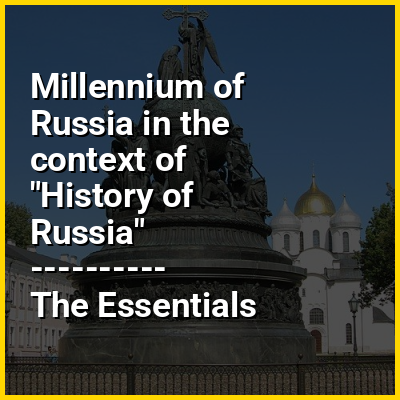
The history of Russia begins with the histories of the East Slavs. The traditional start date of specifically Russian history is the establishment of the Rus' state in the north in the year 862, ruled by Varangians. In 882, Prince Oleg of Novgorod seized Kiev, uniting the northern and southern lands of the Eastern Slavs under one authority, moving the governance center to Kiev by the end of the 10th century, and maintaining northern and southern parts with significant autonomy from each other. The state adopted Christianity from the Byzantine Empire in 988, beginning the synthesis of Byzantine, Slavic and Scandinavian cultures that defined Russian culture for the next millennium. Kievan Rus' ultimately disintegrated as a state due to the Mongol invasions in 1237–1240. After the 13th century, Moscow emerged as a significant political and cultural force, driving the unification of Russian territories. By the end of the 15th century, many of the petty principalities around Moscow had been united with the Grand Duchy of Moscow, which took full control of its own sovereignty under Ivan the Great.
Ivan the Terrible transformed the Grand Duchy into the Tsardom of Russia in 1547. However, the death of Ivan's son Feodor I without issue in 1598 created a succession crisis and led Russia into a period of chaos and civil war known as the Time of Troubles, ending with the coronation of Michael Romanov as the first Tsar of the Romanov dynasty in 1613. During the rest of the seventeenth century, Russia completed the exploration and conquest of Siberia, claiming lands as far as the Pacific Ocean by the end of the century. Domestically, Russia faced numerous uprisings of the various ethnic groups under their control, as exemplified by the Cossack leader Stenka Razin, who led a revolt in 1670–1671. In 1721, in the wake of the Great Northern War, Tsar Peter the Great renamed the state as the Russian Empire; he is also noted for establishing St. Petersburg as the new capital of his Empire, and for his introducing Western European culture to Russia. In 1762, Russia came under the control of Catherine the Great, who continued the westernizing policies of Peter the Great, and ushered in the era of the Russian Enlightenment. Catherine's grandson, Alexander I, repulsed an invasion by the French Emperor Napoleon, leading Russia into the status of one of the great powers.