Mieszko I in the context of "Republic of Poland"

Play Trivia Questions online!

or

Skip to study material about Mieszko I in the context of "Republic of Poland"

Ad spacer

⭐ Core Definition: Mieszko I

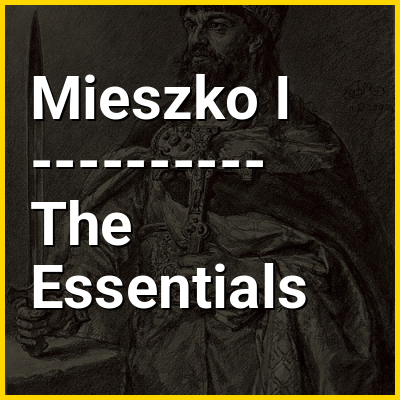
Mieszko I (Polish pronunciation: [ˈmjɛʂkɔ ˈpjɛrfʂɨ] ; c. 930 – 25 May 992) was Duke of Poland from 960 until his death in 992 and the founder of the first unified Polish state, the Civitas Schinesghe. A member of the Piast dynasty, he was the first Christian ruler of Poland and continued the policies of both his father Siemomysł and his grandfather Lestek, who initiated a process of unification among the Polish tribes and the creation of statehood.

According to existing sources, Mieszko I was a potent politician, a talented military leader and a charismatic ruler. Through both alliances and military force, he extended ongoing Polish conquests. Early in his reign, he subjugated Kuyavia and likely Gdańsk Pomerania and Masovia. For most of his reign, Mieszko I waged war for control of Western Pomerania. He eventually annexed it to the vicinity of the lower Oder River. His internal reforms were aimed at expanding and improving the so-called war monarchy system. During the last years of his life, he fought the Bohemian state and captured Silesia and lands now constituting Lesser Poland.
↓ Menu

>>>PUT SHARE BUTTONS HERE<<<
In this Dossier

Mieszko I in the context of Poland

Poland, officially the Republic of Poland, is a country in Central Europe. It extends from the Baltic Sea in the north to the Sudetes and Carpathian Mountains in the south, and borders Lithuania and Russia to the northeast; Belarus and Ukraine to the east; Slovakia and the Czech Republic to the south; and Germany to the west. The territory has a varied landscape, diverse ecosystems, and a temperate climate. Poland is composed of sixteen voivodeships and is the fifth most populous member state of the European Union (EU), with over 38 million people, and the fifth largest EU country by land area, covering 312,696 km (120,733 sq mi). The capital and largest city is Warsaw; other major cities include Kraków, Wrocław, Łódź, Poznań, and Gdańsk.

Prehistoric human activity on Polish soil dates to the Lower Paleolithic, with continuous settlement since the end of the Last Glacial Period. Culturally diverse throughout late antiquity, in the early medieval period the region became inhabited by the West Slavic tribal Polans, who gave Poland its name. The process of establishing statehood coincided with the conversion of a pagan ruler of the Polans to Christianity in 966. Under the auspices of the Roman Catholic Church, the dominion became part of the Western world. In 1025, the Kingdom of Poland emerged, and in 1569 it cemented its long-standing association with Lithuania, forming the Polish–Lithuanian Commonwealth. At the time, the Commonwealth was one of Europe's great powers, with an elective monarchy and a uniquely liberal political system. It adopted Europe's first modern constitution in 1791.

↑ Return to Menu

Mieszko I in the context of List of Polish rulers

Poland was ruled at various times either by dukes and princes (10th to 14th centuries) or by kings (11th to 18th centuries). During the latter period, a tradition of free election of monarchs made it a uniquely electable position in Europe (16th to 18th centuries).

The first Polish ruler whose existence is not debatable was Duke Mieszko I, who adopted Christianity under the authority of Rome in the year 966. He was succeeded by his son, Bolesław I the Brave, who greatly expanded the boundaries of the Polish state and ruled as the first king in 1025. The following centuries gave rise to the mighty Piast dynasty, consisting of both kings such as Mieszko II Lambert, Przemysł II or Władysław I the Elbow-high and dukes like Bolesław III Wrymouth. The dynasty's rule over Poland ceased with the death of Casimir III the Great in 1370. In the same year, the Capetian House of Anjou became the ruling house with Louis I as king of both Poland and Hungary. His daughter, Jadwiga, later married Jogaila, the pagan Grand Duke of Lithuania, who in 1386 was baptized and crowned as Władysław II Jagiełło, thus creating the Jagiellonian dynasty and a personal union between Poland and Lithuania.

↑ Return to Menu

Mieszko I in the context of Lechites

Lechites (Polish: Lechici, German: Lechiten), also known as the Lechitic tribes (Polish: Plemiona lechickie, German: Lechitische Stämme), is a name given to certain West Slavic tribes who inhabited modern-day Poland and eastern Germany, and were speakers of the Lechitic languages. Distinct from the Czech–Slovak subgroup, they are the closest ancestors of ethnic Poles and of Pomeranians, Lusatians and Polabians.

↑ Return to Menu

Mieszko I in the context of Old Prussians

Old Prussians, Baltic Prussians or simply Prussians were a Baltic people that inhabited the region of Prussia, on the southeastern shore of the Baltic Sea between the Vistula Lagoon to the west and the Curonian Lagoon to the east. As Balts, they spoke an Indo-European language of the Baltic branch now known as Old Prussian and worshipped pre-Christian deities. Their ethnonym was later adopted by predominantly Low German-speaking inhabitants of the region.

The duchy of the Polans under Mieszko I, which was the predecessor of the Kingdom of Poland, first attempted to conquer and baptize the Baltic tribes during the 10th century, but repeatedly encountered strong resistance. Not until the 13th century were the Old Prussians subjugated and their lands conquered by the Teutonic Order. The remaining Old Prussians were assimilated during the following two centuries. The Old Prussian language, documented only in a limited way, was effectively extinct by the 18th century.

↑ Return to Menu

Mieszko I in the context of Siemomysł

Siemomysł or Ziemomysł (c. 910c. 960) was the third duke of the Polans and the father of Poland's first Christian ruler, Mieszko I. A member of the Piast dynasty, he was listed by Gallus Anonymous in his Gesta principum Polonorum as the son of Lestek, the second known duke of the Polans. According to Gallus' account and historical research, Siemomysł has been credited with leaving the lands of the Polans, Goplans and Masovians to his son Mieszko I, who further expanded them during his reign.

↑ Return to Menu