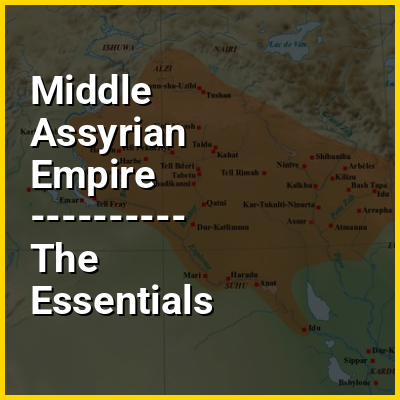
The Middle Assyrian Empire was the third stage of Assyrian history, covering the history of Assyria from the accession of Ashur-uballit I c. 1363 BC and the rise of Assyria as a territorial kingdom to the death of Ashur-dan II in 912 BC. The Middle Assyrian Empire was Assyria's first period of ascendancy as an empire. Though the empire experienced successive periods of expansion and decline, it remained the dominant power of northern Mesopotamia throughout the period. In terms of Assyrian history, the Middle Assyrian period was marked by important social, political and religious developments, including the rising prominence of both the Assyrian king and the Assyrian national deity Ashur.
The Middle Assyrian Empire was founded through Assur, a city-state through most of the preceding Old Assyrian period, and the surrounding territories achieving independence from the Mitanni kingdom. Under Ashur-uballit, Assyria began to expand and assert its place as one of the great powers of the Ancient Near East. This aspiration chiefly came into fruition through the efforts of the kings Adad-nirari I (r. c. 1305–1274 BC), Shalmaneser I (r. c. 1273–1244 BC) and Tukulti-Ninurta I (r. c. 1243–1207 BC), under whom Assyria expanded to for a time become the dominant power in Mesopotamia. The reign of Tukulti-Ninurta I marked the height of the Middle Assyrian Empire and included the subjugation of Babylonia and the foundation of a new capital city, Kar-Tukulti-Ninurta, though it was abandoned after his death. Though Assyria was left largely unscathed by the direct effects of the Late Bronze Age collapse of the 12th century BC, the Middle Assyrian Empire began to experience a significant period of decline roughly at the same time. The assassination of Tukulti-Ninurta I c. 1207 BC led to inter-dynastic conflict and a significant drop in Assyrian power.