Microcosm–macrocosm analogy in the context of "Hindu temple"

Play Trivia Questions online!

or

Skip to study material about Microcosm–macrocosm analogy in the context of "Hindu temple"

Ad spacer

⭐ Core Definition: Microcosm–macrocosm analogy

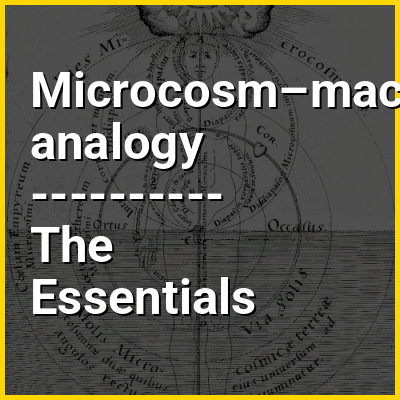
The microcosm–macrocosm analogy (or, equivalently, macrocosm–microcosm analogy) refers to a historical view that posited a structural similarity between the human being (the microcosm, i.e., the small order or the small universe) and the cosmos as a whole (the macrocosm, i.e., the great order or the great universe). Given this fundamental analogy, truths about the nature of the cosmos as a whole may be inferred from truths about human nature, and vice versa.

One important corollary of this view is that the cosmos as a whole may be considered to be alive, and thus to have a mind or soul (the world soul), a position advanced by Plato in his Timaeus. Moreover, this cosmic mind or soul was often thought to be divine, most notably by the Stoics and those who were influenced by them, such as the authors of the Hermetica. Hence, it was sometimes inferred that the human mind or soul was divine in nature as well.
↓ Menu

>>>PUT SHARE BUTTONS HERE<<<
In this Dossier

Microcosm–macrocosm analogy in the context of Mandir

A Hindu temple, also known as a Mandir, Devasthanam, Pura, Kshetram or Kovil, is a sacred place where Hindus worship and show their devotion to deities through worship, sacrifice, and prayers. It is considered the house of the god to whom it is dedicated. Hindu temple architecture, which makes extensive use of squares and circles, has its roots in later Vedic traditions, which also influence the temples' construction and symbolism. Through astronomical numbers and particular alignments connected to the temple's location and the relationship between the deity and the worshipper, the temple's design also illustrates the idea of recursion and the equivalency of the macrocosm and the microcosm. A temple incorporates all elements of the Hindu cosmos—presenting the good, the evil and the human, as well as the elements of the Hindu sense of cyclic time and the essence of life—symbolically presenting dharma, artha, kama, moksha, and karma.

The spiritual principles symbolically represented in Hindu temples are detailed in the ancient later Vedic texts, while their structural rules are described in various ancient Sanskrit treatises on architecture (Bṛhat Saṃhitā, Vāstu Śāstras). The layout, motifs, plan, and the building process recite ancient rituals and geometric symbolism, and reflect beliefs and values innate within various schools of Hinduism. A Hindu temple is a spiritual destination for many Hindus, as well as landmarks around which ancient arts, community celebrations and the economy have flourished.

↑ Return to Menu

Microcosm–macrocosm analogy in the context of Languages of Nigeria

There are over 520 native languages spoken in Nigeria. The official language is English, which was the language of Colonial Nigeria. The English-based creole Nigerian Pidgin – first used by the British and African slavers to facilitate the Atlantic slave trade in the late 17th century – is the most common lingua franca, spoken by over 60 million people.

The most commonly spoken native languages are Hausa (over 63 million when including second-language, or L2, speakers), Yoruba (over 47 million, including L2 speakers), Igbo (over 46 million, including L2 speakers), Ibibio (over 10 million, including L2 speakers), Ijaw cluster (over 5 million), Fulfulde (18 million), Kanuri (7.6 million), Tiv (5 million), and approximately 2 to 3 million each of Nupe, Karai-Karai, Kupa, Kakanda, Edo, Igala, Mafa, Idoma and Efik. Nigeria's linguistic diversity is a microcosm of much of Africa as a whole, and the country contains languages from the three major African language families: Afroasiatic, Nilo-Saharan and Niger-Congo. Nigeria also has several as-yet unclassified languages, such as Centúúm, which may represent a relic of an even greater diversity before the spread of the current language families.

↑ Return to Menu