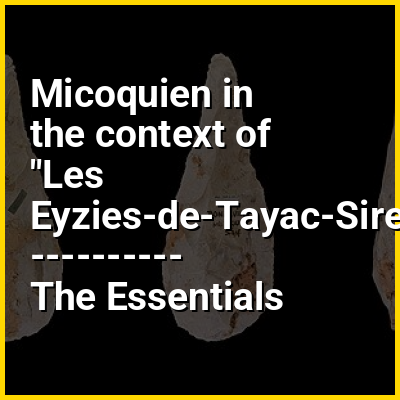
The Prehistoric Sites and Decorated Caves of the Vézère Valley is a UNESCO World Heritage Site in France since 1979. It specifically lists 15 prehistoric sites in the Vézère valley in the Dordogne department, mostly in and around Les Eyzies-de-Tayac-Sireuil, which has been called the "Capital of Prehistory". This valley is exceptionally rich in prehistoric sites, with more than 150 known sites including 25 decorated caves, and has played an essential role in the study of the Paleolithic era and its art. Three of the sites are the namesakes for prehistoric periods; the Micoquien (named after La Micoque), Mousterian (after Le Moustier), and Magdalenian (after Abri de la Madeleine). Furthermore, the Cro-Magnon rock shelter gave its name to the Cro-Magnon, the generic name for the European early modern humans. Many of the sites were discovered or first recognised as significant and scientifically explored by the archaeologists Henri Breuil and Denis Peyrony in the early twentieth century, while Lascaux, which has the most exceptional rock art of these, was discovered in 1940.
The decorated caves in the region were instrumental in ending the debate about the nature of prehistoric art, which was still considered by many to be modern fakes. The late 19th century discoveries of first the Chabot cave (in 1879), Cave of Altamira (in 1880) and Pair-non-Pair (in 1881) were widely discussed, but no definite proof of their ancient origin was generally accepted. The cave of La Mouthe was the first cave in the Vézère region where decorations were discovered, but only with the double discoveries at Font-de-Gaume and Les Combarelles in 1901 was the debate finally settled.
View the full Wikipedia page for Prehistoric Sites and Decorated Caves of the Vézère Valley