Meskwaki in the context of "Indian reservations"

Play Trivia Questions online!

or

Skip to study material about Meskwaki in the context of "Indian reservations"

Ad spacer

⭐ Core Definition: Meskwaki

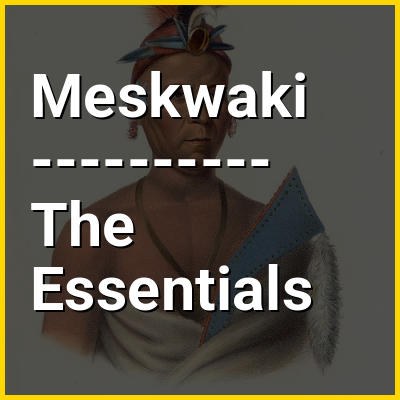
The Meskwaki (sometimes spelled Mesquaki), also known by the European exonyms Fox Indians or the Fox, are a Native American people. They have been closely linked to the Sauk (Sac) people of the same language family. In the Meskwaki language, the Meskwaki call themselves Meshkwahkihaki, which means "the Red-Earths", related to their creation story.

The Meskwaki suffered damaging wars with the French and their Native American allies in the early 18th century, with one in 1730 decimating the tribe. Euro-American colonization and settlement proceeded in the United States during the 19th century and forced the Meskwaki south and west into the tallgrass prairie in the American Midwest. In 1851 the Iowa state legislature passed an unusual act to allow the Meskwaki to buy land and stay in the state. Other Sauk and Meskwaki were removed to Indian territory in what became Kansas, Oklahoma and Nebraska. In the 21st century, two federally recognized tribes of "Sac and Fox" have reservations, and one has a settlement.
↓ Menu

>>>PUT SHARE BUTTONS HERE<<<
In this Dossier

Meskwaki in the context of Sauk people

The Sauk or Sac (Sauk: Thâkîwaki) are Native Americans and Indigenous peoples of the Northeastern Woodlands. Their historical territory was near Green Bay, Wisconsin. Today they have three tribes based in Iowa, Kansas, Nebraska, and Oklahoma. Their federally recognized tribes are:

They are closely allied with the Meskwaki people. Their Sauk language is part of the Algonquian language family.

↑ Return to Menu

Meskwaki in the context of Meskwaki language

Fox (known by a variety of different names, including Mesquakie (Meskwaki), Mesquakie-Sauk, Mesquakie-Sauk-Kickapoo, Sauk-Fox, and Sac and Fox) is an Algonquian language, spoken by a thousand Meskwaki, Sauk, and Kickapoo in various locations in the Midwestern United States and in northern Mexico.

↑ Return to Menu

Meskwaki in the context of Sac and Fox Nation

The Sac and Fox Nation (Sauk language: Thâkîwaki) is the largest of three federally recognized tribes of Sauk and Meskwaki (Fox) Indian peoples. They are based in central Oklahoma.

Originally from the Lake Huron and Lake Michigan area, they were forcibly relocated to Oklahoma in the 1870s and are predominantly Sauk. The Sac and Fox Oklahoma Tribal Statistical Area (OTSA) is the land base in Oklahoma governed by the tribe.

↑ Return to Menu

Meskwaki in the context of Fort Pontchartrain du Détroit

Fort Pontchartrain du Détroit or Fort Detroit (1701–1796) was a French and later British fortification established in 1701 on the north side of the Detroit River by Antoine Laumet de Lamothe Cadillac. A settlement based on the fur trade, farming and missionary work slowly developed in the area. The fort was located in what is now downtown Detroit, northeast of the intersection of Washington Boulevard and West Jefferson Avenue.

Fort Pontchartrain du Détroit was attacked by the Meskwaki during the Fox Wars, and was the target of an aborted attack by English-aligned Wyandot during King George's War. During the French and Indian War, Fort Pontchartrain du Détroit surrendered to the British on November 29, 1760 after the capture of Montreal. It was besieged by Indigenous forces during Pontiac's War in 1763. The British controlled the area throughout the American Revolutionary War, but replaced the French fort with the newly constructed Fort Lernoult in 1779. While the territory on what is now the Michigan side of the Detroit River was ceded to the United States in the Treaty of Paris in 1783, control of the fort was not transferred until 1796, after the Jay Treaty.

↑ Return to Menu

Meskwaki in the context of Sac and Fox Nation of Missouri in Kansas and Nebraska

The Sac and Fox Nation of Missouri in Kansas and Nebraska is one of three federally recognized Native American tribes of Sauk and Meskwaki (Fox) peoples. Their name for themselves is Nemahahaki (Meskwaki: Nîmahâhaki) and they are an Algonquian people and Eastern Woodland culture.

↑ Return to Menu

Meskwaki in the context of Sac and Fox Tribe of the Mississippi in Iowa

The Sac and Fox Tribe of the Mississippi in Iowa is one of three federally recognized Native American tribes of Sac and Meskwaki (Fox) peoples in the United States. The Fox call themselves Meskwaki and because they are the dominant people in this tribe, it is also simply called the Meskwaki Nation (Meskwaki: Meshkwahkîhaki, meaning: "People of the red earth"). The Sauk people call themselves Êshkwîha (literally: "Fox people") or Yochikwîka, both with the meaning "Northern Sauk". They are Algonquian peoples, historically developed in the Eastern Woodland culture. The settlement, called Meskwakiinaki, is located in Tama County, Iowa.

↑ Return to Menu

Meskwaki in the context of Black Hawk War

The Black Hawk War was a conflict between the United States and Native Americans led by Black Hawk, a Sauk leader. The war erupted after Black Hawk and a group of Sauks, Meskwakis (Fox), and Kickapoos, known as the "British Band", crossed the Mississippi River, to the U.S. state of Illinois, from Iowa Indian Territory in April 1832. Black Hawk's motives were ambiguous, but he was apparently hoping to reclaim land that was taken over by the United States in the disputed 1804 Treaty of St. Louis.

U.S. officials, convinced that the British Band was hostile, mobilized a frontier militia and opened fire on a delegation from the Native Americans on May 14, 1832. Black Hawk responded by successfully attacking the militia at the Battle of Stillman's Run. He led his band to a secure location in what is now southern Wisconsin and was pursued by U.S. forces. Meanwhile, other Native Americans conducted raids against forts and colonies largely unprotected with the absence of the militia. Some Ho-Chunk and Potawatomi warriors took part in these raids, although most tribe members tried to avoid the conflict. The Menominee and Dakota tribes, already at odds with the Sauks and Meskwakis, supported the United States.

↑ Return to Menu

Meskwaki in the context of Ho-Chunk

The Ho-Chunk, also known as Hoocąk, Hoocągra, or Winnebago are a Siouan-speaking Native American people whose historic territory includes parts of Wisconsin, Minnesota, Iowa, and Illinois. Today, Ho-Chunk people are enrolled in two federally recognized tribes: the Ho-Chunk Nation of Wisconsin and the Winnebago Tribe of Nebraska.

In the Late Woodland Period (650–1200 CE), precontact Ho-Chunks built thousands of effigy mounds in Wisconsin and surrounding states. They are successors to the Oneota culture. Prior to the arrival of Europeans, the Ho-Chunk were the dominant tribe in its territory in the 16th century, with a population estimated at several thousand. They lived in permanent villages of wigwams and cultivated corn, squash, beans, wild rice. They hunted wild animals, and fished from canoes. The name Ho-Chunk comes from the word Hoocąk and "Hoocąkra" (Ho meaning "voice", cąk meaning "sacred", ra being a definite article), meaning "People of the Sacred Voice". Their name comes from oral history that state they are the originators of the many branches of the Siouan language. The Ho-Chunk have 12 clans, each with specific roles. Wars with the Illinois Confederacy and later wars with the Ojibwe, Potawatomi, Meskwaki, and Sauk peoples pushed them out of their territories in eastern Wisconsin and Illinois, along with conflicts with the United States such as Winnebago War and Black Hawk War. The Ho-Chunk suffered severe population loss in the 17th century to a low of perhaps 500 individuals. This has been attributed to casualties of a lake storm, epidemics of infectious disease, and competition for resources from migrating Algonquian tribes. By the early 19th century, their population had increased to 2,900, but they suffered further losses in the smallpox epidemic of 1836. In 1990 they numbered 7,000; current estimates of total population of the two tribes are 12,000.

↑ Return to Menu