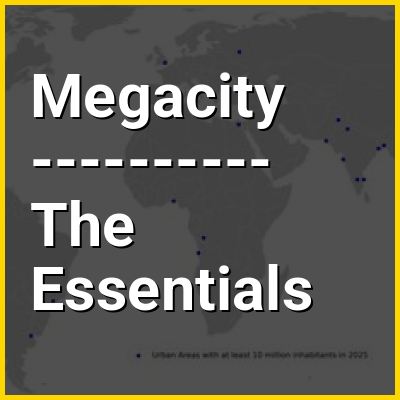
A megacity is a very large city, typically with a population of more than 10 million people. The United Nations Department of Economic and Social Affairs (UN DESA) in its "World Urbanization Prospects" report defines megacities as urban agglomerations with over 10 million inhabitants. A University of Bonn report holds that they are "usually defined as metropolitan areas with a total population of 10 million or more people". Elsewhere in other sources, from five to eight million is considered the minimum threshold, along with a population density of at least 2,000 per square kilometre. The terms conurbation, metropolis, and metroplex are also applied to the latter.
The total number of megacities in the world varies between different sources and their publication dates. The world had 32 according to EU Global Human Settlement Layer (in 2024), 33 according to UN DESA (in 2025), 39 according to the OECD, 42 according to Demographia (in 2025), and 45 according to CityPopulation.de (in 2023). The later two add 13 additional cities that are calculated outside the range otherwise. In total, at most 53 unique places are mentioned as megacities across these sources, although some of these are just agglomerated differently between them. A good percentage of these urban agglomerations are in China and India. The other three-to-five countries with more than one megacity are Brazil, Indonesia, Japan, Pakistan, and the United States. African megacities are present in Angola, Democratic Republic of the Congo, Egypt, Nigeria and South Africa; European megacities are present in France, Germany, Russia, the United Kingdom, and Turkey (also in Asia); megacities can be found in Latin America in the countries of Brazil, Mexico, Colombia, Peru, and Argentina.