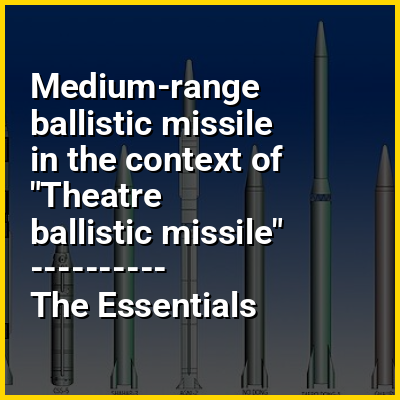
A medium-range ballistic missile (MRBM) is a type of ballistic missile with medium range, this last classification depending on the standards of certain organizations. Within the U.S. Department of Defense, a medium-range missile is defined by having a maximum range of between 1,000 and 3,000 kilometres (620 and 1,860 mi). In modern terminology, MRBMs are part of the wider grouping of theatre ballistic missiles, which includes any ballistic missile with a range of less than 3,500 kilometres (2,200 mi). Roughly speaking, MRBM covers the ranges over SRBM (tactical) and under IRBM.
HINT:
In this Dossier
- ⭐ Core Definition: Medium-range ballistic missile
- Medium-range ballistic missile in the context of PGM-19 Jupiter
- Medium-range ballistic missile in the context of Israel and nuclear power
- Medium-range ballistic missile in the context of Strategic Rocket Forces
- Medium-range ballistic missile in the context of Juno I
- Medium-range ballistic missile in the context of Missile silo
- Medium-range ballistic missile in the context of Intermediate-range ballistic missile
- Medium-range ballistic missile in the context of Pre-emptive nuclear strike
- Medium-range ballistic missile in the context of JL-1 (air-launched ballistic missile)
Medium-range ballistic missile in the context of PGM-19 Jupiter
The PGM-19 Jupiter was the first nuclear armed, medium-range ballistic missile (MRBM) of the United States Air Force (USAF). It was a liquid-propellant rocket using RP-1 fuel and LOX oxidizer, with a single Rocketdyne LR79-NA (model S-3D) rocket engine producing 150,000 lbf (670 kN) of thrust. It was armed with the 1.44 Mt (6.0 PJ) W49 nuclear warhead. The prime contractor was the Chrysler Corporation.
The Jupiter was originally designed by the US Army, which was looking for a highly accurate missile designed to strike enemy states such as China and the Soviet Union. The US Navy also expressed an interest in the design as an SLBM but left the collaboration to work on their solid-fuel Polaris. Jupiter retained the short, squat shape intended to fit in submarines.
View the full Wikipedia page for PGM-19 JupiterMedium-range ballistic missile in the context of Israel and nuclear power
Israel is widely believed to possess nuclear weapons. Estimates of Israel's stockpile range from 90 to 400 warheads, and the country is believed to possess a nuclear triad of delivery options: by F-15 and F-16 fighters, by Dolphin-class submarine-launched cruise missiles, and by the Jericho series of medium to intercontinental range ballistic missiles. Its first deliverable nuclear weapon is estimated to have been completed in late 1966 or early 1967, which would make it the sixth of nine nuclear-armed countries.
Israel maintains a policy of deliberate ambiguity, neither formally denying nor admitting to having nuclear weapons, instead repeating over the years that "Israel will not be the first country to introduce nuclear weapons to the Middle East". Israel interprets "introduce" to mean it will not test or formally acknowledge its nuclear arsenal. Western governments, including the United States, similarly do not acknowledge the Israeli capacity. Israeli officials, including prime ministers, have made statements that seemed to imply that Israel possesses nuclear weapons, including discussions of use in the Gaza war.
View the full Wikipedia page for Israel and nuclear powerMedium-range ballistic missile in the context of Strategic Rocket Forces
The Strategic Rocket Forces of the Russian Federation (RVSN RF) is a separate combat arm of the Russian Armed Forces that controls Russia's land-based intercontinental ballistic missiles (ICBMs). It was formerly part of the Soviet Armed Forces from 1959 to 1991.
The Strategic Rocket Forces was created on 17 December 1959 as part of the Soviet Armed Forces as the main force for operating all Soviet nuclear ground-based intercontinental, intermediate-range ballistic missile, and medium-range ballistic missile with ranges over 1,000 kilometers. After the Soviet Union collapsed in 1991, assets of the Strategic Rocket Forces were in the territories of several new states in addition to Russia, with armed nuclear missile silos in Belarus, Kazakhstan and Ukraine. On 8 December 1991 according to Belovezha Accords, which dissolved the Soviet Union, the other 3 nuclear member states transferred Soviet missiles on their territory to Russia and they all joined the Nuclear Non-Proliferation Treaty.
View the full Wikipedia page for Strategic Rocket ForcesMedium-range ballistic missile in the context of Juno I
The Juno I was a four-stage American space launch vehicle, used to launch lightweight payloads into low Earth orbit. The launch vehicle was used between January 1958 to December 1959. The launch vehicle is a member of the Redstone launch vehicle family, and was derived from the Jupiter-C sounding rocket. It is commonly confused with the Juno II launch vehicle, which was derived from the PGM-19 Jupiter medium-range ballistic missile. In 1958, a Juno I launch vehicle was used to launch America's first satellite, Explorer 1.
View the full Wikipedia page for Juno IMedium-range ballistic missile in the context of Missile silo
A missile launch facility, also known as an underground missile silo, launch facility (LF), or nuclear silo, is a vertical cylindrical structure constructed underground, for the storage and launching of intercontinental ballistic missiles (ICBMs), intermediate-range ballistic missiles (IRBMs), or medium-range ballistic missiles (MRBMs). Similar facilities can be used for anti-ballistic missiles (ABMs).
The structures typically have the missile some distance below ground, protected by a large "blast door" on top. They are usually connected, physically and/or electronically, to a missile launch control center.
View the full Wikipedia page for Missile siloMedium-range ballistic missile in the context of Intermediate-range ballistic missile
An intermediate-range ballistic missile (IRBM) is a ballistic missile with a range between 3,000 to 5,500 km (1,864 to 3,418 miles), categorized between a medium-range ballistic missile (MRBM) and an intercontinental ballistic missile (ICBM). Classifying ballistic missiles by range is done mostly for convenience. In principle there is little difference between a high-performance IRBM and a low-performance ICBM, because decreasing payload mass can increase the range over the ICBM threshold. The range definition used here is used within the U.S. Missile Defense Agency.
View the full Wikipedia page for Intermediate-range ballistic missileMedium-range ballistic missile in the context of Pre-emptive nuclear strike
In nuclear strategy, a first strike or preemptive strike is a preemptive surprise attack employing overwhelming force. First strike capability is an attacking country's ability to significantly cripple another nuclear power's second strike retaliatory capacity. The preferred methodology is to attack the opponent's strategic nuclear weapon facilities (missile silos, submarine bases, bomber airfields), command and control sites (a decapitation strike), and storage depots first. The strategy is called counterforce.
During the 1950s, first strike strategy required strategic bomber sorties taking place over hours and days. In the 1960s, the deployment of intercontinental ballistic missiles cut the first strike duration to 30 minutes. Also during the Cold War, medium- and intermediate-range ballistic missiles, such as those involved in the Cuban Missile Crisis and Euromissile Crisis, as well as submarine-launched ballistic missiles, reduced the time even further, often below 10 minutes.
View the full Wikipedia page for Pre-emptive nuclear strikeMedium-range ballistic missile in the context of JL-1 (air-launched ballistic missile)
The JL-1 (Chinese: 惊雷-1; pinyin: Jīng Léi-Yī; lit. 'thunderclap-1') is a Chinese nuclear-capable air-launched ballistic missile (ALBM); designed to be carried by the People's Liberation Army Air Force's Xi'an H-6N strategic bombers and launched as a standoff weapon, forming part of China's nuclear triad.
The JL-1 missile was first unveiled at the 2025 China Victory Day Parade. Analysts believed the JL-1 is an air-launched missile variant of the DF-21 medium-range ballistic missile, previously known as the KF-21 or by its NATO designation: CH-AS-X-13. The KF-21 was reportedly to serve a nuclear strike or anti-ship role, and is a two-stage missile with a range of 3,000 km (1,900 mi). It was in development by 2018, and the United States projected it would be ready for deployment by 2025. However, during its official reveal, the missile was reported to have a range of 8,000 km (5,000 mi), which is significantly longer than both DF-21 and DF-26, making it an intercontinental ballistic missile. The missile's longer range may have benefited from the speed of its launch aircraft, thus having a much greater range than its ground-launched counterparts.
View the full Wikipedia page for JL-1 (air-launched ballistic missile)