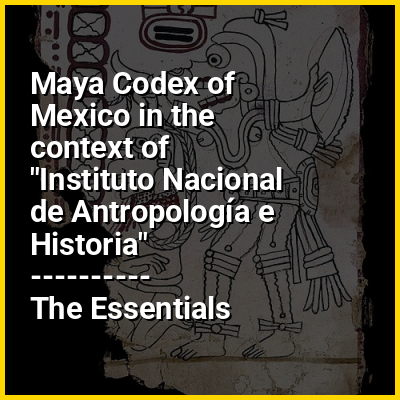
The Maya Codex of Mexico (MCM) is a Maya screenfold codex manuscript of a pre-Columbian type. Long known as the Grolier Codex or Sáenz Codex, in 2018 it was officially renamed the Códice Maya de México (CMM) by the National Institute of Anthropology and History of Mexico. It is one of only four known extant Maya codices, and the only one that still resides in the Americas.
The MCM first appeared in a private collection in the 1960s and was shown at "The Maya Scribe and His World", an exhibition held at the Grolier Club in New York City in 1971, hence its original name. An almanac that charts the movements of the planet Venus, it originally consisted of twenty pages; the first eight and the last two are now missing. Folio 8 has the tallest fragment, measuring 19 centimeters (7.5 in), and its pages are typically 12.5 centimeters (4.9 in) wide. The red frame lines at the bottom of pages four through eight indicates that the dimensions were once substantially taller, and that the scribe prepared a space for text under the figure on each page. Accordingly, the manuscript would once have measured 250 centimeters (98.4 in), roughly the size of the Dresden Codex.