Mathematical objects in the context of "Abstract concept"

Play Trivia Questions online!

or

Skip to study material about Mathematical objects in the context of "Abstract concept"


⭐ Core Definition: Mathematical objects

A mathematical object is an abstract concept arising in mathematics. Typically, a mathematical object can be a value that can be assigned to a symbol, and therefore can be involved in formulas. Commonly encountered mathematical objects include numbers, expressions, shapes, functions, and sets. Mathematical objects can be very complex; for example, theorems, proofs, and even formal theories are considered as mathematical objects in proof theory.

In philosophy of mathematics, the concept of "mathematical objects" touches on topics of existence, identity, and the nature of reality. In metaphysics, objects are often considered entities that possess properties and can stand in various relations to one another. Philosophers debate whether mathematical objects have an independent existence outside of human thought (realism), or if their existence is dependent on mental constructs or language (idealism and nominalism). Objects can range from the concrete: such as physical objects usually studied in applied mathematics, to the abstract, studied in pure mathematics. What constitutes an "object" is foundational to many areas of philosophy, from ontology (the study of being) to epistemology (the study of knowledge). In mathematics, objects are often seen as entities that exist independently of the physical world, raising questions about their ontological status. There are varying schools of thought which offer different perspectives on the matter, and many famous mathematicians and philosophers each have differing opinions on which is more correct.

↓ Menu

In this Dossier

Mathematical objects in the context of Metaphysics (Aristotle)

Metaphysics (Greek: των μετὰ τὰ φυσικά, "those after the physics"; Latin: Metaphysica) is one of the principal works of Aristotle, in which he develops the doctrine that he calls First Philosophy. The work is a compilation of various texts treating abstract subjects, notably substance theory, different kinds of causation, form and matter, the existence of mathematical objects and the cosmos, which together constitute much of the branch of philosophy later known as metaphysics.

↑ Return to Menu

Mathematical objects in the context of Matrix (mathematics)

In mathematics, a matrix (pl.: matrices) is a rectangular array of numbers or other mathematical objects with elements or entries arranged in rows and columns, usually satisfying certain properties of addition and multiplication.

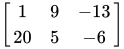
For example, denotes a matrix with two rows and three columns. This is often referred to as a "two-by-three matrix", a 2 × 3 matrix, or a matrix of dimension 2 × 3.

↑ Return to Menu

Mathematical objects in the context of Mental world

The mental world or mindscape is an ontological category in metaphysics, populated by nonmaterial mental objects, without physical extension (though possibly with mental extension as in a visual field, or possibly not, as in an olfactory field) contrasted with the physical world of space and time populated with physical objects, or Plato's world of ideals populated, in part, with mathematical objects.

↑ Return to Menu