Mary II in the context of "James II of England"

Play Trivia Questions online!

or

Skip to study material about Mary II in the context of "James II of England"

Ad spacer

⭐ Core Definition: Mary II

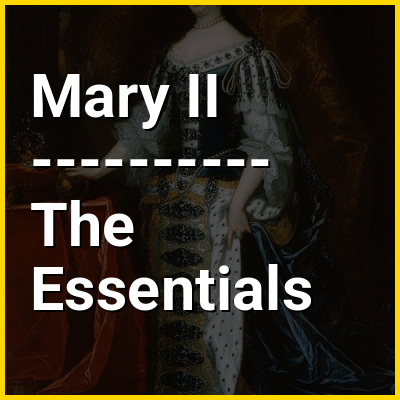
Mary II (30 April 1662 – 28 December 1694) was Queen of England, Scotland, and Ireland with her husband, King William III and II, from 1689 until her death in 1694. She was also Princess of Orange following her marriage on 4 November 1677. Her joint reign with William over Britain is known as that of William and Mary.

Mary was born during the reign of her uncle King Charles II. She was the eldest daughter of James, Duke of York (the future James II of England), and his first wife, Anne Hyde. Mary and her sister Anne were raised as Anglicans at the behest of Charles II, although their parents both converted to Roman Catholicism. Charles lacked legitimate children, making Mary second in the line of succession. At the age of 15, she married her cousin William of Orange, a Protestant. Charles died in 1685 and James became king, making Mary heir presumptive. James's attempts at rule by decree and the birth of his son from a second marriage, James Francis Edward (later known as "the Old Pretender"), led to his deposition in the Glorious Revolution of 1688 and the adoption of the English Bill of Rights.
↓ Menu

>>>PUT SHARE BUTTONS HERE<<<
In this Dossier

Mary II in the context of Glorious Revolution

The Glorious Revolution, also known as the Revolution of 1688, was the deposition of King James II Stuart (James II of England and Ireland and James VII of Scotland) in November 1688. He was replaced by his daughter Mary II and her Dutch husband, stadtholder William III of Orange (William III and II), a nephew of James who thereby had an interest to the throne irrespective of his marriage to his cousin Mary. The two ruled as joint monarchs of England, Scotland, and Ireland until Mary's death in 1694, when William became ruler in his own right. Jacobitism, the political movement that aimed to restore the exiled James or his descendants of the House of Stuart to the throne, persisted into the late 18th century. William's invasion was the last successful invasion of England.

Despite his own Catholicism, usually an impediment to Protestant support, James became king in February 1685 with widespread backing from the Protestant majorities in England and Scotland, as well as largely Catholic Ireland. However, his policies quickly eroded support and by June 1688, dissatisfaction turned into active, yet largely unarmed, resistance. The prospect of a Catholic dynasty following the birth of his son James Francis Edward Stuart on 10 June led a group of domestic opponents to issue the Invitation to William, seeking Dutch support to remove him.

↑ Return to Menu

Mary II in the context of William III of Orange

William III and II (William Henry; Dutch: Willem Hendrik; 4 November 1650 – 8 March 1702), also known as William of Orange, was the sovereign Prince of Orange from birth, Stadtholder of Holland, Zeeland, Utrecht, Guelders, and Overijssel in the Dutch Republic from 1672, and King of England, Ireland, and Scotland from 1689 until his death in 1702. He ruled England, Scotland, and Ireland with his wife, Queen Mary II, and their joint reign is known as that of William and Mary.

William was the only child of William II, Prince of Orange, and Mary, Princess Royal, the daughter of King Charles I of England, Scotland, and Ireland. His father died before his birth, making William III the prince of Orange from birth. In 1677, he married his first cousin Mary, the elder daughter of his maternal uncle James, Duke of York (later King James II).

↑ Return to Menu

Mary II in the context of Convention Parliament (1689)

The English Convention was an assembly of the Parliament of England which met between 22 January and 12 February 1689 (1688 old style, so its legislation was labelled with that earlier year) and transferred the crowns of England and Ireland from James II to William III and Mary II.

A parallel Scottish Convention met in March 1689 and confirmed that the throne of Scotland was also to be awarded to William and Mary.

↑ Return to Menu

Mary II in the context of Act of Settlement 1701

The Act of Settlement (12 & 13 Will. 3. c. 2) is an act of the Parliament of England that settled the succession to the English and Irish crowns to only Protestants, which passed in 1701. More specifically, anyone who became a Roman Catholic, or who married one, became disqualified to inherit the throne. This deposed the remaining descendants of Charles I, other than his Protestant granddaughter Anne, as the next Protestant in line to the throne was Sophia of Hanover. Born into the House of Wittelsbach, she was a granddaughter of James VI and I from his most junior surviving line, with the crowns descending only to her non-Catholic heirs. Sophia died less than two months before Queen Anne, and Sophia's son succeeded to the throne as King George I, starting the Hanoverian dynasty in Great Britain and Ireland.

The Act of Supremacy 1558 (1 Eliz. 1. c. 1) had confirmed the independence of the Church of England from Roman Catholicism under the English monarch. One of the principal factors which contributed to the Glorious Revolution was the perceived assaults made on the Church of England by King James II, a Roman Catholic, who was deposed in favour of his Protestant daughter Mary II and her husband William III. The need for this Act of Settlement was prompted by the inability of William and Mary, as well as of Mary's Protestant sister (the future Queen Anne), to produce any surviving children, and by the perceived threat posed by the pretensions to the throne by remaining Roman Catholic members of the House of Stuart.

↑ Return to Menu

Mary II in the context of Palace of Placentia

The Palace of Placentia, also known as Greenwich Palace,was an English royal residence that was initially built by Prince Humphrey, Duke of Gloucester, in 1443. Over the centuries it took several different forms, until it was turned into a hospital in the 1690s. The palace was a place designed for pleasure, entertainment and an escape from the city. It was located at Greenwich on the south bank of the River Thames, downstream from London.

On a hill behind his palace, the duke built Duke Humphrey's Tower, later known as Greenwich Castle; the "castle" was subsequently demolished to make way for the Royal Observatory, Greenwich, which survives. The original river-side residence was extensively rebuilt around 1500 by King Henry VII. A detached residence, the Queen's House, was built on the estate in the early 1600s and also survives. In 1660, the old main palace was demolished by Charles II to make way for a proposed new palace, which was only partly constructed in the east wing. Nearly forty years later, at the behest of Queen Mary II, the Greenwich Hospital (now called the Old Royal Naval College) remodelled this wing, expanded, and rebuilt on the site.

↑ Return to Menu

Mary II in the context of Williamite War in Ireland

The Williamite War in Ireland took place from March 1689 to October 1691. Fought between Jacobite supporters of James II and those of his successor, William III, it resulted in a Williamite victory. It is generally viewed as a related conflict of the 1688 to 1697 Nine Years' War.

The November 1688 Glorious Revolution replaced the Catholic James with his Protestant daughter Mary II and her husband William, who ruled as joint monarchs of England, Ireland, and Scotland. However, James retained considerable support in largely Catholic Ireland, where it was hoped he would address long-standing grievances on land ownership, religion, and civic rights.

↑ Return to Menu

Mary II in the context of List of English royal consorts

The English royal consorts listed here were the spouses of the reigning monarchs of the Kingdom of England, excluding joint rulers William III and Mary II who reigned together in the 17th century.

Most of the consorts were women, and enjoyed titles and honours pertaining to a queen consort; some few were men, whose titles were not consistent. The Kingdom of England merged with the Kingdom of Scotland in 1707, to form the Kingdom of Great Britain. Consorts since that date are listed at List of British royal consorts.

↑ Return to Menu