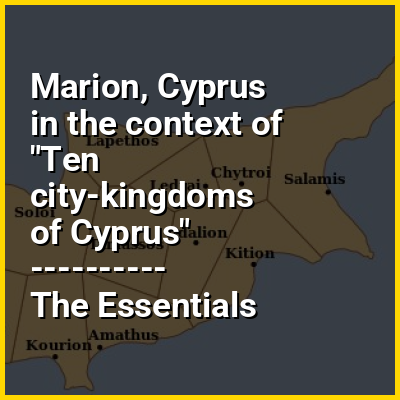
Marion (Greek: Μάριον) was one of the ten city-kingdoms of Cyprus. It was situated in the north-west of the island in the Akamas region, close to or under the current town of Polis. Both Strabo and Pliny the Elder mention the city in their writings.
HINT:
In this Dossier
- ⭐ Core Definition: Marion, Cyprus
- Marion, Cyprus in the context of Swedish Cyprus Expedition
- Marion, Cyprus in the context of Persophile
Marion, Cyprus in the context of Swedish Cyprus Expedition
The Swedish Cyprus Expedition was assembled to systematically investigate Cyprus’s early archaeological history. The expedition occurred between September 1927 and March 1931 and was led by the three archaeologists Einar Gjerstad, Erik Sjöqvist and Alfred Westholm together with the architect John Lindros who photographed during their time in Cyprus. The excavation constitutes the foundation of modern archaeology in Cyprus. The results of the excavations revealed that the distinctive culture of early Cyprus had been created in close contact with various cultures from the Middle East and the western Mediterranean areas.
Through careful archaeological excavations around the whole island of Cyprus, the Swedish Cyprus Expedition mapped Cyprus's history from the Stone Age to the end of the Roman period. Archaeological excavations were made at various locations in Cyprus including Lapithos, Nitovikla, Agia Eirini, Marion, Idalion, Amathus, and Enkomi. They investigated around 25 sites all over the island during the short time of four years. The results were published in four volumes. Most of the archaeological materials are now kept at the Cyprus Museum in Nicosia and Medelhavsmuseet in Stockholm.
View the full Wikipedia page for Swedish Cyprus ExpeditionMarion, Cyprus in the context of Persophile
Persophilia (Persian: پارسی دوستی, pârsi dusti) is the feeling or expression of interest in, respect for, and appreciation of Persians on the part of a non-Persian. More specifically, a Persophile is someone who has a strongly positive predisposition or sympathy towards Persia and the Persian people, with an admiration for their language and literature, culture (art, music, cuisine, etc.), history, or government. The earliest use of the word may have been by the Royal Numismatic Society of the United Kingdom in 1838, referring to the pro-Persian policy of a Cypriot king of Marion. The opposite sentiment is known as Persophobia.
View the full Wikipedia page for Persophile