Marine plastic pollution in the context of "Plastic pollution"

Play Trivia Questions online!

or

Skip to study material about Marine plastic pollution in the context of "Plastic pollution"

Ad spacer

⭐ Core Definition: Marine plastic pollution

Marine plastic pollution is a type of marine pollution by plastics, ranging in size from large original material such as bottles and bags, down to microplastics formed from the fragmentation of plastic material. Marine debris is mainly discarded human rubbish which floats on, or is suspended in the ocean. Eighty percent of marine debris is plastic. Microplastics and nanoplastics result from the breakdown or photodegradation of plastic waste in surface waters, rivers or oceans. Recently, scientists have uncovered nanoplastics in heavy snow, more specifically about 3,000 tons that cover Switzerland yearly.

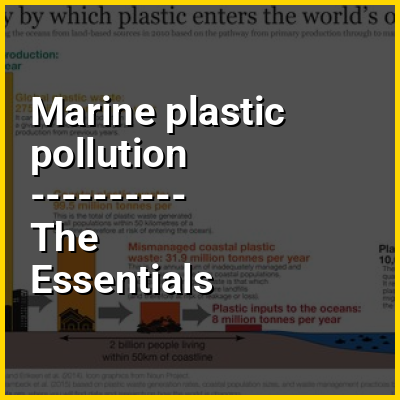
It is approximated that there is a stock of 86 million tons of plastic marine debris in the worldwide ocean as of the end of 2013, assuming that 1.4% of global plastics produced from 1950 to 2013 has entered the ocean and has accumulated there. Global consumption of plastics is estimated to be 300 million tonnes per year as of 2022, with around 8 million tonnes ending up in the oceans as macroplastics. Approximately 1.5 million tonnes of primary microplastics end up in the seas. Around 98% of this volume is created by land-based activities, with the remaining 2% being generated by sea-based activities. It is estimated that 19–23 million tonnes of plastic leaks into aquatic ecosystems annually. The 2017 United Nations Ocean Conference estimated that the oceans might contain more weight in plastics than fish by the year 2050.
↓ Menu

>>>PUT SHARE BUTTONS HERE<<<
In this Dossier

Marine plastic pollution in the context of Human impact on marine life

Human activities affect marine life and marine habitats through overfishing, habitat loss, the introduction of invasive species, ocean pollution, ocean acidification and ocean warming. These impact marine ecosystems and food webs and may result in consequences as yet unrecognised for the biodiversity and continuation of marine life forms.

The ocean can be described as the world's largest ecosystem and it is home for many species of marine life. Different activities carried out and caused by human beings such as global warming, ocean acidification, and pollution affect marine life and its habitats. For the past 50 years, more than 90 percent of global warming resulting from human activity has been absorbed into the ocean. This results in the rise of ocean temperatures and ocean acidification which is harmful to many fish species and causes damage to habitats such as coral. With coral producing materials such as carbonate rock and calcareous sediment, this creates a unique and valuable ecosystem not only providing food/homes for marine creatures but also having many benefits for humans too. Ocean acidification caused by rising levels of carbon dioxide leads to coral bleaching where the rates of calcification is lowered affecting coral growth. Additionally, another issue caused by humans which impacts marine life is marine plastic pollution, which poses a threat to marine life. According to the IPCC (2019), since 1950 "many marine species across various groups have undergone shifts in geographical range and seasonal activities in response to ocean warming, sea ice change and biogeochemical changes, such as oxygen loss, to their habitats."

↑ Return to Menu

Marine plastic pollution in the context of Sustainable Development Goal 14

Sustainable Development Goal 14 (Goal 14 or SDG 14) is about "Life below water" and is one of the 17 Sustainable Development Goals established by the United Nations in 2015. The official wording is to "Conserve and sustainably use the oceans, seas and marine resources for sustainable development". The Goal has ten targets to be achieved by 2030. Progress towards each target is being measured with one indicator each time by time.

The first seven targets are outcome targets: Reduce marine pollution; protect and restore ecosystems; reduce ocean acidification; sustainable fishing; conserve coastal and marine areas; end subsidies contributing to overfishing; increase the economic benefits from sustainable use of marine resources. The last three targets are means of implementation targets: To increase scientific knowledge, research and technology for ocean health; support small scale fishers; implement and enforce international sea law. One indicator (14.1.1b) under Goal 14 specifically relates to reducing impacts from marine plastic pollution.

↑ Return to Menu