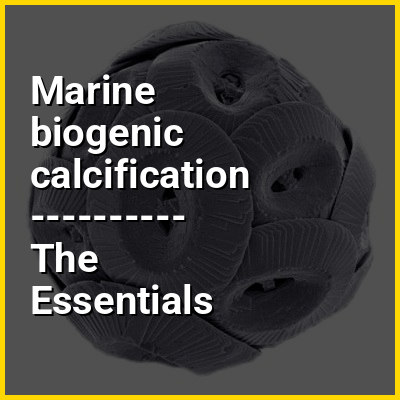
Marine biogenic calcification is the production of calcium carbonate by organisms in the global ocean.
Marine biogenic calcification is the biologically mediated process by which marine organisms produce and deposit calcium carbonate minerals to form skeletal structures or hard tissues. This process is a fundamental aspect of the life cycle of some marine organisms, including corals, mollusks, foraminifera, certain types of plankton, and other calcifying marine invertebrates. The resulting structures, such as shells, skeletons, and coral reefs, function as protection, support, and shelter and create some of the most biodiverse habitats in the world. Marine biogenic calcifiers also play a key role in the biological carbon pump and the biogeochemical cycling of nutrients, alkalinity, and organic matter.
Marine biogenic calcification in the context of Ocean acidification
Ocean acidification is the ongoing decrease in the pH of the Earth's ocean. Between 1950 and 2020, the average pH of the ocean surface fell from approximately 8.15 to 8.05. Carbon dioxide emissions from human activities are the primary cause of ocean acidification, with atmospheric carbon dioxide (CO2) levels exceeding 422 ppm (as of 2024). CO2 from the atmosphere is absorbed by the oceans. This chemical reaction produces carbonic acid (H2CO3) which dissociates into a bicarbonate ion (HCO−3) and a hydrogen ion (H). The presence of free hydrogen ions (H) lowers the pH of the ocean, increasing acidity (this does not mean that seawater is acidic yet; it is still alkaline, with a pH higher than 8). Marine calcifying organisms, such as mollusks and corals, are especially vulnerable because they rely on calcium carbonate to build shells and skeletons.
A change in pH by 0.1 represents a 26% increase in hydrogen ion concentration in the world's oceans (the pH scale is logarithmic, so a change of one in pH units is equivalent to a tenfold change in hydrogen ion concentration). Sea-surface pH and carbonate saturation states vary depending on ocean depth and location. Colder and higher latitude waters are capable of absorbing more CO2. This can cause acidity to rise, lowering the pH and carbonate saturation levels in these areas. There are several other factors that influence the atmosphere-ocean CO2 exchange, and thus local ocean acidification. These include ocean currents and upwelling zones, proximity to large continental rivers, sea ice coverage, and atmospheric exchange with nitrogen and sulfur from fossil fuel burning and agriculture.
Marine biogenic calcification in the context of Hermit crab
Hermit crabs are anomurandecapodcrustaceans of the superfamilyPaguroidea that have adapted to occupy empty scavenged gastropod shells to protect their fragile abdomens. There are over 800 species of hermit crab, most of which possess an asymmetric abdomen concealed by a snug-fitting shell. Hermit crabs' soft (non-calcified) abdominal exoskeleton means they must occupy shelter produced by other organisms or risk being defenseless.
The strong association between hermit crabs and their shelters has significantly influenced their biology. Almost 800 species carry mobile shelters (most often calcified snail shells); this protective mobility contributes to the diversity and multitude of these crustaceans which are found in almost all marine environments. In most species, development involves metamorphosis from symmetric, free-swimming larvae to morphologically asymmetric, benthic-dwelling, shell-seeking crabs. Such physiological and behavioral extremes facilitate a transition to a sheltered lifestyle, revealing the extensive evolutionary lengths that led to the superfamily's success.