Manueline in the context of "Flamboyant"

Play Trivia Questions online!

or

Skip to study material about Manueline in the context of "Flamboyant"

Ad spacer

⭐ Core Definition: Manueline

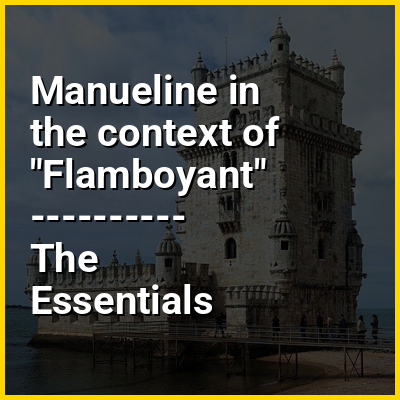
The Manueline (Portuguese: estilo manuelino, IPA: [ɨʃˈtilu mɐnweˈlinu]), occasionally known as Portuguese late Gothic, is the sumptuous, composite Portuguese architectural style originating in the 16th century, during the Portuguese Renaissance and Age of Discoveries. Manueline architecture incorporates maritime elements and representations of the discoveries brought from the voyages of Vasco da Gama and Pedro Álvares Cabral. This innovative style synthesizes aspects of Late Gothic Flamboyant architecture with original motifs and influences of the Plateresque, Mudéjar, Italian, and Flemish architecture. It marks the transition from Late Gothic to Renaissance. The construction of churches and monasteries in Manueline was largely financed by proceeds of the lucrative spice trade with Africa and India.

The style was given its name, many years later, by Francisco Adolfo de Varnhagen, Viscount of Porto Seguro, in his 1842 book Noticia historica e descriptiva do Mosteiro de Belem, com um glossario de varios termos respectivos principalmente a architectura gothica, in his description of the Jerónimos Monastery. Varnhagen named the style after King Manuel I, whose reign (1495–1521) coincided with its development. The style was much influenced by the astonishing successes of the voyages of discovery of Portuguese navigators, from the coastal areas of Africa to the discovery of Brazil and the ocean routes to the Far East.
↓ Menu

>>>PUT SHARE BUTTONS HERE<<<
In this Dossier

Manueline in the context of Manuel I of Portugal

Manuel I (European Portuguese: [mɐnuˈɛl]; 31 May 1469 – 13 December 1521), known as the Fortunate (Portuguese: O Venturoso), was King of Portugal from 1495 to 1521. A member of the House of Aviz, Manuel was Duke of Beja and Viseu prior to succeeding his cousin, John II of Portugal, as monarch. Manuel ruled over a period of intensive expansion of the Portuguese Empire owing to the numerous Portuguese discoveries made during his reign. His sponsorship of Vasco da Gama led to the Portuguese discovery of the sea route to India in 1498, resulting in the creation of the Portuguese India Armadas, which guaranteed Portugal's monopoly on the spice trade. Manuel began the Portuguese colonization of the Americas and Portuguese India, and oversaw the establishment of a vast trade empire across Africa and Asia.

Manuel established the Casa da Índia, a royal institution that managed Portugal's monopolies and its imperial expansion. He financed numerous famed Portuguese navigators, including Pedro Álvares Cabral (who discovered Brazil), Afonso de Albuquerque (who established Portuguese hegemony in the Indian Ocean), among numerous others. The income from Portuguese trade monopolies and colonized lands made Manuel the wealthiest monarch in Europe, allowing him to be one of the great patrons of the Portuguese Renaissance, which produced many significant artistic and literary achievements. Manuel patronized numerous Portuguese intellectuals, including playwright Gil Vicente (called the father of Portuguese and Spanish theatre). The Manueline style, considered Portugal's national architecture, is named for the king.

↑ Return to Menu

Manueline in the context of El Jadida

El Jadida (Arabic: الجديدة, romanizedal-Jadīda, [alʒadiːda]) is a major port city on the Atlantic coast of Morocco, located 96 kilometres (60 mi) south of the city of Casablanca, in the province of El Jadida and the region of Casablanca-Settat. It has a population of 170,956 as of 2023.

The fortified city, built by the Portuguese at the beginning of the 16th century and named Mazagan (Mazagão in Portuguese), was given up by the Portuguese in 1769 and incorporated into Morocco. El Jadida's old city sea walls are one of the Seven Wonders of Portuguese Origin in the World. The Portuguese Fortified City of Mazagan was registered as a UNESCO World Heritage Site in 2004, on the basis of its status as an "outstanding example of the interchange of influences between European and Moroccan cultures" and as an "early example of the realisation of the Renaissance ideals integrated with Portuguese construction technology". According to UNESCO, the most important buildings from the Portuguese period are the cistern and the Church of the Assumption, both in a Manueline style.

↑ Return to Menu

Manueline in the context of Culture of Brazil

The culture of Brazil has been shaped by the amalgamation of diverse indigenous cultures, and the cultural fusion that took place among Indigenous communities, Portuguese colonists, and Africans, primarily during the Brazilian colonial period. In the late 19th and early 20th centuries, Brazil received a significant number of immigrants, primarily of Portuguese, Italian, Spanish, and German origin, which along with smaller numbers of Japanese, Austrians, Dutch, Armenians, Arabs, Jews, Poles, Ukrainians, French, Russians, Swiss, Hungarians, Greeks, Chinese, and Koreans gave a relevant contribution to the formation of regional cultures in Brazil, and thus contributed to its current existence as a plural and racially diverse society.

As consequence of three centuries of colonization by the Portuguese empire, many aspects of Brazilian culture are derived from the culture of Portugal. The numerous Portuguese inheritances include the language, cuisine items such as rice and beans and feijoada, the predominant religion and the colonial architectural styles. These aspects, however, were influenced by African and Indigenous traditions, as well as those from other Western European countries. Some aspects of Brazilian culture are contributions of Italian, Spaniard, German, Japanese and other European immigrants. Amerindian people and Africans also played an important role in the formation of Brazilian language, cuisine, music, dance and religion.

↑ Return to Menu