Magnetic monopole in the context of "Grand unified theory"

Play Trivia Questions online!

or

Skip to study material about Magnetic monopole in the context of "Grand unified theory"

Ad spacer

⭐ Core Definition: Magnetic monopole

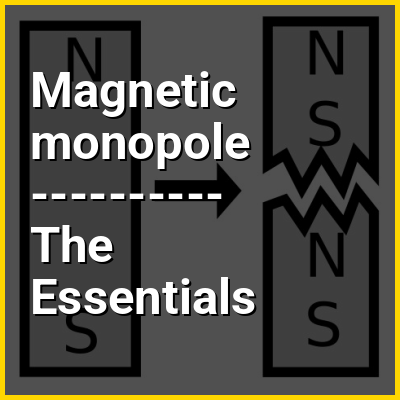
In particle physics, a magnetic monopole is a hypothetical particle that is an isolated magnet with only one magnetic pole (a north pole without a south pole or vice versa). A magnetic monopole would have a net north or south "magnetic charge". Modern interest in the concept stems from particle theories, notably grand unified and superstring theories, which predict their existence.The known elementary particles that have electric charge are electric monopoles.

Magnetism in bar magnets and electromagnets is not caused by magnetic monopoles, and indeed, there is no known experimental or observational evidence that magnetic monopoles exist. A magnetic monopole is not necessarily an elementary particle, and models for magnetic monopole production can include (but are not limited to) spin-0 monopoles or spin-1 massive vector mesons. The term "magnetic monopole" only refers to the nature of the particle, rather than a designation for a single particle.
↓ Menu

>>>PUT SHARE BUTTONS HERE<<<
In this Dossier

Magnetic monopole in the context of Cosmic inflation

In physical cosmology, cosmic inflation, cosmological inflation, or just inflation, is a theory of exponential expansion of space in the very early universe. Following the inflationary period, the universe continued to expand, but at a slower rate. The re-acceleration of this slowing expansion due to dark energy began after the universe was already over 7.7 billion years old (5.4 billion years ago).

Inflation theory was developed in the late 1970s and early 1980s, with notable contributions by several theoretical physicists, including Alexei Starobinsky at Landau Institute for Theoretical Physics, Alan Guth at Cornell University, and Andrei Linde at Lebedev Physical Institute. Starobinsky, Guth, and Linde won the 2014 Kavli Prize "for pioneering the theory of cosmic inflation". It was developed further in the early 1980s. It explains the origin of the large-scale structure of the cosmos. Quantum fluctuations in the microscopic inflationary region, magnified to cosmic size, become the seeds for the growth of structure in the Universe (see galaxy formation and evolution and structure formation). Many physicists also believe that inflation explains why the universe appears to be the same in all directions (isotropic), why the cosmic microwave background radiation is distributed evenly, why the universe is flat, and why no magnetic monopoles have been observed.

↑ Return to Menu

Magnetic monopole in the context of Magnetic dipole

In electromagnetism, a magnetic dipole is the limit of either a closed loop of electric current or a pair of poles as the size of the source is reduced to zero while keeping the magnetic moment constant.

It is a magnetic analogue of the electric dipole, but the analogy is not perfect. In particular, a true magnetic monopole, the magnetic analogue of an electric charge, has never been observed in nature.

↑ Return to Menu

Magnetic monopole in the context of Inflation (cosmology)

In physical cosmology, cosmic inflation, cosmological inflation, or just inflation, is a theory of exponential expansion of space in the very early universe. This enormous expansion supercooled the universe and ending when the energy content of the field driving inflation condensed into hot, dense particles, a process called reheating. Following the inflationary period, the universe continued to expand, but at a slower rate.

Inflation theory was developed in the late 1970s and early 1980s, with notable contributions by several theoretical physicists, including Alexei Starobinsky at Landau Institute for Theoretical Physics, Alan Guth at Cornell University, and Andrei Linde at Lebedev Physical Institute. Starobinsky, Guth, and Linde won the 2014 Kavli Prize "for pioneering the theory of cosmic inflation". It was developed further in the early 1980s. It explains the origin of the large-scale structure of the cosmos. Quantum fluctuations in the microscopic inflationary region, magnified to cosmic size, become the seeds for the growth of structure in the Universe (see galaxy formation and evolution and structure formation). Many physicists also believe that inflation explains why the universe appears to be the same in all directions (isotropic), why the cosmic microwave background radiation is distributed evenly, why the universe is flat, and why no magnetic monopoles have been observed.

↑ Return to Menu