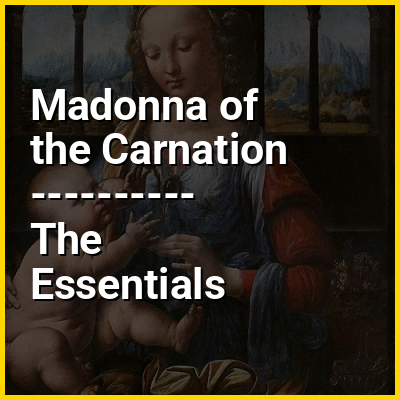
The Italian polymath Leonardo da Vinci (1452–1519) was one of the founding figures of the High Renaissance, and exhibited enormous influence on subsequent artists. Only around eight major works—The Adoration of the Magi, Saint Jerome in the Wilderness, the Louvre Virgin of the Rocks, The Last Supper, the ceiling of the Sala delle Asse, The Virgin and Child with Saint Anne and Saint John the Baptist, The Virgin and Child with Saint Anne, and the Mona Lisa—are universally attributed to him, and have aroused little or no controversy in the past. Ten additional works are now widely attributed to his oeuvre, though most have previously incited considerable controversy or doubt: the Annunciation, Madonna of the Carnation, The Baptism of Christ (with his teacher, Verrocchio), Ginevra de' Benci, the Benois Madonna, the Portrait of a Musician (with possible studio assistance), the Lady with an Ermine, La Belle Ferronnière, the London Virgin of the Rocks (with studio assistance), the Portrait of Isabella d'Este, and Saint John the Baptist.
Other attributions are more complicated. La Scapigliata appears to be attributed by most scholars, but some prominent specialists are silent on the issue. Salvator Mundi's attribution remains extremely controversial, and the extensive nature of the restoration may never allow a definitive resolution. The small number of surviving paintings is due in part to Leonardo's habit of disastrous experimentation with new techniques and his chronic procrastination, resulting in many incomplete works. It is thought that he created many more works that are now lost, though records and copies have survived for some.