Los Angeles Aqueduct in the context of Owens River


Los Angeles Aqueduct in the context of Owens River

⭐ Core Definition: Los Angeles Aqueduct

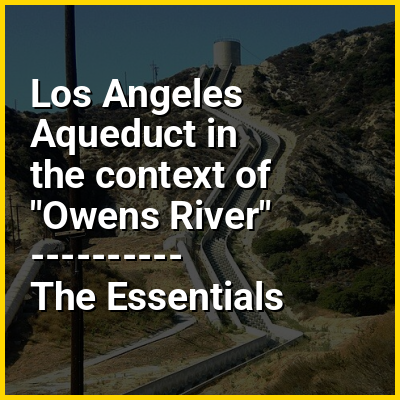
The Los Angeles Aqueduct system, comprising the Los Angeles Aqueduct (Owens Valley aqueduct) and the Second Los Angeles Aqueduct, is a water conveyance system, built and operated by the Los Angeles Department of Water and Power. The Owens Valley aqueduct was designed and built by the city's water department, at the time named The Bureau of Los Angeles Aqueduct, under the supervision of the department's Chief Engineer William Mulholland. The system delivers water from the Owens River in the eastern Sierra Nevada mountains to Los Angeles.

The aqueduct's construction was controversial from the start, as water diversions to Los Angeles eliminated the Owens Valley as a viable farming community. Clauses in the city's charter originally stated that the city could not sell or provide surplus water to any area outside the city, forcing adjacent communities to annex themselves into Los Angeles.
↓ Menu
HINT:

In this Dossier

Los Angeles Aqueduct in the context of Inyo National Forest

Inyo National Forest is a United States National Forest covering parts of the eastern Sierra Nevada of California and the White Mountains of California and Nevada. The forest hosts several superlatives, including Mount Whitney, the highest point in the contiguous United States; Boundary Peak, the highest point in Nevada; and the Ancient Bristlecone Pine Forest, which protects the oldest living trees in the world. The forest, encompassing much of the Owens Valley, was established by Theodore Roosevelt as a way of sectioning off land to accommodate the Los Angeles Aqueduct project in 1907, making the Inyo National Forest one of the least wooded forests in the U.S. National Forest system.

View the full Wikipedia page for Inyo National Forest
↑ Return to Menu

Los Angeles Aqueduct in the context of Los Angeles River

The Los Angeles River (Spanish: Río de Los Ángeles), historically known as Paayme Paxaayt 'West River' by the Tongva and the Río Porciúncula 'Porciúncula River' by the Spanish, is a major river in Los Angeles County, California. Its headwaters are in the Simi Hills and Santa Susana Mountains, and it flows nearly 51 miles (82 km) from Canoga Park through the San Fernando Valley, downtown Los Angeles, and the Gateway Cities to its mouth in Long Beach, where it flows into San Pedro Bay. While the river was once free-flowing and frequently flooding, forming alluvial flood plains along its banks, it currently flows through a concrete channel on a fixed course, which was built after a series of devastating floods in the early 20th century.

Before the opening of the Los Angeles Aqueduct, the river was the primary source of fresh water for the city. Although the Los Angeles region still receives some water from the river and other local sources, most of the water supply flows from several aqueducts serving the area. The Los Angeles River is heavily polluted from agricultural and urban runoff.

View the full Wikipedia page for Los Angeles River
↑ Return to Menu

Los Angeles Aqueduct in the context of Owens River Valley

Owens Valley (Mono: Payahǖǖnadǖ, meaning "place of flowing water") is an arid valley of the Owens River in eastern California in the United States. It is located to the east of the Sierra Nevada, west of the White Mountains and Inyo Mountains, and is split between the Great Basin Desert and the Mojave Desert. The mountain peaks on its west side (including Mount Whitney) reach above 14,000 feet (4,300 m) in elevation, while the floor of the Owens Valley is at about 4,000 feet (1,200 m), making the valley the deepest in the United States. The Sierra Nevada casts the valley in a rain shadow, which makes Owens Valley "the Land of Little Rain". The bed of Owens Lake, now a predominantly dry endorheic alkali flat, sits on the southern end of the valley.

The current arid nature of the valley is mostly due to the Los Angeles Department of Water and Power diverting the water of the region. The valley provides water to the Los Angeles Aqueduct, the source of one-third of the water for city, and was the area at the center of one of the fiercest and longest-running episodes of the California Water Wars. Owens Lake was completely emptied by 1926, only 13 years after Los Angeles began diverting water. The water diversions inspired aspects of the 1974 film Chinatown.

View the full Wikipedia page for Owens River Valley
↑ Return to Menu