Longitudinal wave in the context of "Particle displacement"

Play Trivia Questions online!

or

Skip to study material about Longitudinal wave in the context of "Particle displacement"

Ad spacer

⭐ Core Definition: Longitudinal wave

Longitudinal waves are waves which oscillate in the direction which is parallel to the direction in which the wave travels and displacement of the medium is in the same (or opposite) direction of the wave propagation. Mechanical longitudinal waves are also called compressional or compression waves, because they produce compression and rarefaction when travelling through a medium, and pressure waves, because they produce increases and decreases in pressure. A wave along the length of a stretched Slinky toy, where the distance between coils increases and decreases, is a good visualization. Real-world examples include sound waves (vibrations in pressure, a particle of displacement, and particle velocity propagated in an elastic medium) and seismic P waves (created by earthquakes and explosions).

The other main type of wave is the transverse wave, in which the displacements of the medium are at right angles to the direction of propagation. Transverse waves, for instance, describe some bulk sound waves in solid materials (but not in fluids); these are also called "shear waves" to differentiate them from the (longitudinal) pressure waves that these materials also support.

↓ Menu

>>>PUT SHARE BUTTONS HERE<<<
In this Dossier

Longitudinal wave in the context of Polarization (waves)

Polarization, or polarisation, is a property of transverse waves which specifies the geometrical orientation of the oscillations. In a transverse wave, the direction of the oscillation is perpendicular to the direction of motion of the wave. One example of a polarized transverse wave is vibrations traveling along a taut string, for example, in a musical instrument like a guitar string. Depending on how the string is plucked, the vibrations can be in a vertical direction, horizontal direction, or at any angle perpendicular to the string. In contrast, in longitudinal waves, such as sound waves in a liquid or gas, the displacement of the particles in the oscillation is always in the direction of propagation, so these waves do not exhibit polarization. Transverse waves that exhibit polarization include electromagnetic waves such as light and radio waves, gravitational waves, and transverse sound waves (shear waves) in solids.

An electromagnetic wave such as light consists of a coupled oscillating electric field and magnetic field that are always perpendicular to each other. Different states of polarization correspond to different relationships between the directions of the fields and the direction of propagation. In linear polarization, the electric and magnetic fields each oscillate in a single direction, perpendicular to one another. In circular or elliptical polarization, the fields rotate around the beam's direction of travel at a constant rate. The rotation can be either in the right-hand or in the left-hand direction.

↑ Return to Menu

Longitudinal wave in the context of Audio signal processing

Audio signal processing is a subfield of signal processing that is concerned with the electronic manipulation of audio signals. Audio signals are electronic representations of sound waveslongitudinal waves which travel through air, consisting of compressions and rarefactions. The energy contained in audio signals or sound power level is typically measured in decibels. As audio signals may be represented in either digital or analog format, processing may occur in either domain. Analog processors operate directly on the electrical signal, while digital processors operate mathematically on its digital representation.

↑ Return to Menu

Longitudinal wave in the context of Mechanical wave

In physics, a mechanical wave is a wave that is an oscillation of matter, and therefore transfers energy through a material medium. Vacuum is, from classical perspective, a non-material medium, where electromagnetic waves propagate.

While waves can move over long distances, the movement of the medium of transmission—the material—is limited. Therefore, the oscillating material does not move far from its initial equilibrium position. Mechanical waves can be produced only in media which possess elasticity and inertia. There are three types of mechanical waves: transverse waves, longitudinal waves, and surface waves. Some of the most common examples of mechanical waves are water waves, sound waves, and seismic waves.

↑ Return to Menu

Longitudinal wave in the context of Transverse wave

In physics, a transverse wave is a wave that oscillates perpendicularly to the direction of the wave's advance. In contrast, a longitudinal wave travels in the direction of its oscillations. All waves move energy from place to place without transporting the matter in the transmission medium if there is one. Electromagnetic waves are transverse without requiring a medium. The designation “transverse” indicates the direction of the wave is perpendicular to the displacement of the particles of the medium through which it passes, or in the case of EM waves, the oscillation is perpendicular to the direction of the wave.

A simple example is given by the waves that can be created on a horizontal length of string by anchoring one end and moving the other end up and down. Another example is the waves that are created on the membrane of a drum. The waves propagate in directions that are parallel to the membrane plane, but each point in the membrane itself gets displaced up and down, perpendicular to that plane. Light is another example of a transverse wave, where the oscillations are the electric and magnetic fields, which point at right angles to the ideal light rays that describe the direction of propagation.

↑ Return to Menu

Longitudinal wave in the context of Particle velocity

Particle velocity (denoted v or SVL) is the velocity of a particle (real or imagined) in a medium as it transmits a wave. The SI unit of particle velocity is the metre per second (m/s). In many cases this is a longitudinal wave of pressure as with sound, but it can also be a transverse wave as with the vibration of a taut string.

When applied to a sound wave through a medium of a fluid like air, particle velocity would be the physical speed of a parcel of fluid as it moves back and forth in the direction the sound wave is travelling as it passes.

↑ Return to Menu

Longitudinal wave in the context of Sound energy

In physics, sound energy is a form of energy that can be heard by living things. Only those waves that have a frequency of 20 Hz to 20 kHz are audible to humans. However, this range is an average and will slightly change from individual to individual. Sound waves that have frequencies below 20 Hz are called infrasonic and those above 20 kHz are called ultrasonic. Sound is a longitudinal mechanical wave and as such consists physically in oscillatory elastic compression and in oscillatory displacement of a fluid. Therefore, the medium acts as storage for both potential and kinetic energy.

Consequently, the sound energy in a volume of interest is defined as the sum of the potential and kinetic energy densities integrated over that volume:

↑ Return to Menu

Longitudinal wave in the context of Plasma waves

In plasma physics, waves in plasmas are an interconnected set of particles and fields which propagate in a periodically repeating fashion. A plasma is a quasineutral, electrically conductive fluid. In the simplest case, it is composed of electrons and a single species of positive ions, but it may also contain multiple ion species including negative ions as well as neutral particles. Due to its electrical conductivity, a plasma couples to electric and magnetic fields. This complex of particles and fields supports a wide variety of wave phenomena.

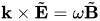
The electromagnetic fields in a plasma are assumed to have two parts, one static/equilibrium part and one oscillating/perturbation part. Waves in plasmas can be classified as electromagnetic or electrostatic according to whether or not there is an oscillating magnetic field. Applying Faraday's law of induction to plane waves, we find , implying that an electrostatic wave must be purely longitudinal. An electromagnetic wave, in contrast, must have a transverse component, but may also be partially longitudinal.

↑ Return to Menu