List of largest cities of Iran in the context of "Isfahan"

Play Trivia Questions online!

or

Skip to study material about List of largest cities of Iran in the context of "Isfahan"

Ad spacer

⭐ Core Definition: List of largest cities of Iran

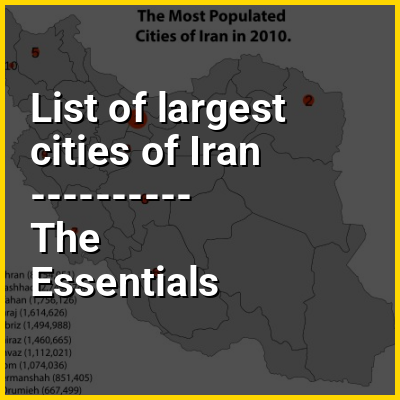
Iran has one of the highest urban population growth rates in the world. From 1950 to 2002, the urban proportion of the population increased from 27% to 60%. The United Nations (UN) predicts that by 2030 80% of the population will live in urban areas. Most internal migrants have settled near the cities of Tehran, Isfahan, Karaj, Ahvaz, Mashhad and Qom. Tehran, with a population of 8.7 million in 2016, is the largest city in Iran and is the nation's capital. Tehran is home to around 11% of Iran's population. It is the hub of Iran's communication and transport networks.

Mashhad, with a population of 4.2 million in 2019, is the second-largest Iranian city and the centre of the province of Razavi Khorasan. Mashhad is one of the holiest Shi'a cities in the world as it is the site of the Imam Reza shrine. It is the centre of tourism in Iran. Between 15 and 20 million pilgrims go to Imam Reza's shrine every year.
↓ Menu

>>>PUT SHARE BUTTONS HERE<<<
In this Dossier

List of largest cities of Iran in the context of Tehran

Tehran is the capital and largest city of Iran. It is also the capital of Tehran province and the administrative center for Tehran County and its Central District. With a population of around 9 million in the city, and 15 million in the metropolitan area, Tehran is the most populous city in Iran and West Asia, the second largest metropolitan area in the Middle East after Cairo, and the 24th-most-populous metropolitan area in the world. Greater Tehran includes several municipalities, including but not limited to Karaj, Eslamshahr, Shahriar, Qods, Malard, Golestan, Pakdasht, Qarchak, Nasimshahr, Parand, Pardis, Andisheh and Fardis.

In classical antiquity, part of the territory of present-day Tehran was controlled by Rhages/Rey/Ray). Modern Ray was absorbed into the metropolitan area of Greater Tehran. Tehran was 1st chosen as the capital of Iran in 1786 by Agha Mohammad Khan of the Qajar dynasty, because of its proximity to Iran's territories in the Caucasus—which were contested in the Russo-Iranian Wars—and to avoid the vying factions of prior ruling Iranian dynasties; the capital of Iran had been moved several times throughout its long history, with Tehran becoming the 32nd. Under (1848-1896), Tehran witnessed Iran's first institute of higher learning, bank, railway line, and museum. Large-scale construction works began in the 1920s, and Tehran became a destination for mass migrations from all over Iran especially in the 20th century.

↑ Return to Menu

List of largest cities of Iran in the context of Tabriz

Tabriz (Persian: تبریز, romanizedtabriz; pronounced [tæbˈɾiːz] ) is a city in the Central District of Tabriz County, in East Azerbaijan province of northwestern Iran. It serves as capital of the province, the county, and the district. It is the sixth-most-populous city in Iran.

The city of Tabriz lies close to the borders of the Republic of Azerbaijan, 130 kilometers from the Azerbaijan-Iran border.

↑ Return to Menu

List of largest cities of Iran in the context of Shiraz

Shiraz is the fifth-most-populous city of Iran and the capital of Fars province, historically known by the exonym Persia proper. As of the 2016 national census, the population of the city was 1,565,572 people, and its built-up area with Sadra was home to almost 1,800,000 inhabitants. A census in 2021 showed an increase in the city's population to 1,995,500 people. Shiraz is located in southwestern Iran on the rudkhaneye khoshk (lit.'dry river') seasonal river. The city has a moderate climate and has been a regional trade center for over a thousand years.

The earliest reference to the city, as Tiraziš, is on Elamite clay tablets dated to 2000 BCE. The modern city was founded by the Sasanian dynasty and restored by the Umayyad Caliphate in 693 CE and grew prominent under the successive Iranian Saffarid and Buyid dynasties in the 9th and 10th–11th centuries, respectively. In the 13th century, Shiraz became a leading center of the arts and letters, due to the encouragement of its ruler and the presence of many Persian scholars and artists. Two famous poets of Iran, Hafez and Saadi, are from Shiraz, whose tombs are located on the north side of the current city boundaries.

↑ Return to Menu

List of largest cities of Iran in the context of Shiraz, Iran

Shiraz is the fifth-most-populous city of Iran and the capital of Fars province, which is historically known by the exonym Persia proper. As of the 2016 national census, the population of the city was 1,565,572 people, and its built-up area with Sadra was home to almost 1,800,000 inhabitants. A census in 2021 showed an increase in the city's population to 1,995,500 people. Shiraz is located in southwestern Iran on the rudkhaneye khoshk (lit.'dry river') seasonal river. The city has a moderate climate and has been a regional trade center for over a thousand years.

The earliest reference to the city, as Tiraziš, is on Elamite clay tablets dated to 2000 BCE. The modern city was founded by the Sasanian dynasty and restored by the Umayyad Caliphate in 693 CE and grew prominent under the successive Iranian Saffarid and Buyid dynasties in the 9th and 10th–11th centuries, respectively. In the 13th century, Shiraz became a leading center of the arts and letters, due to the encouragement of its ruler and the presence of many Persian scholars and artists. Two famous poets of Iran, Hafez and Saadi, are from Shiraz, whose tombs are located on the north side of the current city boundaries.

↑ Return to Menu