Linear elasticity in the context of "Young's modulus"

Play Trivia Questions online!

or

Skip to study material about Linear elasticity in the context of "Young's modulus"

Ad spacer

⭐ Core Definition: Linear elasticity

Linear elasticity is a mathematical model of how solid objects deform and become internally stressed by prescribed loading conditions. It is a simplification of the more general nonlinear theory of elasticity and a branch of continuum mechanics.

The fundamental assumptions of linear elasticity are infinitesimal strains — meaning, "small" deformations — and linear relationships between the components of stress and strain — hence the "linear" in its name. Linear elasticity is valid only for stress states that do not produce yielding. Its assumptions are reasonable for many engineering materials and engineering design scenarios. Linear elasticity is therefore used extensively in structural analysis and engineering design, often with the aid of finite element analysis.
↓ Menu

>>>PUT SHARE BUTTONS HERE<<<

👉 Linear elasticity in the context of Young's modulus

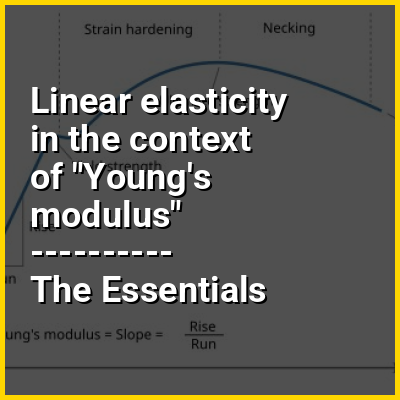
Young's modulus (or the Young modulus) is a mechanical property of solid materials that measures the tensile or compressive stiffness when the force is applied lengthwise. It is the elastic modulus for tension or axial compression. Young's modulus is defined as the quotient of the stress (force per unit area) applied to the object and the resulting axial strain (a dimensionless quantity that quantifies relative deformation) in the linear elastic region of the material. As such, Young's modulus is similar to and proportional to the spring constant in Hooke's law, but with dimensions of pressure instead of force per distance.

Although Young's modulus is named after the 19th-century British scientist Thomas Young, the concept was developed in 1727 by Leonhard Euler. The first experiments that used the concept of Young's modulus in its modern form were performed by the Italian scientist Giordano Riccati in 1782, pre-dating Young's work by 25 years. The term modulus is derived from the Latin root term modus, which means measure.

↓ Explore More Topics
In this Dossier

Linear elasticity in the context of Seismic

Seismology (/szˈmɒləi, ss-/; from Ancient Greek σεισμός (seismós) meaning "earthquake" and -λογία (-logía) meaning "study of") is the scientific study of earthquakes (or generally, quakes) and the generation and propagation of elastic waves through planetary bodies. It also includes studies of the environmental effects of earthquakes such as tsunamis; other seismic sources such as volcanoes, plate tectonics, glaciers, rivers, oceanic microseisms, and the atmosphere; and artificial processes such as explosions.

Paleoseismology is a related field that uses geology to infer information regarding past earthquakes. A recording of Earth's motion as a function of time, created by a seismograph is called a seismogram. A seismologist is a scientist who works in basic or applied seismology.

↑ Return to Menu

Linear elasticity in the context of Shear wave

In seismology and other areas involving elastic waves, S waves, secondary waves, or shear waves (sometimes called elastic S waves) are a type of elastic wave and are one of the two main types of elastic body waves, so named because they move through the body of an object, unlike surface waves.

S waves are transverse waves, meaning that the direction of particle movement of an S wave is perpendicular to the direction of wave propagation, and the main restoring force comes from shear stress. Therefore, S waves cannot propagate in liquids with zero (or very low) viscosity; however, they may propagate in liquids with high viscosity. Similarly, S waves cannot travel through gases.

↑ Return to Menu

Linear elasticity in the context of Euler–Bernoulli beam theory

Euler–Bernoulli beam theory (also known as engineer's beam theory or classical beam theory) is a simplification of the linear theory of elasticity which provides a means of calculating the load-carrying and deflection characteristics of beams. It covers the case corresponding to small deflections of a beam that is subjected to lateral loads only. By ignoring the effects of shear deformation and rotatory inertia, it is thus a special case of Timoshenko–Ehrenfest beam theory. It was first enunciated circa 1750, but was not applied on a large scale until the development of the Eiffel Tower and the Ferris wheel in the late 19th century. Following these successful demonstrations, it quickly became a cornerstone of engineering and an enabler of the Second Industrial Revolution.

Additional mathematical models have been developed, such as plate theory, but the simplicity of beam theory makes it an important tool in the sciences, especially structural and mechanical engineering.

↑ Return to Menu