Lighthouse of Alexandria in the context of Seven wonders of the ancient world


Lighthouse of Alexandria in the context of Seven wonders of the ancient world

⭐ Core Definition: Lighthouse of Alexandria

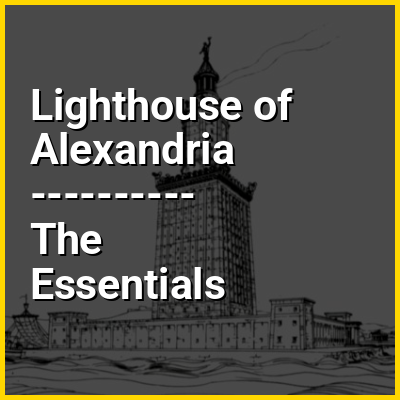
The Lighthouse of Alexandria, sometimes called the Pharos of Alexandria, was a lighthouse built by the Ptolemaic Kingdom of Ancient Egypt, during the reign of Ptolemy II Philadelphus (280–247 BC). It has been estimated to have been at least 100 metres (330 ft) in overall height. One of the Seven Wonders of the Ancient World, for many centuries it was one of the tallest man-made structures in the world.

The lighthouse was severely damaged by three earthquakes between 956 and 1303 AD and became an abandoned ruin. It was the third-longest surviving ancient wonder, after the Mausoleum at Halicarnassus and the extant Great Pyramid of Giza, surviving in part until 1480, when the last of its remnant stones were used to build the Citadel of Qaitbay on the site.
↓ Menu
HINT:

In this Dossier

Lighthouse of Alexandria in the context of Alexandria

Alexandria is a major city in Egypt. Lying at the western edge of the Nile River Delta, it extends about 40 km (25 mi) along the country's northern coast. It is Egypt's principal seaport, the second largest city after Cairo, and the largest city on the Mediterranean coast. Founded in 331 BC by Alexander the Great, Alexandria is one of the largest and most important cities of antiquity and a leading hub for science, culture, and scholarship.

Nicknamed the "Bride of the Mediterranean" and "Pearl of the Mediterranean Coast", the city is a popular tourist destination and a major industrial centre. It is the sixth-largest city in the Arab world and in the Middle East, and the eleventh-largest city and urban area in Africa. Alexandria was established originally near an ancient Egyptian settlement named Rhacotis, which later became its Egyptian quarter. The city was made the capital of the Ptolemaic Kingdom and became the foremost commercial, intellectual, and cultural centre for much of the Hellenistic age and late antiquity; at one time, it was the most populous city in the ancient world. Alexandria was best known for the Lighthouse of Alexandria (Pharos), one of the Seven Wonders of the Ancient World; its Great Library, the largest in the ancient world; and the Catacombs of Kom El Shoqafa, one of the Seven Wonders of the Middle Ages.

View the full Wikipedia page for Alexandria
↑ Return to Menu

Lighthouse of Alexandria in the context of Seven Wonders of the Ancient World

The Seven Wonders of the Ancient World, also known as the Seven Wonders of the World or simply the Seven Wonders, is a list of seven notable structures present during classical antiquity, first established in the 1572 publication Octo Mundi Miracula using a combination of historical sources.

The seven traditional wonders established by the Octo Mundi Miracula are the Great Pyramid of Giza, the Colossus of Rhodes, the Lighthouse of Alexandria, the Mausoleum at Halicarnassus, the Temple of Artemis, the Statue of Zeus at Olympia, and the Hanging Gardens of Babylon. Using modern-day countries, two of the wonders were located in Greece, two in Turkey, two in Egypt, and one in Iraq. Of the seven wonders, only the Pyramid of Giza, which is also by far the oldest of the wonders, remains standing, while the others have been destroyed over the centuries. Remains exist from the Lighthouse, Temple of Artemis and the Mausoleum – either in situ or in museums. There is scholarly debate over the exact nature of the Hanging Gardens, and there is doubt as to whether they existed at all.

View the full Wikipedia page for Seven Wonders of the Ancient World
↑ Return to Menu

Lighthouse of Alexandria in the context of Wonders of the Middle Ages

Various lists of the Wonders of the World have been compiled from antiquity to the present day, in order to catalogue the world's most spectacular natural features and human-built structures.

The Seven Wonders of the Ancient World is the oldest known list of this type, documenting the most iconic and remarkable human-made creations of classical antiquity; the canonical list was established in the 1572 Octo Mundi Miracula, based on classical sources which varied widely. The classical sources only include works located around the Mediterranean rim and in the ancient Near East. The number seven was chosen because the Greeks believed it represented perfection and plenty, and because it reflected the number of planets known in ancient times (five) plus the Sun and Moon.

View the full Wikipedia page for Wonders of the Middle Ages
↑ Return to Menu

Lighthouse of Alexandria in the context of Ptolemy I Soter

Ptolemy I Soter (/ˈtɒləmi/; Greek: Πτολεμαῖος Σωτήρ, Ptolemaîos Sōtḗr, "Ptolemy the Savior"; c. 369/68 BC – January 282 BC) was a Macedonian Greek general, historian, and successor of Alexander the Great who went on to found the Ptolemaic Kingdom centered on Egypt. Ptolemy was king and pharaoh of Ptolemaic Egypt from 305/304 BC to his death in 282 BC, and his descendants continued to rule Egypt until 30 BC. During their rule, Egypt became a thriving bastion of Hellenistic civilization and Alexandria a great seat of Greek culture.

Ptolemy I was the son of Arsinoe of Macedon by either her husband Lagus or Philip II of Macedon, the father of Alexander. However, the latter is unlikely and may be a myth fabricated to glorify the Ptolemaic Dynasty. Ptolemy was one of Alexander's most trusted companions and military officers. After the death of Alexander in 323 BC, Ptolemy retrieved his body as it was en route to be buried in Macedon, placing it in Memphis instead, where it was later moved to Alexandria in a new tomb. Afterwards he joined a coalition against Perdiccas, the royal regent over Philip III of Macedon. Perdiccas invaded Egypt but was assassinated by his own officers in 320 BC, allowing Ptolemy I to consolidate his control over the country. After a series of wars between Alexander's successors, Ptolemy gained a claim to Judea in southern Syria, which was disputed with the Seleucid king Seleucus I. He also took control of Cyprus and Cyrenaica, the latter of which was placed under the control of Ptolemy's stepson Magas. Ptolemy also commanded the construction of the Library of Alexandria and of the Lighthouse of Alexandria, one of the Seven Wonders of the Ancient World.

View the full Wikipedia page for Ptolemy I Soter
↑ Return to Menu

Lighthouse of Alexandria in the context of Octo Mundi Miracula

Octo Mundi Miracula is a series of engravings published in 1572 by the Flemish engraver Philips Galle, based on a set of eight drawings by Dutch painter Maarten van Heemskerck, with accompanying elegiac couplet verses written by Hadrianus Junius. Heemskerck's primary source was Pedro Mexía's 1540 Silva de varia lección, which noted how the classical sources for the Seven Wonders of the Ancient World do not agree on a consistent list.

The series is considered the first known complete visual representation of the Seven Wonders of the Ancient World, and created the modern canonical list of seven wonders – the specific list had not existed in the various classical sources. Despite creating the modern canonical seven, the engravings included an eighth monument—the Colosseum—following van Heemskerck's 1533 Self-Portrait with the Colosseum.

View the full Wikipedia page for Octo Mundi Miracula
↑ Return to Menu