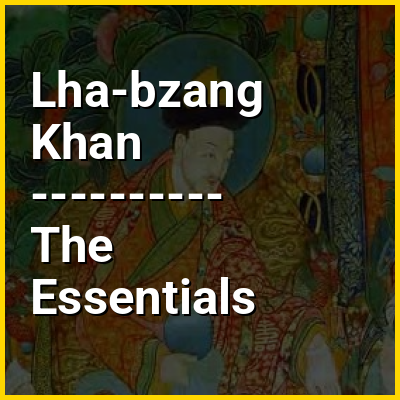
Lha-bzang Khan (Mongolian: ᠯᠠᠽᠠᠩ ᠬᠠᠭᠠᠨ Lazang Khaan; Tibetan: ལྷ་བཟང༌, ZWPY: Lhasang; alternatively, Lhazang or Lapsangn or Lajang; d.1717) was the ruler of the Khoshut (also spelled Qoshot, Qośot, or Qosot) tribe of the Oirats. He was the son of Tenzin Dalai Khan (1668–1701) and grandson (or great-grandson) of Güshi Khan, being the last khan of the Khoshut Khanate and Oirat King of Tibet. He acquired effective power as ruler of Tibet by eliminating the regent (desi) Sangye Gyatso and the Sixth Dalai Lama, Tsangyang Gyatso, but his rule was cut short by an invasion by another group of Oirats, the Dzungar people. At length, this led to the direct involvement of the Chinese Qing dynasty in the Tibetan politics.
>>>PUT SHARE BUTTONS HERE<<<
In this Dossier
Lha-bzang Khan in the context of History of Tibet
While the Tibetan Plateau has been inhabited since pre-historic times, most of Tibet's history went unrecorded until the creation of Tibetan script in the 7th century. Tibetan texts refer to the kingdom of Zhangzhung (c. 500 BCE – 625 CE) as the precursor of later Tibetan kingdoms and the originators of the Bon religion. While mythical accounts of early rulers of the Yarlung dynasty exist, historical accounts begin with the introduction of Tibetan script from the unified Tibetan Empire in the 7th century. Following the dissolution of Tibetan Empire and a period of fragmentation in the 9th–10th centuries, a Buddhist revival in the 10th–12th centuries saw the development of three of the four major schools of Tibetan Buddhism.
After a period of control by the Mongol Empire and the also Mongol led Yuan dynasty, Tibet effectively became independent in the 14th century and was ruled by a succession of noble houses for the next 300 years. In the 16th century, the Dalai Lama title was created by Altan Khan, and as requested by the family of Altan Khan, seal of authority was granted to the Dalai Lama by the Wanli Emperor. In the 17th century, the senior lama of the Gelug school, the Dalai Lama, became the head of state with the aid of the Khoshut Khanate. Seal of authority and golden sheets were granted by the Shunzhi Emperor to both the Dalai Lama and the founder Güshi Khan of Khoshut Khanate in 1653. In 1717, the Dzungar Khanate invaded Lhasa, killed Lha-bzang Khan of the Khoshut Khanate, which effectively destroyed the Khoshut Khanate. The Qing dynasty then sent military troops in the same year to fight the Dzungars, but failed.
Lha-bzang Khan in the context of Khoshut Khanate
The Khoshut Khanate was a Mongol Oirat khanate based in the Tibetan Plateau from 1642 to 1717. Based in modern Qinghai, it was founded by Güshi Khan in 1642 after defeating the opponents of the Gelug school of Tibetan Buddhism in Tibet. The 5th Dalai Lama established a civil administration known as Ganden Phodrang with the aid of Güshi Khan. The role of the khanate in the affairs of Tibet has been subject to various interpretations. Some sources claim that the Khoshut did not interfere in Tibetan affairs and had a priest and patron relationship between the khan and Dalai Lama while others claim that Güshi appointed a minister, Sonam Rapten, as de facto administrator of civil affairs while the Dalai Lama was only responsible for religious matters. Güshi Khan accepted the nominal suzerainty of the Qing dynasty in 1654, when seal of authority and golden sheets were granted by the Shunzhi Emperor. In the last years of the khanate, Lha-bzang Khan murdered the Tibetan regent and deposed the 6th Dalai Lama in favor of a pretender Dalai Lama.
The Khoshut Khanate was ended in 1717 when the Dzungar prince Tseren Dondup invaded Tibet, killed Lha-bzang Khan, and installed the 7th Dalai Lama.
Lha-bzang Khan in the context of 6th Dalai Lama
The 6th Dalai Lama, Tsangyang Gyatso (Tibetan: ཚངས་དབྱངས་རྒྱ་མཚོ, Wylie: tshangs-dbyangs rgya-mtsho, ZWPY: Cangyang Gyamco; 1 March 1683 – after 1706), was recognized as the 6th Dalai Lama after a delay of many years, permitting the Potala Palace to be completed. He was an unconventional Dalai Lama that preferred a Nyingma school yogi's life to that of an ordained monk. He was later kidnapped and deposed by the Koshut Lha-bzang Khan.
The death of the 5th Dalai Lama remained concealed for many years by his Kalon, in order to complete the building of the Potala Palace. The 6th Dalai Lama was born in southern Tibet, known as "Monyul", at Urgelling Monastery, which is in modern-day Tawang district, Arunachal Pradesh, India. He was officially located at the age of either 13 or 14.
Lha-bzang Khan in the context of Yeshe Gyatso
Yeshe Gyatso (Wylie: Ye shes rgya mtsho) (1686–1725) was a pretender for the position of the 6th Dalai Lama of Tibet. Declared by Lha-bzang Khan of the Khoshut Khanate on June 28, 1707, he was the only unofficial Dalai Lama. While praised for his personal moral qualities, he was not recognized by the bulk of the Tibetans and Mongols and is not counted in the official list of the Dalai Lamas.
Lha-bzang Khan in the context of Tsewang Rabtan
Tsewang Rabtan (from Tibetan: ཚེ་དབང་རབ་བརྟན Tsewang Rapten; Chinese: 策妄阿拉布坦; Mongolian: ᠴᠡᠸᠡᠩᠷᠠᠪᠳᠠᠨ; 1643–1727) was a Choros prince and the Khong Tayiji of the Dzungar Khanate from 1697 (following the death of his uncle and rival Galdan Boshugtu Khan) until his death in 1727. He was married to Lha-bzang Khan's sister.