Leukotriene in the context of Leukotriene B4


Leukotriene in the context of Leukotriene B4

⭐ Core Definition: Leukotriene

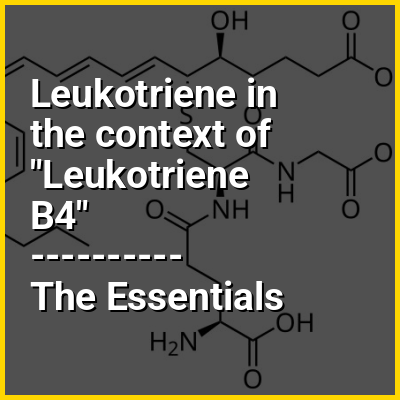
Leukotrienes are a family of eicosanoid inflammatory mediators produced in leukocytes by the oxidation of arachidonic acid (AA) and the essential fatty acid eicosapentaenoic acid (EPA) by the enzyme arachidonate 5-lipoxygenase.

Leukotrienes use lipid signaling to convey information to either the cell producing them (autocrine signaling) or neighboring cells (paracrine signaling) in order to regulate immune responses. The production of leukotrienes is usually accompanied by the production of histamine and prostaglandins, which also act as inflammatory mediators.

↓ Menu
HINT:

In this Dossier

Leukotriene in the context of Eicosanoid

Eicosanoids are signaling molecules made by the enzymatic or non-enzymatic oxidation of arachidonic acid or other polyunsaturated fatty acids (PUFAs) that are, similar to arachidonic acid, around 20 carbon units in length. Eicosanoids are a sub-category of oxylipins, i.e. oxidized fatty acids of diverse carbon units in length, and are distinguished from other oxylipins by their overwhelming importance as cell signaling molecules. Eicosanoids function in diverse physiological systems and pathological processes such as: mounting or inhibiting inflammation, allergy, fever and other immune responses; regulating the abortion of pregnancy and normal childbirth; contributing to the perception of pain; regulating cell growth; controlling blood pressure; and modulating the regional flow of blood to tissues. In performing these roles, eicosanoids most often act as autocrine signaling agents to impact their cells of origin or as paracrine signaling agents to impact cells in the proximity of their cells of origin. Some eicosanoids, such as prostaglandins, may also have endocrine roles as hormones to influence the function of distant cells.

There are multiple subfamilies of eicosanoids, including most prominently the prostaglandins, thromboxanes, leukotrienes, lipoxins, resolvins, and eoxins. For each subfamily, there is the potential to have at least 4 separate series of metabolites, two series derived from the ω−6 PUFAs arachidonic and dihomo-gamma-linolenic acids, one series derived from the ω−3 PUFA eicosapentaenoic acid, and one series derived from the ω−9 PUFA mead acid. This subfamily distinction is important. Mammals, including humans, are unable to convert ω−6 into ω−3 PUFA. In consequence, tissue levels of the ω−6 and ω−3 PUFAs and their corresponding eicosanoid metabolites link directly to the amount of dietary ω−6 versus ω−3 PUFAs consumed. Since certain of the ω−6 and ω−3 PUFA series of metabolites have almost diametrically opposing physiological and pathological activities, it has often been suggested that the deleterious consequences associated with the consumption of ω−6 PUFA-rich diets reflects excessive production and activities of ω−6 PUFA-derived eicosanoids, while the beneficial effects associated with the consumption of ω−3 PUFA-rich diets reflect the excessive production and activities of ω−3 PUFA-derived eicosanoids. In this view, the opposing effects of ω−6 PUFA-derived and ω−3 PUFA-derived eicosanoids on key target cells underlie the detrimental and beneficial effects of ω−6 and ω−3 PUFA-rich diets on inflammation and allergy reactions, atherosclerosis, hypertension, cancer growth, and a host of other processes.

View the full Wikipedia page for Eicosanoid
↑ Return to Menu

Leukotriene in the context of Arachidonic acid

Arachidonic acid (AA, sometimes ARA) is a polyunsaturated omega−6 fatty acid 20:4(ω−6), or 20:4(5,8,11,14). It is a precursor in the formation of leukotrienes, prostaglandins, and thromboxanes.

View the full Wikipedia page for Arachidonic acid
↑ Return to Menu

Leukotriene in the context of Essential fatty acid

Essential fatty acids, or EFAs, are fatty acids that are required by humans and other animals for normal physiological function that cannot be synthesized in the body.⁠ As they are not synthesized in the body, the essential fatty acids – alpha-linolenic acid (ALA) and linoleic acid – must be obtained from food or from a dietary supplement. Essential fatty acids are needed for various cellular metabolic processes and for the maintenance and function of tissues and organs. These fatty acids also are precursors to vitamins, cofactors, and derivatives, including prostaglandins, leukotrienes, thromboxanes, lipoxins, and others.

Only two fatty acids are known to be essential for humans: alpha-linolenic acid (an omega−3 fatty acid) and linoleic acid (an omega−6 fatty acid). These are supplied to the body either as the free fatty acid, or more commonly as some glyceride derivative. ALA can be converted into eicosapentaenoic acid and docosahexaenoic acid, but the conversion amount is small, requiring intake from food or supplements. Deficiency in omega−3 fatty acids is very common. The average American has a dietary ratio between omega−6 fatty acids and omega−3 fatty acids of 20:1.

View the full Wikipedia page for Essential fatty acid
↑ Return to Menu

Leukotriene in the context of Gamma-linolenic acid

γ-Linolenic acid or GLA (INN: gamolenic acid) is an n−6, or omega-6, fatty acid found primarily in seed oils. When acting on GLA, arachidonate 5-lipoxygenase produces no leukotrienes and the conversion by the enzyme of arachidonic acid to leukotrienes is inhibited.

View the full Wikipedia page for Gamma-linolenic acid
↑ Return to Menu

Leukotriene in the context of Eoxin

Eoxins are proposed to be a family of proinflammatory eicosanoids (signaling compounds that regulate inflammatory and immune responses). They are produced by human eosinophils (a class of white blood cells), mast cells, the L1236 Reed–Sternberg cell line derived from Hodgkin's lymphoma, and certain other tissues. These cells produce the eoxins by initially metabolizing arachidonic acid, an omega-6 (ω-6) fatty acid, via any enzyme possessing 15-lipoxygenase activity. The product of this initial metabolic step, 15(S)-hydroperoxyeicosatetraenoic acid, is then converted to a series of eoxins by the same enzymes that metabolize the 5-lipoxygenase product of arachidonic acid metabolism, i.e. 5-Hydroperoxy-eicosatetraenoic acid to a series of leukotrienes. That is, the eoxins are 14,15-disubstituted analogs of the 5,6-disubstituted leukotrienes.

A closely related set of 15-lipoxygenase metabolites are derived from anandamide (i.e. arachidonic acid containing ethanolamine esterified to its carboxy residue). These eoxin-like metabolites, termed eoxamides, are also formed by L1235 Reed-Sternberg cells and proposed to play a role in Hodgkins disease.

View the full Wikipedia page for Eoxin
↑ Return to Menu