Lead sheet in the context of "Lyrics"

Play Trivia Questions online!

or

Skip to study material about Lead sheet in the context of "Lyrics"

Ad spacer

⭐ Core Definition: Lead sheet

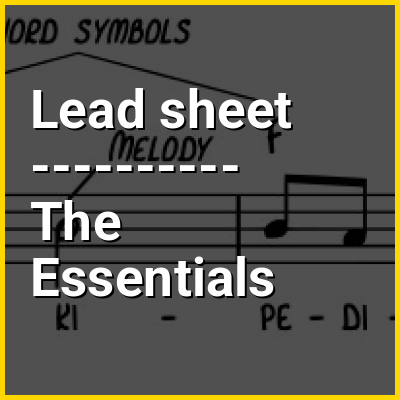
A lead sheet or fake sheet is a form of musical notation that specifies the essential elements of a popular song: the melody, lyrics and harmony. The melody is written in modern Western music notation, the lyric is written as text below the staff and the harmony is specified with chord symbols above the staff.

The lead sheet does not describe the chord voicings, voice leading, bass line or other aspects of the accompaniment. These are specified later by an arranger or improvised by the performers, and are considered aspects of the arrangement or performance of a song, rather than a part of the song itself. "Lead" refers to a song's lead part, the most important melody line or voice.

↓ Menu

>>>PUT SHARE BUTTONS HERE<<<
In this Dossier

Lead sheet in the context of Musical composition

Musical composition can refer to an original piece or work of music, either vocal or instrumental, the structure of a musical piece or to the process of creating or writing a new piece of music. People who create new compositions are called composers. Composers of primarily songs are usually called songwriters; with songs, the person who writes lyrics for a song is the lyricist. In many cultures, including Western classical music, the act of composing typically includes the creation of music notation, such as a sheet music "score", which is then performed by the composer or by other musicians. In popular music and traditional music, songwriting may involve the creation of a basic outline of the song, called the lead sheet, which sets out the melody, lyrics and chord progression. In classical music, orchestration (choosing the instruments of a large music ensemble such as an orchestra which will play the different parts of music, such as the melody, accompaniment, countermelody, bassline and so on) is typically done by the composer, but in musical theatre and in pop music, songwriters may hire an arranger to do the orchestration. In some cases, a pop or traditional songwriter may not use written notation at all and instead compose the song in their mind and then play, sing or record it from memory. In jazz and popular music, notable sound recordings by influential performers are given the weight that written or printed scores play in classical music.

Although a musical composition often uses musical notation and has a single author, this is not always the case. A work of music can have multiple composers, which often occurs in popular music when all members of a band collaborate to write a song or in musical theatre, when one person writes the melodies, a second person writes the lyrics and a third person orchestrates the songs.
↑ Return to Menu

Lead sheet in the context of Chord progression

In a musical composition, a chord progression or harmonic progression (informally chord changes, used as a plural, or simply changes) is a succession of chords. Chord progressions are the foundation of harmony in Western musical tradition from the common practice era of classical music to the 21st century. Chord progressions are the foundation of popular music styles (e.g., pop music, rock music), traditional music, as well as genres such as blues and jazz. In these genres, chord progressions are the defining feature on which melody and rhythm are built.

In tonal music, chord progressions have the function of either establishing or otherwise contradicting a tonality, the technical name for what is commonly understood as the "key" of a song or piece. Chord progressions, such as the extremely common chord progression I-V-vi-IV, are usually expressed by Roman numerals in classical music theory. In many styles of popular and traditional music, chord progressions are expressed using the name and "quality" of the chords. For example, the previously mentioned chord progression, in the key of E major, would be written as E major–B major–C minor–A major in a fake book or lead sheet. In the first chord, E major, the "E" indicates that the chord is built on the root note "E" and the word "major" indicates that a major chord is built on this "E" note.

↑ Return to Menu

Lead sheet in the context of Major chord

In music theory, a major chord is a chord that has a root, a major third, and a perfect fifth. When a chord comprises only these three notes, it is called a major triad. For example, the major triad built on C, called a C major triad, has pitches C–E–G:

In harmonic analysis and on lead sheets, a C major chord can be notated as C, CM, CΔ, or Cmaj. A major triad is represented by the integer notation {0, 4, 7}.

↑ Return to Menu

Lead sheet in the context of Minor triad

In music theory, a minor chord is a chord that has a root, a minor third, and a perfect fifth. When a chord comprises only these three notes, it is called a minor triad. For example, the minor triad built on A, called an A minor triad, has pitches A–C–E:

In harmonic analysis and on lead sheets, a C minor chord can be notated as Cm, C−, Cmin, or simply the lowercase "c". A minor triad is represented by the integer notation {0, 3, 7}.

↑ Return to Menu