Layered intrusion in the context of "Ultramafic"

Play Trivia Questions online!

or

Skip to study material about Layered intrusion in the context of "Ultramafic"

Ad spacer

⭐ Core Definition: Layered intrusion

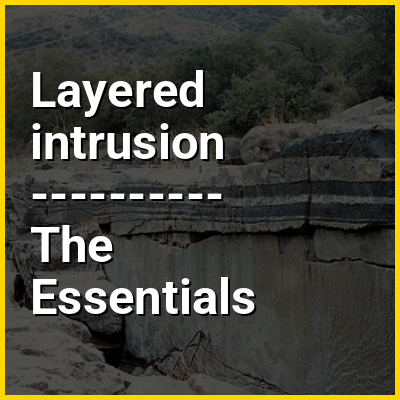
A layered intrusion is a large sill-like body of igneous rock which exhibits vertical layering or differences in composition and texture. These intrusions can be many kilometres in area covering from around 100 km (39 sq mi) to over 50,000 km (19,000 sq mi) and several hundred metres to over one kilometre (3,300 ft) in thickness. While most layered intrusions are Archean to Proterozoic in age (for example, the Paleoproterozoic Bushveld complex), they may be any age such as the Cenozoic Skaergaard intrusion of east Greenland or the Rum layered intrusion in Scotland. Although most are ultramafic to mafic in composition, the Ilimaussaq intrusive complex of Greenland is an alkalic intrusion.

Layered intrusions are typically found in ancient cratons and are rare but worldwide in distribution. The intrusive complexes exhibit evidence of fractional crystallization and crystal segregation by settling or floating of minerals from a melt.
↓ Menu

>>>PUT SHARE BUTTONS HERE<<<
In this Dossier

Layered intrusion in the context of Marble

Marble is a metamorphic rock consisting of carbonate minerals (most commonly calcite (CaCO3) or dolomite (CaMg(CO3)2) that have recrystallized under the influence of heat and pressure. It has a crystalline texture, and is typically not foliated (layered), although there are exceptions.

In geology, the term marble refers to metamorphosed limestone, but its use in stonemasonry more broadly encompasses unmetamorphosed limestone.

↑ Return to Menu

Layered intrusion in the context of Troctolite

Troctolite /ˈtrɒktəlt/ (from Greek τρώκτης 'trout' and λίθος 'stone') is a mafic intrusive rock type. It consists essentially of major but variable amounts of olivine and calcic plagioclase along with minor pyroxene. It is an olivine-rich anorthosite, or a pyroxene-depleted relative of gabbro. However, unlike gabbro, no troctolite corresponds in composition to a partial melt of peridotite. Thus, troctolite is necessarily a cumulate of crystals that have fractionated from melt.

Troctolite is found in some layered intrusions such as in the Archean Windimurra intrusion of Western Australia, the Voisey's Bay nickel-copper-cobalt magmatic sulfide deposit of northern Labrador, the Stillwater igneous complex of Montana, the Duluth Complex of the North American Midcontinent Rift, and the Tertiary Rhum layered intrusion of the island of Rùm, Scotland. Troctolite is also found, for example, in the Merensky Reef of the Bushveld Igneous Complex, South Africa and in the Lizard complex in Cornwall.

↑ Return to Menu

Layered intrusion in the context of Lithostratigraphy

Lithostratigraphy is a sub-discipline of stratigraphy, the geological science associated with the study of strata or rock layers. Major focuses include geochronology, comparative geology, and petrology.

In general, strata are primarily igneous or sedimentary relating to how the rock was formed. Sedimentary layers are laid down by deposition of sediment associated with weathering processes, decaying organic matter (biogenic) or through chemical precipitation. These layers are often distinguishable as having many fossils and are important for the study of biostratigraphy. Igneous layers occur as stacks of lava flows, layers of lava fragments (called tephra) both erupted onto the Earth's surface by volcanoes, and in layered intrusions formed deep underground. Igneous layers are generally devoid of fossils and represent magmatic or volcanic activity that occurred during the geologic history of an area.

↑ Return to Menu

Layered intrusion in the context of Bushveld Igneous Complex

The Bushveld Igneous Complex (BIC) is the largest layered igneous intrusion within the Earth's crust. It has been tilted and eroded forming the outcrops around what appears to be the edge of a great geological basin: the Transvaal Basin. It is approximately two billion years old and is divided into four limbs or lobes: northern, eastern, southern and western. It comprises the Rustenburg Layered suite, the Lebowa Granites and the Rooiberg Felsics, that are overlain by the Karoo sediments. The site was first publicised around 1897 by Gustaaf Molengraaff who found the native South African tribes residing in and around the area.

Located in South Africa, the BIC contains some of the richest ore deposits on Earth. It contains the world's largest reserves of platinum-group metals (PGMs) and platinum group elements (PGEs) — platinum, palladium, osmium, iridium, rhodium and ruthenium — along with vast quantities of iron, tin, chromium, titanium and vanadium. These are used in, but not limited to, jewellery, automobiles and electronics. Gabbro or norite is also quarried from parts of the complex and rendered into dimension stone. There have been more than 20 mine operations. There have been studies of potential uranium deposits. The complex is well known for its chromitite reef deposits, particularly the Merensky reef and the UG2 reef. It represents about 75 percent of the world's platinum and about 50 percent of the world's palladium resources. In this respect, the Bushveld complex is unique and one of the most economically significant mineral deposit complexes in the world.

↑ Return to Menu

Layered intrusion in the context of Windimurra intrusion

The Windimurra Igneous Complex is a giant ultramafic-mafic intrusion emplaced within the Yilgarn craton of Western Australia. It is located approximately 100 kilometres south east of the town of Mount Magnet.

↑ Return to Menu

Layered intrusion in the context of Stillwater igneous complex

The Stillwater igneous complex is a large layered mafic intrusion (LMI) located in southern Montana in Stillwater, Sweet Grass and Park Counties. The complex is exposed across 30 miles (48 km) of the north flank of the Beartooth Mountain Range. The complex has extensive reserves of chromium ore and has a history of being mined for chromium. More recent mining activity has produced palladium and other platinum group elements.

↑ Return to Menu

Layered intrusion in the context of Lopolith

A lopolith is a large igneous intrusion which is lenticular in shape with a depressed central region. Lopoliths are generally concordant with the intruded strata with dike or funnel-shaped feeder bodies below the body. The term was first defined and used by Frank Fitch Grout during the early 1900s in describing the Duluth gabbro complex in northern Minnesota and adjacent Ontario.

Lopoliths typically consist of large layered intrusions that range in age from Archean to Eocene. Examples include the Duluth gabbro, the Sudbury igneous complex of Ontario, the Bushveld igneous complex of South Africa, the Great Dyke in Zimbabwe, the Skaergaard complex of Greenland and the Humboldt lopolith of Nevada. The Sudbury occurrence has been attributed to an impact event and associated crustal melting.

↑ Return to Menu

Layered intrusion in the context of Chromitite

Chromitite is an igneous cumulate rock composed mostly of the mineral chromite. It is found in layered intrusions such as the Bushveld Igneous Complex in South Africa, the Stillwater igneous complex in Montana and the Ring of Fire discovery in Ontario.

Chromitite typically forms as orthocumulate layered lenses in peridotite rocks, at times intergrown with other oxides such as magnetite and ilmenite, and silicates such as olivine, pyroxene, plagioclase feldspar (mainly anorthite), and garnet crystals. The chromium rich garnet uvarovite forms in interbedded layers with chromitite.

↑ Return to Menu