Later Qin in the context of "Yao Xing"

Play Trivia Questions online!

or

Skip to study material about Later Qin in the context of "Yao Xing"


⭐ Core Definition: Later Qin

Qin, known in historiography as the Later Qin (simplified Chinese: 后秦; traditional Chinese: 後秦; pinyin: Hòuqín; 384–417) or Yao Qin (姚秦), was a dynastic state of China ruled by the Yao clan of Qiang ethnicity during the Sixteen Kingdoms period in northern China. As the only Qiang-led state among the Sixteen Kingdoms, it was most known for its propagation of Buddhism under its second ruler, Yao Xing, who sponsored the Madhyamakin monk, Kumārajīva to translate Sanskrit Buddhist text into Chinese.

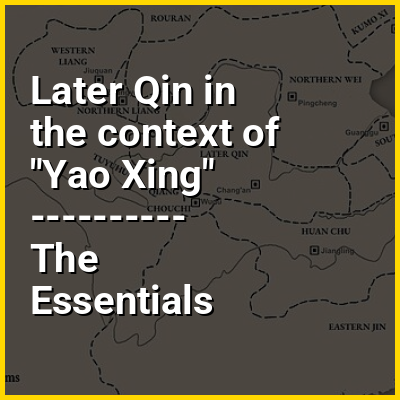
All rulers of the Later Qin declared themselves emperors, but for a substantial part of Yao Xing's reign, he used the title Heavenly King. Historiographers gave the state the prefix of "Later" to distinguish it with the Former Qin and Western Qin as it was founded during the Former Qin's collapse after the Battle of Fei River and went on to conquer the Former Qin's power base in the Guanzhong. With Chang'an as its capital, the Later Qin also controlled Henan and vassalised the Western Qin, the four Liangs (Later, Southern, Northern and Western), Southern Yan, Qiao Shu, Chouchi and various tribes of the Ordos region.
↓ Menu

In this Dossier

Later Qin in the context of Sixteen Kingdoms

The Sixteen Kingdoms (simplified Chinese: 十六国; traditional Chinese: 十六國; pinyin: Shíliù Guó), less commonly the Sixteen States, was a chaotic period in Chinese history from AD 304 to 439 when northern China fragmented into a series of short-lived dynastic states. Most of these regimes were created by groups such as the Xiongnu, Xianbei, Di, Jie, and Qiang, who had moved into northern and western China over earlier centuries and rose in rebellion against the Western Jin dynasty in the early fourth century. Some states were founded by the Han as well. Regardless of their rulers' background, every state adopted dynastic institutions in the Han tradition and styled itself as a legitimate monarchy. These states often fought one another and also contended with the Eastern Jin dynasty, which governed the south after the collapse of Western Jin in 317. The era ended in 439, when Northern Wei, founded by the Tuoba clan of the Xianbei, reunified the north. The Eastern Jin dynasty had already collapsed in 420 and been replaced by the Liu Song dynasty, the first of the Southern Dynasties. After the consolidation of the north, Chinese history entered the period known as the Northern and Southern Dynasties.

The term "Sixteen Kingdoms" was first used by the 6th-century historian Cui Hong in the Spring and Autumn Annals of the Sixteen Kingdoms and refers to the five Liangs (Former, Later, Northern, Southern and Western), four Yans (Former, Later, Northern, and Southern), three Qins (Former, Later and Western), two Zhaos (Han/Former and Later), Cheng-Han and Xia. Cui Hong did not count several other kingdoms that appeared at the time including the Ran Wei, Zhai Wei, Chouchi, Duan Qi, Qiao Shu, Huan Chu, Tuyuhun and Western Yan. Nor did he include the Northern Wei and its predecessor Dai, because the Northern Wei is considered to be the first of the Northern Dynasties in the period that followed the Sixteen Kingdoms.

↑ Return to Menu

Later Qin in the context of Southern Liang (Sixteen Kingdoms)

The Southern Liang (Chinese: 南涼; pinyin: Nán Liáng; 397–404, 408–414) was a dynastic state of China listed as one of the Sixteen Kingdoms in Chinese historiography. Members of the ruling Tufa clan were of Xianbei ethnicity and distant relatives of the Tuoba imperial house of the Northern Wei dynasty. According to the Book of Jin, the surname of the ruling house was changed from Tuoba to Tufa because one of the Tufa ancestors was born on a blanket, and in the Xianbei language, "Tufa" meant "blanket."

All rulers of the Southern Liang proclaimed themselves wang (king). The state was briefly discontinued in 404 after Tufa Rutan surrendered to the Later Qin, but restored in 408. As the state grew in power, the Tufa rulers also elevated their peerages before claiming the title of King of Liang in 402. It was hence only known as "Liang" (涼) from 402 to 404 and 408 to 414. They are given the prefix of "Southern" in historiography as they were based south of the other Liang states in northeastern Qinghai, although after occupying central Gansu, they briefly shifted the capital to the major city of Guzang (姑臧, in modern Wuwei, Gansu).

↑ Return to Menu

Later Qin in the context of Former Qin

Qin, known as the Former Qin and Fu Qin (苻秦) in historiography, was a dynastic state of China ruled by the Fu (Pu) clan of the Di peoples during the Sixteen Kingdoms period. Founded in the wake of the Later Zhao dynasty's collapse in 351, it completed the unification of northern China in 376 during the reign of Fu Jiān (Emperor Xuanzhao), being the only state of the Sixteen Kingdoms to achieve so. Its capital was Chang'an up to Fu Jiān's death in 385. The prefix "Former" is used to distinguish it from the Later Qin and Western Qin dynasties that were founded later.

In 383, the severe defeat of the Former Qin by the Jin dynasty at the Battle of Fei River encouraged uprisings, splitting Former Qin territory into two noncontiguous pieces after the death of Fu Jiān. One remnant, at present-day Taiyuan, Shanxi was soon overwhelmed in 386 by the Xianbei under the Later Yan, Western Yan and the Dingling. The other struggled in greatly reduced territories around the border of present-day Shaanxi and Gansu until its final disintegration in 394 following years of invasions by Western Qin and Later Qin.

↑ Return to Menu

Later Qin in the context of Western Qin

The Western Qin (Chinese: 西秦; pinyin: Xī Qín; 385–400, 409–431) was a dynastic state of China ruled by the Qifu clan of Xianbei ethnicity during the era of Sixteen Kingdoms. All rulers of the Western Qin declared themselves "wang", translatable as either "king" or "prince." They ruled an area corresponding to modern-day southwestern Gansu in Northwest China, also known as the Longxi region, along with parts of northeastern Qinghai in the later years. The state went by various different names as their rulers opted for lesser peerages while they were acting as vassals, and they were only known as "Qin" (秦) from 395 to 400, from 409 to 411 and from 414 to 431.

The Western Qin was briefly discontinued in 400 after Qifu Gangui surrendered to the Later Qin before it was revived in 409. They also frequently shifted their capital from time to time, with Fuhan (枹罕, in modern Linxia, Gansu) as their longest-serving capital at 18 years without interruption. They are given the prefix of "Western" in historiography to distinguish them with the Former Qin and Later Qin as they were situated to the west of the two states.

↑ Return to Menu

Later Qin in the context of Qiao Zong

Qiao Zong (simplified Chinese: 谯纵; traditional Chinese: 譙縱; pinyin: Qiáo Zòng) (died 413) was a Han Chinese military leader in present-day Sichuan province in China during the Eastern Jin Dynasty. He proclaimed himself the Prince of Chengdu in 405 and was given the title "Prince of Shu" by Yao Xing, ruler of the Later Qin, in 409. His state of Shu (Chinese: ; pinyin: Shǔ) is known in historiography as Qiao Shu (simplified Chinese: 谯蜀; traditional Chinese: 譙蜀; pinyin: Qiào Shǔ) or Western Shu (Chinese: 西蜀; pinyin: Xī Shǔ). His self-governing body coordinated offensive campaigns with Later Qin along the Yangtze River until Qiao's state was destroyed by a campaign under military subordinates of Liu Yu in 413.

↑ Return to Menu

Later Qin in the context of Juqu Mengxun

Juqu Mengxun (Chinese: 沮渠蒙遜; 368–433), also known by his posthumous name as the Prince Wuxuan of Northern Liang (北涼武宣王), was the second prince of the Lushuihu-led Chinese Northern Liang dynasty, and the first from the Juqu clan. His cousin Juqu Nancheng (沮渠男成) and he initially supported Duan Ye as prince of Northern Liang in 397 after rebelling against the Later Liang dynasty, but in 401, Juqu Mengxun tricked Duan Ye into wrongly executing Juqu Nancheng, and then used that as an excuse to attack and kill Duan Ye, taking over the throne himself. While he maintained his own state, he also nominally served as a vassal of the Later Qin, Eastern Jin, and Northern Wei dynasties. He was considered a capable ruler when he was young, but in his old age was considered cruel and arbitrary.

↑ Return to Menu

Later Qin in the context of Helian Bobo

Helian Bobo (Chinese: 赫連勃勃; Middle Chinese Guangyun: [xɐk-li̯ɛn˩ bʰuət-bʰuət]; 381 – c. September 425), né Liu Bobo (劉勃勃), with the epithet Qujie (屈孑), was the founder of the Xiongnu state of Xia, which rose to prominence during the Sixteen Kingdoms period. He belonged to the Tiefu (鐵弗) branch of the Xiongnu, was a descendant of the southern chanyu Liu Qubei, and the son of Liu Weichen, its chieftain. After his father was killed by Northern Wei and the tribe collapsed, Liu Bobo sought refuge with Moyigan, a Xianbei chieftain of Later Qin, and married Moyigan's daughter. As an adult, noted for his imposing stature, eloquence, and intelligence, he won the favor of Emperor Yao Xing of Later Qin, who appointed him a general and placed more than thirty thousand men from the Tiefu and other tribes under his command.

In 407, after Later Qin made peace with Northern Wei, Liu Bobo rebelled. Claiming descent from the Xia dynasty royal line, he styled himself Heavenly King of Great Xia and Grand Chanyu and adopted the era name Longsheng (龍昇), marking the establishment of the Xia state. He spent the following years roaming the northern steppe, deploying cavalry offensives against Later Qin and Southern Liang in the Shuofang region.

↑ Return to Menu

Later Qin in the context of Kumārajīva

Kumārajīva (Sanskrit: कुमारजीव; traditional Chinese: 鳩摩羅什; simplified Chinese: 鸠摩罗什; pinyin: Jiūmóluóshí; Wade–Giles: Chiu mo lo shih, 344–413 CE) was a Buddhist monk, scholar, missionary and translator from Kucha (present-day Aksu Prefecture, Xinjiang, China). Kumārajīva is seen as one of the greatest translators of Chinese Buddhism. According to Lu Cheng, Kumarajiva's translations are "unparalleled either in terms of translation technique or degree of fidelity".

Kumārajīva first studied teachings of the Sarvastivadin schools, later studied under Buddhasvāmin, and finally became an adherent of Mahayana Buddhism, studying the Mādhyamaka doctrine of Nāgārjuna. After mastering the Chinese language, Kumārajīva settled as a translator and scholar in Chang'an (c. 401 CE) under the patronage of the Later Qin dynasty during the Sixteen Kingdoms period. He was the head of a team of translators which included his amanuensis Sengrui. This team was responsible for the translation of many Sanskrit Buddhist texts into Chinese.

↑ Return to Menu